
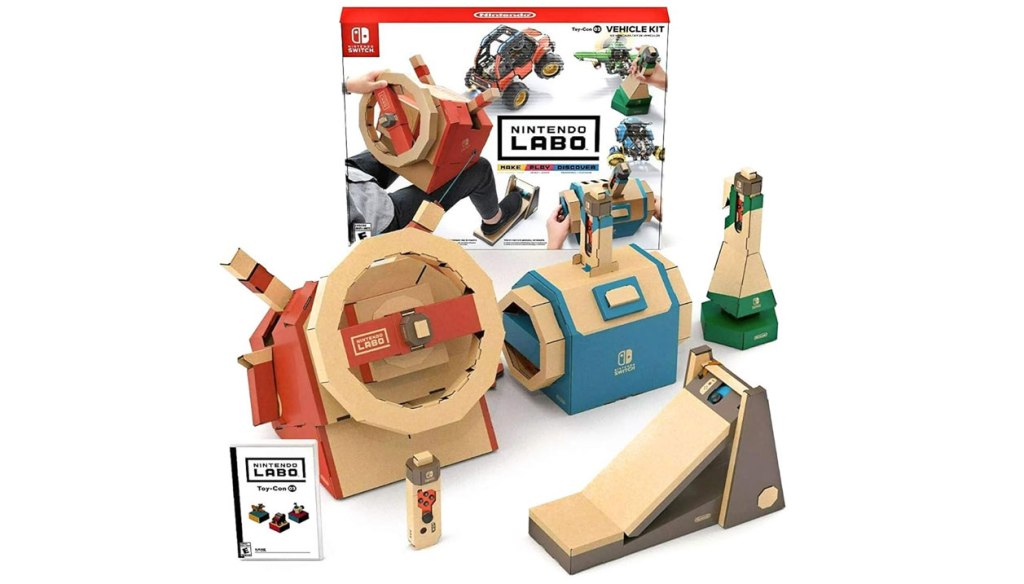
Nintendo LABO Toy-Con 03: Vehicle Kit
Genre: Accessory / Minigame Collection / Party Game / Racing / Open World / Misc.
Players: 1-2 Co-Op (Local), 2-4 Competitive (Local)
.
Review:
Nintendo LABO is one of those uniquely Nintendo products that often seem to come out of left field and give players something strange and wonderful and often not quite completely thought-out. In this case, each of the four Nintendo LABO kits provides players with one or multiple objects that they can create using cardboard pieces included in the package, along with software that incorporates that cardboard into various games, usually by incorporating the Joy-Con controllers in various ways.
For the third of these LABO kits, the Nintendo LABO Toy-Con 03: Vehicle Kit, players are presented with four larger construction projects along with several smaller ones, and various activities to use them in. Players should be aware of a few things before getting the game, however. Firstly, while eShopperReviews tends to focus mostly on digital releases, Nintendo LABO is strictly a physical-only release. Secondly, because a part of the experience is constructing the cardboard objects included in the kit, you’re not likely to find much resale value in Nintendo LABO – once you open this game up and start making stuff, you’ll be hard-pressed to find a buyer wanting it used. Likewise, you should be wary of buying a Nintendo LABO kit used, for much the same reason.
Also, be aware that the Nintendo LABO Toy-Con 03: Vehicle Kit absolutely requires at least one pair of Joy-Con controllers to use, and one of the more minor items you’ll be making is designed to incorporate a regular Nintendo Switch – those with a Switch Lite will still be able to use this package if they have a pair of Joy-Con controllers, but if you only have a Switch Lite without extra Joy-Cons, you won’t get much use out of this package.
Finally, a few warnings for those looking to get this game for a young kid. Nintendo LABO is a very kid-friendly game, but making these various constructions is something that will require a fair amount of time and patience, decent reading skills, and the ability to follow directions. Specifically, whoever is building these constructions needs to be sure not to break the pieces, not to fold the wrong part or do things in the wrong order, and not to mess with stuff like the stickers unless they are specifically told where to put them (the stickers aren’t just for show – they serve an important function). What’s more, popping out the bits of cardboard can create a lot of mess. If any of these things sounds like it may pose a problem for your child, this may be something that will require some supervision on your part.
As mentioned before, this game comes with pieces of cardboard designed specifically for use with the game, with cutouts for each of the projects, and those cutouts having lines to be creased in the appropriate places. I suppose in theory it may be possible to use cardboard to produce replacement parts, but you likely won’t end up with something that has quite the same quality as what’s included. However, while the cardboard here is decent quality and fairly sturdy, it’s nothing revolutionary – it’s just cardboard. In addition to the cardboard, the game also comes with a plastic bag full of other components you’ll need for construction – rubber bands, lengths of string, reflective stickers, and a few other odds and ends. While the cardboard pieces could theoretically be replaced with your own hand-crafted duplicates, some of these parts are unique, so you’ll want to be sure not to lose them.
The game itself is separated into three sections, “Make”, “Play”, and “Discover”, with each of these sections further sub-divided into sections focused on individual components.
In “Make”, players are given step-by-step instructions for how to build all of the main components in the box, complete with a full 3D representation of the process in action that players can play at multiple speeds, rewind, or even spin the example around to see it at different angles. This was actually a really excellent guide, although I did find myself sometimes mixing up the button for rewinding and the button to exit, causing a bit of mild frustration every time I did. Overall though, these instructions are fairly fool-proof, and should make it easy for a young child to complete all of the DIY projects contained within the box so long as they’re patient and can follow instructions properly, and the written directions include lots of cute little comments to keep things entertaining. However, be aware that these instructions are only written, not voiced – the only sound you’ll be listening to are the cartoony sound effects signifying cardboard being creased and popped together, and music that sounds like… well, like bad porn music, really. It’s fine, though it can get a bit annoying after listening to it long enough, and thankfully in this entry in the LABO series, this music is mixed up with other tunes that are a bit nicer to listen to while you’re working.
A large part of the joy of this game is piecing things together and seeing how everything connects and builds as you progress, sorta’ comparable to putting together a puzzle except you have instructions for how to do it. So if you’re looking at this game and thinking about the ordeal you have to go through to build the stuff before you can play with it, you’re probably approaching Nintendo LABO with the wrong mindset.
In “Play”, players can make use of the objects they’ve created to play one of multiple minigames (which I’ll go into in a moment). Finally, in “Explore”, players are given insight into how all of this works, as well as being given a utility to create their own LABO projects (again, I’ll get to this a bit later).
For what’s included in the box, you have the following construction projects, although unlike the first Nintendo LABO kit, the projects are not always directly associated with a specific minigame, but shared across multiple minigames, or used in conjunction in minigames. First, here are the projects you’ll be building:
Joy-Con Holder – This is a little box for your Joy-Con. Which… is completely unnecessary and pointless, but acts as a simple project to get players acquainted with how to use Nintendo LABO. This item is not used with any minigame.
Pedal – This is basically just a gas pedal, which is actually sturdier than you may expect from something made out of cardboard. I wouldn’t recommend putting your full weight on the thing, but as long as you’re not too rough with it, it should take a fair amount of “pedal to the metal”-ing. This construction is used for one of the minigames on its own, and used in conjunction with all of the other constructions for their games.
Key – Like the Joy-Con Holder, this is a little box of sorts to house your Joy-Con controller, with a button on the top you can press for various functions. Unlike the Joy-Con holder, this actually is used for gameplay, and in a rather cool and novel fashion, too. This kit actually comes with two of these “Key” constructions to make, with the second one being used to enable co-op play in one of the games included.
“Car” (Steering Wheel) – This is the construction that this kit is probably best known for, and it’s fairly sturdy for a steering wheel, and with quite a few features to it as well. In the games that use this construction, players insert the “Key” into it, with the button on the key being used for various things in the games. In addition, on top of the steering wheel’s base there are two levers that players can pull, each with a knob they can spin for different functions. On the left side of the base there’s an additional lever that acts as a reverse lever, and on the right side there’s a pull-string generally used in-game to enable turbo. I should note that the wheel actually feels really good, but the pull-string is problematic in that it tugs at the whole steering wheel and releasing the thing can send it flying. I really wish that this were just another lever or a button instead, because this one pull-string is probably the worst part of any of these constructions. This construction also has an optional Nintendo Switch holder attachment, the one part of this package that requires an original Nintendo Switch and doesn’t support a Switch Lite (and honestly, it’s kinda’ superfluous anyway).
“Submarine” – This is a bit of an odd construction with a wheel on either side and a button on the front of it. In the game that uses this construction, players insert the “Key” into it. This is probably going to be the construction with the worst ration of “time spent building it” to “time spent playing with it” in this kit.
“Airplane” (Flight Stick) – In the games that use this construction, players insert the “Key” into it (seeing a trend?). Out of the major construction projects in this package, this is the quickest to build, and it works surprisingly well, feeling very much like you’d expect a flight stick to feel (well, if it were made out of cardboard. It is a damn shame that there aren’t any games outside of LABO that support this construction, as it’s actually a pretty decent flight stick, albeit one that only has the trigger button and the top button (the latter provided by the “key”).
Spray Can – Would you believe that you put the “key” in this one as well? Well, believe it or not, you do. And as you might expect, this construction emulates a paint spray can, even down to the rattling bit within it when you shake it.
There are also a few little extra pieces for more minor uses, such as to demonstrate features discussed in the Explore mode.
Now, as for the different games included in this package, you have the following:
Slot Cars – This minigame uses just the pedal construction on its own, and works much like those little toy slot car tracks kids used to get when I was… I mean, when my parents were kids (What, me? Old? Pssh!). This is a surprisingly fun little minigame, and as a bonus, you can even use this in conjunction with the custom courses created using the Nintendo LABO Toy-Con 01: Variety Kit. What’s more, this minigame supports 4-player play, although since this kit only comes with one pedal, additional players will just have to mimic this movement by altering the angle of the Joy-Con. I should mention that while this mode is fun, it doesn’t have much longevity – there are only 7 levels here (plus as many as three more if you made them in the first Nintendo LABO kit), and there are no options beyond determining the number of human and CPU players – it’s always three laps, and the game only records the one best time on each course.
Circuit – This minigame uses the pedal and the steering wheel constructions together, and has players racing on a track in the first-person perspective. This mode is really fun, and does a great job showing off how the steering wheel can be used for traditional racing game gameplay (although again, that turbo pull-string is absolutely terrible). However, as with the Slot Car minigame, this game doesn’t have much in the way of longevity, featuring the same seven courses (plus once again potentially three more created using the first LABO kit), and even fewer options (now there’s no multiplayer, and players can only turn CPU opponents “on” or “off”).
Paint Studio – This is more of a utility than a minigame, and it uses the Paint Can to let players customize the vehicles they use in-game. This is a pretty straightforward little utility, though I will credit the game for working in the option to detect objects in front of it via the infrared camera and use them as a mask or decal, which is a nice touch.
Adventure – This is where most of the gameplay of this package is, and there’s enough content here that I hesitate to even call this a minigame. Players are given a fairly sizable world to explore, segmented into hexagonal areas, each with a series of tasks to perform. To do so, they’ll need to make use of the steering wheel, submarine, and flight stick constructions, swapping between them by swapping the key into and out of each when you want to. There’s enough stuff to do in this mode that it could take players multiple hours to get through it all, making this one game one of the most substantial bits of any of the Nintendo LABO games. There’s a fair amount of variety too, from hunting down enemies and targets in the air as a plane, exploring the sea as a submarine, destroying objects or carting around passengers as a car, and the transition between all of these is seamless, and players who bring a friend can have that friend use the second key to join them (not in a second vehicle though – this is mainly used to get a buddy riding in the back and aiming a bazooka using the flight stick)). However, I will note one issue I had with this game – it seems like more thought was put into the car than the other vehicles. Players will be required to refuel at gas stations periodically, and the only practical way to do this is in the car (although even then, maneuvering the car into position is a bit of a pain), and this means forcing players to swap back to the steering wheel regularly, even if they want to play around in one of the other vehicles. Also, the car just has far more bells and whistles than either of the other vehicles combined, thanks to its many levers. Don’t get me wrong, it’s still fun, it’s just short-sighted and disappointing that more thought wasn’t put into the other vehicles, particularly the submarine, which is honestly a real pain to pilot.
Rally – This mode requires players to play through the Adventure mode to unlock areas. Once they do, they gain access to various races within those areas, with each area having its own rally course (or a few) to navigate with a specific vehicle. This feels like a fun little extra tacked on to the adventure mode, giving that focal part of the game a bit more meat to chew on.
Battle – This mode has players using the steering wheel and pedal to compete with a CPU or second player in an enclosed arena, with their cars outfitted with extending fists. This is actually quite a fun little minigame, though you will undoubtedly wonder how a second player can join in if the game only comes with one pedal and one steering wheel. Well, on its own, this minigame only works in multiplayer if someone has a second Nintendo LABO wheel, which is a bit absurd, although the game also provides a workaround of sorts in an unlockable custom control mode (more on this in a bit). This mode, while fun, is a bit shallow, and probably won’t distract you for very long (though it does amusingly include a feature to use a Joy-Con’s infrared camera to import a real-life object or even a person’s face to become the battle arena).
I should note that in pretty much all of these constructions and minigames, you’ll find a lot that’s impressive and that makes ingenious use of the features of the Joy-Cons, but you’ll also find some degree of disappointment at how shallow a lot of this is. These constructions really make amazing use of the Joy-Cons’ motion-sensing capabilities, infrared camera, and HD Rumble in ways that you wouldn’t necessarily consider or even think possible, but it feels like every one of these minigames could do with more content to expand upon what’s included here. At the very least, the Adventure game is fairly sizable for a minigame, to the point where I wouldn’t even necessarily consider it a minigame.
While I found the minigames in the first Nintendo LABO kit to be fairly shallow and negligible, and those in the second kit to be too similar and few in number (and just not very good), I have to admit that what’s on offer here in the third kit feels a lot more substantial, thanks both because of the game’s fairly extensive Adventure mode, but also because most of the minigames here all share a theme and as such they feel like they fit together better as one cohesive package. These games are all visually pretty nice too, featuring some good textures, and some very nice water and lighting effects, although I did notice a fair amount of pop-in in the game’s Adventure mode. Despite this, the minigames still look pretty polished overall.
I should note that the steering wheel, in conjunction with the pedal, is usable in two games other than Nintendo LABO – Mario Kart 8 Deluxe and GRID Autosport. However, I’m not thrilled with how it’s implemented in either game – in Mario Kart, stepping on the pedal is gas, but stepping farther causes you to jump, which takes a lot of getting used to. And in GRID, I often ran into the problem that turning the wheel too far seemed to make it act as if I was turning in the opposite direction. Plus, both games suffered from the fact that the wheel doesn’t really have a “center”, making it difficult to steer straight as there’s not a clear indication when you’ve gotten the wheel back to the neutral position. Overall, it’s a nice option, but I’m more likely to play these games either with a regular controller or a real peripheral.
For the more ambitious creative types, there is of course the Explore mode that’s included with each of the Nintendo LABO games, which not only acts as a fascinating tour through the different features of the Joy-Cons (simplified so that kids can understand them), but also gives players access to a “Garage” tool that enables them to design their own interactive applications using a drag-and-drop interface. Don’t get too excited, though – you’re not going to be getting any sort of extensive game design kit here, as there’s not any way to alter the graphical interface beyond the buttons and light-up panels you’ll be using, so you won’t be producing anything as visually impressive as the minigames included with this package. However, for those looking to jerry-rig their own tools using the Joy-Cons, or get a very, very basic grasp of how programming languages work (including interface features that represent “IF/THEN”, “AND”, and “NOT”). I should note that while most of Nintendo LABO is extremely kid-friendly, this final section may be confusing to even more seasoned game players, despite that it is very, very simplified compared to actual programming languages.
This kit also goes a step beyond the earlier Nintendo LABO kits by offering a second additional tool in the Explore mode that wasn’t in the previous games, which enables players to create their own custom control scheme, using a similar interface. While this unfortunately only works with the minigames in this collection, it is nevertheless another good tool to get more technical design types thinking about how game controls work. This is also, as it happens, the best way to make the Battle mode playable in multiplayer, as one of the templates in this mode is designed specifically to make that game playable just using a pair of Joy-Cons (it’s frustrating that the option is hidden away in this section, but it’s nice that it’s present, at least).
All told, I feel that Nintendo LABO Toy-Con 03: Vehicle Kit is overall a better package than Toy-Con Kit 01, with its more interesting and useful constructions, and with game content that is not only more connected due to a cohesive theme, but also features a lot more to do thanks to its Adventure mode. And that’s on top of the fun of actually putting these constructions together in the first place. While the first Nintendo LABO kit might make for a good starting point due to its wide variety, I definitely think that this kit is superior and offers a better overall experience.
tl;dr – Nintendo LABO Toy-Con 03: Vehicle Kit is a really unique hybrid of a Minigame Collection, an Open-World Exploration game, a Party game, a series of Accessories you create yourself using the included pieces of custom-made cardboard, and a misc. tool you can use to explore the features of the Nintendo Joy-Con controllers. Furthermore, this game is much better than the previous two in terms of the actual gameplay content it offers, thanks to its Open-World Adventure mode and its overall more cohesive theme. This is definitely one of the better Nintendo LABO kits.
Grade: B+
You can support eShopperReviews on Patreon! Please click HERE to become a Sponsor!
 eShopperReviews
Leave a comment