
Tetris Effect: Connected
Genre: Falling-Block Puzzle
Players: 1-4 Team Co-Op (Local / Online), 2-4 Competitive + 4 Spectators (Local / Online), Online Leaderboards
.
Review:
Tetris Effect is a family-friendly Falling Block Puzzle game originally released on PlayStation 4 with much-touted VR support in 2018 and ported to PC in 2019. An updated version of the game with the new subtitle “Connected” was released on PC, Xbox One, and Xbox Series S/X in 2020, with this version getting ported back to PlayStation 4, as well as Nintendo Switch, in 2021. The Connected version of the game adds an additional “Classic”-style 2-player competitive mode, as well as a new 3-vs-1 “Connected” team co-op mode.
In a way, Tetris Effect: Connected on Nintendo Switch feels a bit like this series coming around full-circle, but to explain why, I need to get into a bit of history…
.
All Clear
The history of Tetris is a fascinating blend of psychology, international politics, legal wrangling, and corporate one-upmanship, and I’ll only quickly gloss over it here, but I highly recommend you read more about it if you can (the book Game Over by David Sheff covers this and other early videogame industry struggles, and it’s a great read). I’ll give you the short version here.
The original version of Tetris dates back to 1984, when Soviet Academy of Sciences software engineer Alexy Pajitnov created the game while running software tests on the Russian-made Electronika 60 computers. Upon introducing the game to colleagues, it became so popular that it famously quickly spread to every Moscow Institute computer and had to be banned for its addictive qualities. A PC port of the game was made soon after and would gradually work its way Westward, eventually releasing in the US in 1988.
The term “Tetris Effect” comes from a 1994 Wired article where the author described the game’s effects on the mind, causing players to start seeing the shapes and patterns of the game in everyday life. This effect isn’t exclusive to Tetris, but Tetris is likely the first time this sort of thing was felt in a widespread manner not just by core gamers, but the general populace.
When Nintendo realized the game’s addictive nature, and knowing how perfect the game would be for their upcoming Game Boy handheld device that still needed its “killer app”, Nintendo secured the exclusive rights to the game after a lot of confusing international deals and court challenges that involved numerous entities, including Nintendo, Atari (through subsidiary Tengen), Sega, and the Russian government. When the dust settled, Nintendo secured the exclusive console and handheld rights to the game, Sega had to shelve plans for a Genesis version of the game, and Tengen had to recall copies of its already-produced version of Tetris.
While so much fighting over just one game may seem excessive, it cannot be overstated just how much this game was important to Nintendo’s success, both then and to this very day. As a pack-in game included with the Game Boy, it was indeed perfectly-suited to the handheld in many ways. Its simplistic visual style wasn’t significantly compromised by the Game Boy’s monochrome screen, and the single-screen gameplay avoided much of the problematic blur that original Game Boy games with too much motion suffered from.
However, more than that, its elegant simplicity and compelling gameplay gave the game massive appeal across every demographic – this game perfectly tapped into the “casual” audience that Nintendo would later court to great success in the Nintendo DS and Wii eras, but Tetris also still managed to appeal to core gamers as well. The Game Boy version’s multiplayer features using a link cable added a social element. In so many ways, this truly was the “killer app” that the Game Boy needed. While Mario, Zelda, and Nintendo’s other properties would have no doubt led to the Game Boy being a success, it was Tetris that made the Game Boy a cultural phenomenon. And undoubtedly in part due to the appeal of this one game, the Game Boy fought off multiple attempts to unseat it from its throne by far more powerful hardware from Sega, Atari, NEC, and others.
This led to a legacy that is reflected in the Nintendo Switch – Nintendo’s consoles have had successes and failures, but their handhelds have always been a success, and untouchable by competitors, even when companies like Sony entered the handheld arena. It is undoubtedly this consistent success in the handheld section of the industry that led to Nintendo’s decision to make the Nintendo Switch a hybrid console. That is a legacy that can all be traced directly back to Tetris.
Likewise, there’s an argument to be made that Tetris has always been at its best on a handheld, as it is a perfect game to play for just a few minutes or let yourself relax to for hours at a time, just the sort of thing to play while waiting in a doctor’s office or at a bus stop. So while Tetris is generally great wherever you play it, it feels just a bit more at home on a Nintendo handheld, the same place it started for many players.
.
Infinite Spin
In the years since Tetris was first released, it has seen countless releases on virtually every platform ever made (well, at least every platform made after Nintendo’s exclusivity deal ran out). And of course, Tetris Effect: Connected is far from the first Tetris game released on Nintendo Switch either. Puyo Puyo Tetris and its sequel, Puyo Puyo Tetris 2, both include a version of Tetris, although this series is more interested in the characters and aesthetic of the Puyo Puyo franchise and combining Tetris with that franchise, rather than presenting a comprehensive Tetris experience.
Then, of course, there’s the elephant in the room.
If you subscribe to Nintendo Switch Online, one of the perks of that $20 yearly subscription is access to Tetris 99 at no additional cost, although for an added $10 you can gain access to additional gameplay modes, including local multiplayer and more traditional endless and line clear game modes. However, Tetris 99’s focus is primarily on its 99-player competitive online mode, and as I said in my review of this game, I found the matchmaking in Tetris 99 to be woefully inadequate, making it virtually hopeless that a player will ever win a game unless they are a Tetris pro.
However, if you already subscribe to Nintendo Switch Online, it bears mention that you needn’t spend a single dime to play Tetris on your Nintendo Switch – just download Tetris 99 and you’ve got a version of Tetris to play at no added cost to you.
This naturally leads to a question – why buy Tetris Effect: Connected on Nintendo Switch?
.
Effect
Tetris Effect is the brainchild of Tetsuya Mizuguchi, likely best known these days as the creator of Rez and Lumines, and so it only seems fitting that Tetris Effect is something like a marriage of Tetris’s gameplay with Lumines’s slick audiovisual presentation.
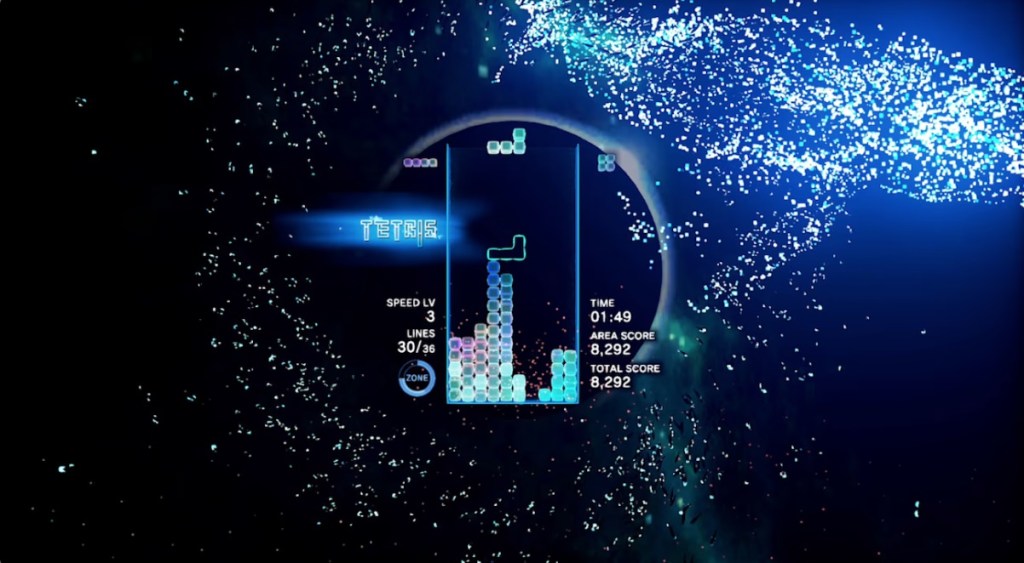
Tetris Effect is visually stunning. While I wouldn’t go quite as far as to say it pushes the graphical capabilities of the Nintendo Switch, its use of particle effects is absolutely gorgeous, and allows the game to maintain a consistent graphical element while it shifts among numerous art styles. While these artistic sensibilities will undoubtedly feel familiar to Lumines players, they are nevertheless fresh and original, and the subtle use of 3D and particle effects makes for a phenomenal display, and it’s truly a wonderful experience the way everything animates, shifts, and even completely transforms during play, sometimes in response to what you’re doing and sometimes in time with the music.
And much like Lumines, Tetris Effect’s fantastic visuals are paired with an audio presentation that ties together the visuals, gameplay, and music, with every interaction punctuated by a bit of musical sound that ties into the reactions of the background visuals, giving players the feeling that they’re partly making the song as they play. In the end, the influence players have in this regard is minimal, but regardless this is nevertheless a great way to make the sound a vibrant part of the gameplay.
And on that note, the soundtrack for this game is absolutely superb, with music in a wide variety of styles from composer Hydelic (AKA Noboru Mutoh), including beautifully upbeat pop songs like Connected (Yours Forever), Look Up, and So They Say, the delightful combination of synthetic and vocal that is Joy, the Middle Eastern-influenced techno song Flames, the instrumental theme Unfold… I could keep going, but suffice it to say that this game’s soundtrack is absolutely phenomenal, and every bit as much of the audiovisual experience as the eye-popping visuals and superb use of sound.
Make no mistake – this game’s release alongside the Nintendo Switch OLED model is no accident. This is unquestionably a great showpiece game that will be sure to show off the OLED’s screen and improved sound (or at least, so I imagine – I haven’t procured an OLED model yet myself). Also, speaking of the Nintendo Switch version of the game, one other small feature does bear mention – this game makes fantastic use of HD rumble to tie into the sound and visuals and truly bring the player just that much deeper into the experience of the game.
.
Connected
At its core, Tetris Effect: Connected is still “just Tetris”. Blocks drop from above, you arrange them as they fall to try to create full horizontal lines so that they clear, and if the screen fills up with blocks you haven’t cleared, you lose. For the most part, this gameplay has remained the same since 1984, although subtle mechanical changes have updated the gameplay since then.
However, within the confines of that classic formula, Tetris Effect: Connected seems to want to explore every corner of the possibilities present here in numerous game modes, with those modes separated into three sections – Journey Mode, Effect Modes, and Multiplayer.
Journey Mode acts as the game’s campaign mode, with players working through about 30 “stages” (think “skins”, each with associated visuals, sound, and music), trying to complete a preset number of lines in each. These stages shift in speed as you play through them and the stages morph based on your gameplay or the music, meaning that you have to account for sudden changes in difficulty as you play through them.
Another new element that’s also present in some of the other game modes is the “Zone” mechanic. As you play, you fill up a “Zone” meter which can be activated to temporarily stop pieces from automatically falling and cause completed lines to stack up at the bottom of your screen, only clearing once this effect is over, with the simultaneous clearing of numerous lines making for a huge addition to your score. This mechanic is pretty clever, not technically changing the core gameplay much while also giving players a way to multiply the score from that great set-up they’ve been working on in one high-speed frenzy to clear as many lines as possible before time is up.
In Effect Modes, players are given 15 different variants on the core gameplay. You have a few standard variants – endless, timed, and speed run. There’s a high-speed variant for experts, a “chill marathon” with no lose state for more casual players, some “playlists” of stages with similar themes, some “Focus” variants that challenge players not to get a high score but to complete specific goals, and some “Adventurous” variants that add unusual twists like I-blocks falling in designated spots after a countdown ticks down or random changes to the board that make things more difficult. These Effect modes give players a wide range of different ways to play the core game, regardless of skill level or interest.
Finally, the Multiplayer here allows friends to challenge each other in local or online play, or lets players challenge strangers online in ranked online play. Multiplayer play includes a mode with the Zone Battle mechanic I mentioned earlier, a more traditional score attack mode, a classic score attack mode that strips away mechanics and quality-of-life features to be closer to the original version of tetris, and finally the new Connected mode that has three players (live or A.I. controlled) fighting an A.I.-controlled “boss” player, with the team gaining the ability to eventually join their boards together and clear lines across their entire combined length. This last mode is really creative, and the game even has weekly events that allow one player to take on the role of the “boss” to make for fun 3-vs-1 matches.
A few notes about the online play specifically. Firstly, it’s important to note that this game supports cross-platform play, allowing players to challenge Xbox, PlayStation, and PC players. Naturally, this makes for well-populated game lobbies, and I didn’t have any difficulty finding opponents online. These online games played smoothly and without any noticeable lag. Overall, Tetris Effect’s online experience was superb.
And for those who found themselves scratching their heads at my low review score for Tetris 99… This. This. This is how you do proper matchmaking in a Tetris game. None of that “leveling” garbage that’s based more on how much you’ve played the game rather than how good you are at it, Tetris Effect: Connect uses a standard online ranking system that raises or lowers your ranking based on whether you win or lose and… seriously, I shouldn’t even need to explain this, this is how ranking has been done in games for decades now. In any case, matchmaking balance here feels just fine – I won some games, I lost some games, and in Connected mode I never felt like I was holding back my team or propping up my team.
.
Garbage Blocks
With all the good in this game, it isn’t without its flaws. In Journey mode, the pause due to the shift from one stage to the next can be jarring, and sometimes the gameplay starts up before the visuals can load on-screen, resulting in a block dropping before you have a chance to do anything about it. While this issue isn’t always present, it happens often enough to be pretty worrisome, and I hope this is addressed in a future patch of the game (note: it appears that as of 10/20/21 the developers are aware of this issue and say it will be addressed in the next patch for the game).
Also, overall this game definitely seemed to have some load times hidden throughout, though never any that were egregiously long. However, my biggest complaint isn’t about anything in the game, but something not in the game.
Given how large a factor the different audiovisual elements in this game are, it seems like a glaring omission that you can’t mix-and-match one of these skins with the game mode of your preference. While some game modes like the endless mode allow you to choose your skin, many are tied to a specific skin that can’t be changed. Also, as far as I can tell there’s no way to create a “playlist” that lets you cycle through multiple skins of your choice. This is a disappointing omission, as the Lumines games have had a similar feature for years.
Overall, these features don’t significantly impact the overall quality of Tetris Effect: Connected on Nintendo Switch, but they do enough to keep this from being the sort of Tetris perfection this game aims to be.
.
High Score
To answer the question, “why buy Tetris Effect: Connected?”, it is quite possibly the best version of Tetris ever created. It’s not perfect – it’s missing a few options and a glitch in stage transitions in the game’s Journey mode can be really frustrating. However, even with those complaints, this is a fantastic version of the classic Falling-Block Puzzle game with a wealth of game modes, superb local and online multiplayer gameplay (far more balanced than Tetris 99’s online gameplay), and it features an audiovisual presentation that makes this more than just a great game, it’s an amazing experience. If you enjoy Puzzle Games and have not already gotten this game on another platform (and maybe even if you have), you need to get Tetris Effect: Connected.
tl;dr – Tetris Effect: Connected is a version of the classic family-friendly Falling-Block Puzzle Game that gives the game an amazing audiovisual presentation with a fantastic soundtrack and beautiful visuals, a wealth of single-player and multiplayer game modes, and online multiplayer gameplay with cross-play and excellent matchmaking. It’s missing features I’d want to see and it has a few other minor issues, but overall this is quite possibly the best version of Tetris ever made. If you like Puzzle games, you need to own this game.
Grade: A-
.
This game has been nominated for one or more of eShopperReviews 2021 Game Awards:
Winner:
Best Game for Kids and Casual Players – There are few games as universal as Tetris, and Tetris Effect: Connected is arguably the best version of Tetris ever made. This version of the game gets bonus points for having a game mode where players literally can’t lose, as well as the new “Zone” mechanic that gives players a chance to take a breather (or rack up a lot of points all at once). If you’re looking to introduce someone to Puzzle games, this is one of the best ways to do it.
Best Puzzle Game – I’ve said multiple times now that Islanders is one of my favorite games of this year, but it straddles both Puzzle and Simulation genres without truly excelling at either on its own. Meanwhile, Tetris Effect is arguably the best version of one of the greatest Puzzle games ever made. So this is where I put personal preference aside, and give this award to Tetris Effect: Connected. This is an absolute no-brainer for Puzzle game fans on the Nintendo Switch, as it gives the classic game an absolutely gorgeous presentation, a beautiful soundtrack, some excellent multiplayer gameplay (far more balanced than what’s in Tetris 99, I will note), and overall presenting an experience as close to Falling Block Puzzle perfection as possible.
.
You can support eShopperReviews on Patreon! Please click HERE to become a Sponsor!
This month’s sponsors are MB, Andy Miller, Johannes, u/RamboFox, Exlene, Eli Goodman, Ilya Zverev, and Stov. Thank you for helping to keep the reviews coming!
 eShopperReviews
Leave a comment