
The Great Ace Attorney Chronicles
Genre: Compilation / Visual Novel / Graphic Adventure
Players: 1
.
Review:
Note: This game is included in the Ace Attorney Turnabout Collection, along with Phoenix Wright: Ace Attorney Trilogy.
The Great Ace Attorney Chronicles, released on PC, PlayStation 4, and Nintendo Switch in 2021, is a Compilation of two games previously only released in Japan – The Great Ace Attorney Adventures, originally released on the Nintendo 3DS in Japan in 2015, and The Great Ace Attorney 2: Resolve. Both of these games, much like the rest of the Ace Attorney series, are games that combine Visual Novel and Graphic Adventure elements, with players taking the role of an attorney combing through witness testimony during a trial to find contradictions that refute their arguments against your clients, with additional gameplay coming in the form of investigating crime scenes to gather information to bolster your client’s case.
I don’t think it’s exaggeration to say that the Ace Attorney series has long been considered one of the crown jewels in the Visual Novel genre, combining engrossing stories, compelling characters, and engrossing gameplay that gives players difficult choices that test their skills of deduction and observation, all wrapped in a presentation that has an undeniably quirky and lovable attitude. What’s more, this pair of games has been unavailable to Western audiences for six years, so I think it’s fair to say that fans of the genre and the series in particular have been eagerly anticipating this release.
Perhaps surprisingly, the Great Ace Attorney games abandon the well-established characters and setting of the prior games to tell a prequel story of sorts, taking place in the Meiji era of Japan and Victorian England and focusing on the character Ryunosuke Naruhodo, the ancestor of series headliner Phoenix Wright.
For those looking to see more adventures of Phoenix Wright, Miles Edgeworth, Apollo Justice, and others in the franchise, this may seem disappointing, but the characters in the Great Ace Attorney games are just as compelling, and in many cases are clearly take after the appearance and mannerisms of their direct descendants – Ryunosuke looks and acts very much like an even less-confident and less-experienced Phoenix Wright, Susato Mikotoba is a somewhat more reserved stand-in for Maya Fey, and even some of the quirky prosecutors from the original series get ancestral echoes here as well. In short, despite that this game introduces a lot of changes to the franchise, there’s still plenty here to latch on to for series fans. And if this is your first Ace Attorney game, you can go in fresh without feeling like you’re missing out on anything.
These ancestral echoes of modern characters are joined by a cast of new characters who are every bit as eccentric as the more familiar faces, with many of them being amusing British stereotypes (thanks to the new locale that much of these games take place in. Most notable is Herlock Sholmes, an eccentric, bumbling, endlessly enthusiastic and unwaveringly self-confident Sherlock Holmes wannabe who is occasionally helpful but also ludicrously wrong in his deductions just as often as he is right. If there is any one character who is likely to be divisive in this game, it is this one – even in a series with some pretty outlandish and cartoony characters, Sholmes really pushes the limits of the player’s patience with his absurdities.
Yet despite the presence of goofy characters the Ace Attorney series is known for, the Great Ace Attorney games feature a story that is somewhat more grounded than the rest of the franchise, and this is because it is very firmly set in its time, its place, and its greater context, and it makes full use of this fact. Where Phoenix Wright and his contemporaries live in a time and place that are both fairly vague (aside from being set in a roughly modern time period), Ryunosuke is very clearly a Meiji-era Japanese man who finds himself caught up in a series of events connected with his nation’s evolving relationship with Victorian-era England, and these politics are at play right from the very start, with pressure on his first trial to not upset the delicate diplomatic situation his nation is in. It is this diplomatic situation that serves as one of the connecting elements that ties together all of the cases in both games, forming them into one continuous story.
The setting also makes for some interesting changes to the dynamics at play between characters here, and limit the tools available to the game’s characters. Modern policing techniques did not exist at this time, technologies like photographs were still cutting-edge, and racial discrimination against Japanese people among Westerners was much the norm.
While many of these elements do a great deal to give the story more depth and make its world feel more real, this latter element of constant racism feels a bit overdone at times here – I don’t doubt that Japanese people in this era faced more than their fair share of racism, but this game takes it to cartoonishly absurd levels at times. And on the other side of things, we have Herlock Sholmes again, undercutting the realistically primitive nature of the technology and techniques of the age by conveniently being in possession of tools that are ahead of their time, even if his deductive reasoning skills are so flawed he can’t always make proper use of them. Overall, while on the whole this game’s setting and overarching story are fantastic, it’s definitely not without its flaws.
The gameplay here is much in line with prior entries in the franchise, with the core experience being the game’s courtroom scenes where players pick through witness statements to find things that are contradicted by evidence, occasionally interspersed with scenes that have the player exploring crime scenes to uncover evidence and interview witnesses. However, these are now joined by additional gameplay elements.
In trials, witnesses will sometimes be brought up simultaneously, and players will have an opportunity to shift their focus from one to another to get a witness to comment on statements made by another. I’m no historian, but I suspect these scenes are unrealistic… and it doesn’t really matter, because it makes for a great new gameplay element. Players now have even more possible avenues of questioning to pursue, and must be observant in witnesses’ reactions to testimony to see where one witness might be hiding something related to what another is saying.
Another new element here are the “Course Correction” segments of the game, that have players picking apart Sholmes’ deductions and steering him towards the right answers. These segments play out somewhat similarly to submitting contradictory evidence in trials, but nevertheless still feel fresh and different due to the change in the context of how this comes about and the fun way this is presented.
Finally, there is this game’s addition of the jury trial system, where players must not only convince a judge of the truth of their arguments, but multiple members of a jury. This expresses itself in a rather odd way, as the jury members declare mid-trial that they’ve made up their minds, blasting a literal ball of flame on the side of the scale that represents their verdict. Should the scale ever tip toward a jury full of members dead-set on a guilty verdict, players will be able to hear each juror’s reasoning, and must find statements from multiple jurors that are contradictory. This is a convoluted and highly unusual spin on the series’ usual formula, but it does make for a nice change of pace even if it means detracting from the game’s realism.
While some of these new elements do complicate the series, they’re generally pretty well-explained. Players can also choose to take on any chapter from either story right from the game’s start, though it is highly encouraged to play them in order – there is an over-arching story here, after all. And as per series norm the gameplay here does a good job of being user-friendly, giving players multiple opportunities to read through important statements, giving helpful hints when the player gets things wrong, and in the Nintendo Switch version giving players the option to play using the touchscreen in handheld mode.
However, while this entry in the franchise makes notable changes to the main cast, the setting, and the gameplay, possibly the biggest changes her are to the presentation.
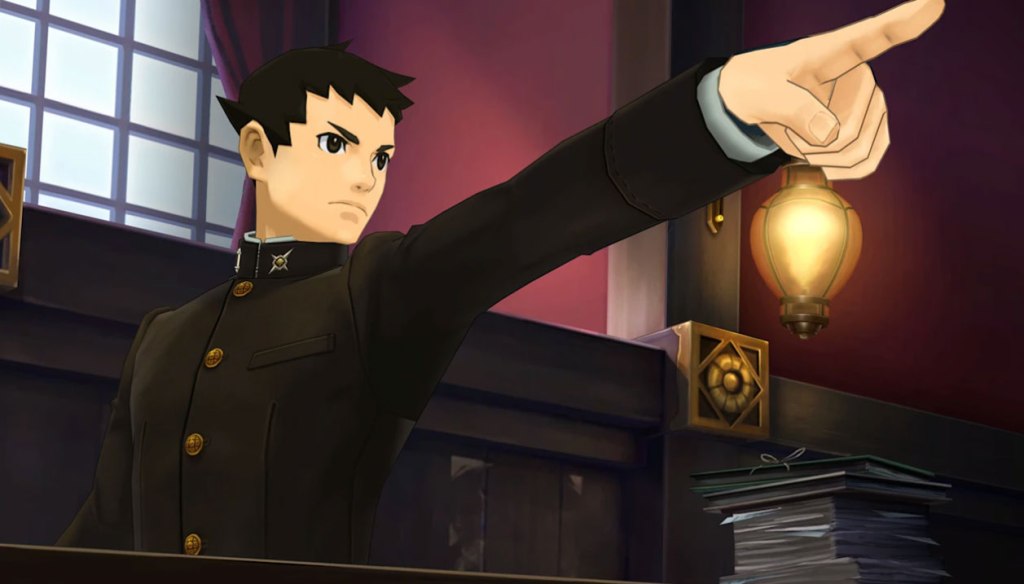
The presentation in The Great Ace Attorney Chronicles is, quite simply, phenomenal. This game manages to bring the series into 3D while remaining extremely faithful to the series’ signature anime art style using highly-detailed, extremely expressive, and incredibly well-animated characters in some nicely-detailed 3D settings. The amount of detail here is extra stunning when you consider that this pair of games began their lives as Nintendo 3DS games, but you’d never guess as much here, and it’s all portrayed with a crystal-clear framerate and resolution. The amount of attention to detail that has been paid to the characters alone here is truly a sight to behold, as still screen grabs of them could easily have you fooled into thinking you’re looking at a drawing of the character.
Yet the animation here is so fluid, it brings every one of these characters to life with gestures and mannerisms both outlandish and minor, with virtually every character having both major and minor quirks. You can see a difference in something as slight as Ryunosuke slamming his hands down nervously while his eyes darting around… doing so nervously, clutching at the desk facing straight ahead… and doing so with fierce determination, almost as if the desk is the only thing stopping him from leaping forward. This is without a doubt some of the best animation I’ve seen in a game this year.
The visuals here aren’t just a graphical upgrade either – they allow for some dynamic moments such as during the Course Correction scenes, where the camera pans and zooms around the room like in a David Fincher movie as Herlock Sholmes poses dramatically in the spotlight and the target of his theory quivers with nervous concern. Even more than this, during these same scenes, players get the opportunity to rotate the camera around characters or points of interest to locate clues, a nice added touch.
Another nice touch are the anime-style animated introductions to each of the game’s sequences
While the upgraded visuals here are a show-stealer, the excellent soundtrack is not to be forgotten either, with some wonderful orchestral themes that do an outstanding job of highlighting the drama of the story at play, with great songs like Ryonusuke Naruhodo ~ Overture of the Adventure, The Great Cross-Examination ~ Moderato 2015, Logic and Trick, Ryunosuke Naruhodo ~ Objection! 2015…
Okay, I love this soundtrack so much, it’s hard to pick just one favorite song, but if I had to narrow it down, my top picks would likely be Kazuma Asogi ~ Samurai of Commission, The Great Stray ~ Suspense (Part One), and The Great Stray ~ Suspense (Part Two) – the former because it really helps to capture the attitude of a supporting character right from the moment you first meet them, and the latter two because they turn gripping courtroom drama moments into moments that have you outright on the edge of your seat.
One final note I’ll mention before going on to the conclusion. The Great Ace Attorney Chronicles, as a two-game compilation, may seem like it’s shorter on content than the Ace Attorney Trilogy, which has three. However, you may find yourself surprised by just how much content is here – these games will take players an estimated 60+ hours to complete the full story (depending on your reading speed and of course your deductive skills), and while there is a little padding and repeated dialogue included in that to make sure the player hasn’t lost track of important details, overall I felt the pacing here was pretty good. And for that significant amount of game, this collection is priced at $40. I don’t know about you, but to me that seems like an absolute steal.
So, in conclusion… wow, I had a lot more to say about this game than I thought when I first started writing this review. I think it’s pretty clear that I thoroughly enjoyed The Great Ace Attorney Chronicles. As we have come to expect from the Ace Attorney series, this is a game that not only elevates the Visual Novel genre, but actually goes above and beyond its genre to become something truly special in its own right. However, even more than that, The Great Ace Attorney Chronicles adds some enjoyable new gameplay elements that expand on the series’ core gameplay strengths, a compelling new setting with some great characters and engrossing story, and a phenomenal presentation that not only leaves the game’s 3DS roots in the dust, but drives innovations in the gameplay as well.
There are absolutely some issues I have with the game in places – especially at the start, Herlock Sholmes is pretty grating, and the new jury system, while fun, seems about as divorced from reality as the series has ever gotten. But overall, this is an absolute must-play for Visual Novel fans, and a pretty excellent game to check out if you’re looking for a game with a great cartoony story, particularly if you enjoy courtroom dramas.
tl;dr – The Great Ace Attorney Chronicles is a Compilation of two Victorian-era prequels in the Ace Attorney series previously only released in Japan, combining the series’ trademark courtroom drama gameplay with a new setting, new characters, new gameplay elements, outstanding graphics and a superb soundtrack, all at a great value. There are a few elements here that don’t quite work as well as they could, but overall, this is a must-have game in the Visual Novel genre, and even if you’re not a fan of the genre you’ll want to give this game a look if you enjoy courtroom dramas.
Grade: A
.
This game has been nominated for one or more of eShopperReviews 2021 Game Awards:
Winner:
Best Graphical Style – This year featured numerous games with strong, vibrant art styles and imaginative worlds, but The Great Ace Attorney’s great accomplishment in its art design is how it evolves the 2D anime art style from earlier games with cel-shaded 3D visuals that bring its characters to life, all while remaining extremely faithful to that art style. This is further enhanced by some outstanding animation that makes each of the game’s characters absolutely full of personality, from the wild and wacky antics of the witnesses you cross-examine, to the subtle darting eyes of hero Ryunosuke as he nervously tries to think of a way out of his latest predicament.
Best Graphic Adventure / Visual Novel – While the Nintendo Switch got some truly creative and original entries in the Visual Novel and Graphic Adventure genres this year, the Ace Attorney series once again proved it’s the king of arguably both genres by taking its tried and true formula, modernizing its visuals, and taking it to a completely new time period with a cast of different (but in some cases suspiciously familiar) characters. Everything the Ace Attorney series does well is on prominent display here, with great story, excellent characters, some wonderful puzzles to solve during the game’s trials and in between them, and with everything now wrapped in some absolutely wonderful visuals. Oh, and did I mention that The Great Ace Attorney Chronicles, is actually two games, not just one? Even if you’re not normally a fan of this genre, The Great Ace Attorney Chronicles is a game you should get your hands on.
Runner-Up: Game of the Year, Funniest Game, Best Song (The Great Stray ~ Suspense Part 2 by Yasumasa Kitagawa), Best New Character (Herlock Sholmes)
.
You can support eShopperReviews on Patreon! Please click HERE to become a Sponsor!
This month’s sponsors are Andy Miller, u/wonderponder, Johannes, Stov, Ilya Zverev, Eli Goodman, and KC. Thank you for helping to keep the reviews coming!
 eShopperReviews
Leave a comment