
The Legend of Zelda: Skyward Sword HD
Genre: Action-RPG
Players: 1
.
Review:
The Legend of Zelda: Skyward Sword was originally released on the Wii in 2011, and this game was remastered for Nintendo Switch in 2021, with improved visuals updated control options, and numerous quality-of-life features. This game marks the last traditional 3D-style Zelda game prior to the release of The Legend of Zelda: Breath of the Wild, and as such players should expect a more linear design than Breath’s open-world style of world design.
.
A Legend Appears!
While it may technically be a remaster, Skyward Sword looks outstanding today, with the improved visuals really helping to bring this decade-old game into the modern era in a way that makes it feel like this could easily be a game released today.
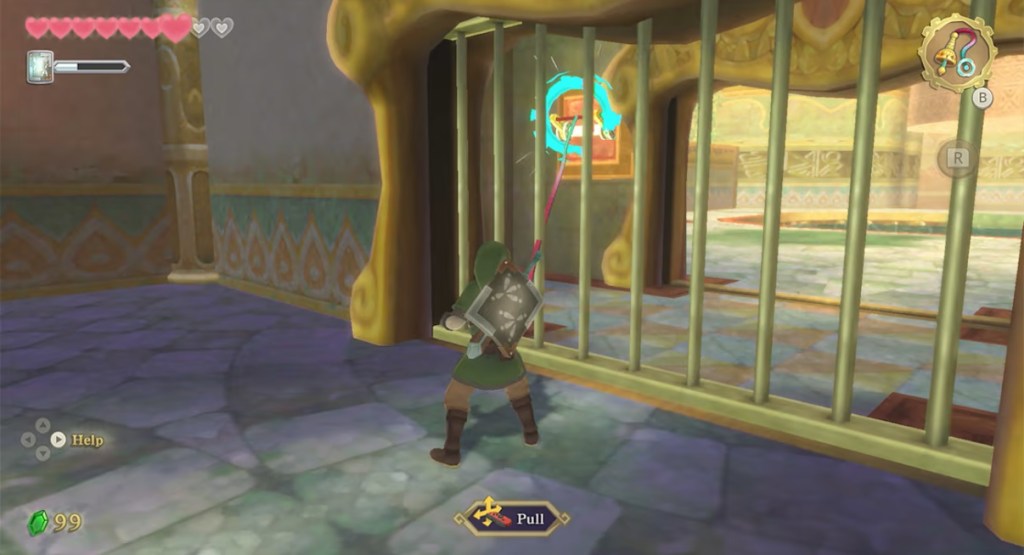
The original Wii version of the game had a 480p resolution, while the Nintendo Switch version gets a massive upgrade to 1080p docked and 720p in handheld mode, at twice the framerate of the original release’s 30FPS to a smooth 60FPS. This release also features improved textures, improved shadows, a completely reworked user interface, and a clever new filter makes distant terrain appear to look like paint on a canvas. The load times are vastly improved too. All of this is on top of a game that was visually beautiful when it released, and being a late release on the Wii meant that that console’s visuals were potentially being pushed to their limits.
In short, The Legend of Zelda: Skyward Sword HD looks fantastic, and while it may not be quite up to the standard of Breath of the Wild in some areas, in others it gives that Earth-shattering release a run for its money (for one thing, I’ll take this game’s framerates over Breath’s any day). While the comparison to Breath of the Wild may not be entirely fair, with Breath’s open-world design not allowing for the same opportunities to create detailed, focused areas that this game has, it bears mention that Skyward Sword features some pretty large areas too, like the opening area of Skyloft.
One thing that has largely been retained here is Skyward Sword’s superb soundtrack, which is still wonderful here. The Legend of Skyloft is still wonderfully epic and cinematic, Fi’s Theme and Follow Fi are still magical, and Temple Spring is still nicely mysterious, to name a few. In fact, the only complaint I have in the sound department is another thing that was kept from the original – the largely silent characters, who talk using text and flappy mouths and only occasional grunts. This is made more noticeable in early cutscenes where Zelda herself sings. This doesn’t ruin the experience, of course, but it does make the game feel more dated than pretty much every other element of the presentation.
.
Legendary Control
However, likely more than the update to the visuals, probably the changes most players were curious about were the changes to this game’s controls and those aforementioned quality-of-life features. In short, a lot of work has been done to specifically address the issues that many players had with this game’s original release, although it’s clear that the game’s design and the limitations of the Nintendo Switch as a platform meant that only so much could be done here.
The original release of Skyward Sword relied heavily on the Wii’s motion controls, something that many found gimmicky, frustrating, and tedious. The thing is, this game was designed around those controls, so you simply couldn’t replace a sword swing with a button press, or at least not without fundamentally changing the game. It seems the compromise made here was to give players their choice of two control schemes – one that still relies heavily on motion controls, and one that remaps these motion controls to a more traditional gamepad control scheme.
Unfortunately, I think both of these control schemes have issues.
For the motion controls, the Joy-Cons simply are not a Wii Remote, and as a result the motion feels like it has less precision here. Players will find themselves needing to recalibrate their gyroscopic pointer frequently, as it veers off in odd directions frustratingly regularly. Thankfully, this can be done with a simple button press, but it’s disappointing how much you’ll need to keep babying this button whenever the game requires you to do something requiring delicacy with the motion controls… which is often.
For gamepad controls, the movements of your sword are remapped to the right analog stick, which does allow for a greater amount of precision in your movements, but it also feels extremely unnatural, and the disconnect it creates between your brain and the controller may make it take longer to input commands that feel more fluid and natural using motion controls. Again, this game was built around the motion controls, so taking those motion controls out of the experience was only ever going to be a grudging compromise.
At the very least, players can opt to still use gyroscopic aiming even if they’re using traditional gamepad controls, which is uncharacteristically considerate of Nintendo to include here. There are also new camera controls (though traditional gamepad controls make it clunky because you need to hold a button while using the right analog stick to use them). However, no matter which way you slice it (ha), this game’s controls have issues, and while they don’t ruin the gameplay, they do constantly make it worse than it otherwise would have been.
.
A Revised Legend
At the very least, the quality-of-life features added here are a different story. Players bemoaned the original game forcing them to sit through constant nagging from Fi, constant interruptions from other characters, and constant reminders of what even the tiniest item you pick up does. Here, much of that is either done away with or made completely optional, and you can skip through text rather than being forced to wait for it to load. What’s more, there are now automatic save checkpoints, and those who buy the Loftwing Amiibo figurine have access to fast travel in more locations. Ugh, okay, that last one feels somewhat dirty, tying a quality-of-life feature to a purchase… but otherwise, this game is much more streamlined than the original, and it makes this game much more of a breeze to play.
As for that actual gameplay, Skyward Sword still features the excellent world design, puzzle design, and boss design that the Zelda franchise is known for, and in this game you can see many of the elements that took on a more mature, developed form in Breath of the Wild, such as the major role stamina plays in the game, and various items players must collect to craft things.
Having said that, this game’s control issues filter into the gameplay as a whole, as this game absolutely wants you to be using those features at all times. Enemies frequently need to be sword-swiped at specific angles, some things will require you to hold the sword up to charge it before letting loose a blast from a distance. It feels like you can’t go more than a few minutes without this game reminding you that it’s fixated on those motion controls.
.
The Legend in the Flesh
In the end, I don’t think there’s any getting around the fact that The Legend of Zelda: Skyward Sword was and will always be a flawed game. This re-release improves the game immensely in numerous ways, but even this much-improved re-release still suffers from Nintendo’s fixation on making the game revolve around its motion controls. However, having said that, this remaster does do everything it can to reduce the pain and frustration that were in the original release, and even with all its problems, this is still a Zelda game, which means you’re getting truly great gameplay, great game design, and an epic presentation that still shines through to this day. As much as I can complain about this game, it is still the best version of a great game… it’s just not as great a game as most (if not all) of the other 3D entries in the Zelda series. However, don’t let that dissuade you if you’re a Zelda fan – this is still a game that any fan of Zelda will want to get their hands on.
tl;dr – The Legend of Zelda: Skyward Sword HD is a massive improvement over the original Wii version of the game, with vastly improved visuals, hugely impactful quality-of-life changes, and new control options that… well, still have a lot of issues, but probably do about as good a job converting this game to Switch as one could hope for. This game’s fixation on the motion controls is still one of its most frustrating qualities, but it still features superb game design and an excellent presentation, and fans of the Zelda franchise won’t want to miss it, despite its flaws.
Grade: B+
You can support eShopperReviews on Patreon! Please click HERE to become a Sponsor!
This month’s sponsors are MB, Andy Miller, Johannes, u/RamboFox, Exlene, Eli Goodman, Ilya Zverev, Stov, Connor Armstrong, and K.H. Thank you for helping to keep the reviews coming!
 eShopperReviews
Leave a comment