
The Legend of Zelda: Tears of the Kingdom
Genre: Open-World Action-RPG
Players: 1
The Nintendo Switch 2 Difference
.
Review:
This has been an extremely difficult game to review.
As I posted when this game came out, I often tell people that I don’t play games until completion before reviewing them, I play them until I have a good feel for them. In keeping with this, I felt like a game this massive would need added time and attention to review properly. As such, I have spent the last three days playing this game almost non-stop (save for breaks for sleep, food, and necessary errands I needed to see to). I would wager that I have spent over 40 hours playing this game, and I still don’t entirely feel comfortable reviewing it, because I keep finding new things that recontextualize this game and how I feel about it.
Every time I think I’ve got a handle on what this game is and what it has to offer, it throws me a new curveball, or a new part of the gameplay experience I hadn’t considered. What’s more, I know there are still huge gaps in my knowledge I haven’t filled yet, things I still need to see. When there are a dozen different things to investigate, checking out any one of them means you’re putting off looking into all of the others. And I find that when I try to focus and make a beeline toward any one specific thing, I end up finding other things that are so unexpected and enticing that I can’t help but get sidetracked to see just what the heck this thing over here is… Wait, you can do that? I didn’t know that’s what those things did! Wait, what is this guy’s deal? Oh, so that’s how you get over there!
Of course, if I’m honest, one of the reasons I didn’t want to write my review of The Legend of Zelda: Tears of the Kingdom is because the time I’m spending writing this review is time I could be spending playing The Legend of Zelda: Tears of the Kingdom.
.
Once More, From the Top…
The Legend of Zelda: Tears of the Kingdom is an Open-World Action-RPG released on Nintendo Switch in 2023. This game is the direct sequel to The Legend of Zelda: Breath of the Wild, a game often cited as the best game on Nintendo Switch, and frequently mentioned as a contender for the best videogame of all time. I don’t think it’s unreasonable to say… that’s a pretty tough act to follow.
Being a direct sequel, Tears of the Kingdom re-uses a lot of stuff from Breath of the Wild. The visuals, much of the soundtrack, the core gameplay mechanics, the physics, the map, the characters… while this game finds interesting new ways to rework Breath of the Wild’s different elements, there’s no question that Breath of the Wild forms the foundation for everything in Tears of the Kingdom. Didn’t like the frail, breakable weapons? Too bad, they’re back. Didn’t like the dozens or hundreds of shrines? Too bad, they’re back. Didn’t like the combat, the cooking, the challenge level…? Yup, all back. In other words, if you hated The Legend of Zelda: Breath of the Wild, you’re probably not going to like The Legend of Zelda: Tears of the Kingdom.
Having said that, do not make the mistake of thinking this is a rehash or a “standalone expansion”. While Tears of the Kingdom is clearly re-using much of Breath of the Wild, it also makes it a point to find ways to take everything about the prior game and make it new again.
And… at this point it’s probably best that I give a big, fat spoiler warning. There’s just no way I can write this review honestly without talking about some of the new stuff, and some of the new stuff are major spoilers that Nintendo has managed to avoid having leaked prior to this game’s release. If you don’t want to be spoiled, and just want my overall thoughts on the game, skip ahead to my tl;dr at the end. However, if you don’t mind spoilers (I won’t reveal major story spoilers beyond the earliest parts of the game), please read on.
.
WARNING: Spoilers ahead!
The Legend of Zelda: Tears of the Kingdom appears to take place a few years after the end of Breath of the Wild. The Kingdom of Hyrule is recovering from the 100 years-long oppressive presence of Calamity Ganon, rebuilding, and starting to thrive again, even finding new scientific and artistic pursuits to help the nation flourish. However, this progress is halted when Hyrule starts to find itself plagued by the spread of a shadowy substance called “gloom” seeping out from caves and crevices around the land, causing illness.
Investigating gloom coming from underneath Hyrule castle itself, Zelda and Link find a desiccated corpse apparently being held down by a magical glowing arm. Just as they arrive, the magic fades, the arm falls, and the corpse comes to life, attacking Link and Zelda. Link’s arm becomes corrupted and the Master Sword shatters, and before Link passes out, he sees Zelda fall down a chasm and suddenly blink out of existence. When Link comes to, massive floating islands have risen up out of the ground around Hyrule, and his corrupted arm has been replaced with the magical arm that was holding back the mummy’s power.
This opening, along with the game’s introductory area, are quite possibly the best start to any Zelda game I’ve ever played.
What follows is a huge adventure and a search for answers. What happened in the cavern? How can Link stop the spread of the gloom? What happened to Zelda? What’s the deal with all the Zelda sightings that have started cropping up around Hyrule? What about strange crop circle-esque “geoglyphs” that have appeared across the kingdom? What is the cause of harmful new weather plaguing parts of Hyrule? How is all of this connected to secrets from Hyrule’s ancient past? How will Link defeat an evil that easily shattered his legendary weapon? Where is that evil?
.
Deciphering a Legend
Unlike Breath of the Wild, which made it very clear early on what players needed to accomplish, the goal structure in Tears of the Kingdom is more murky. You certainly have numerous goals to accomplish, but it’s not always clear how to accomplish those goals, or how doing so will help you in your overall quest. Where Breath of the Wild basically pointed you to four spots on the map with a fifth one once you’re done with that (or before, if you’re particularly brave or particularly suicidal), Tears of the Kingdom points you to four spots on its map and… suggests that you’ll need to do a lot of digging around to figure out what else to do beyond that.
This change may be one of the most quietly disruptive elements in Tears of the Kingdom, because it completely alters how you approach the entire game. In Breath of the Wild, everything was clear – tackle the Four Divine Beasts, solve shrines to power up, find Koroks to expand your inventory, locate the Master Sword, and then head to the castle to beat Ganon. Everything else was enjoyable but largely optional. In Tears of the Kingdom, you still have the shrines and Koroks (though these both now find new challenges for the player based on this game’s different skill set), and you still have four dungeons to tackle (actual unique dungeons this time rather than four suspiciously similar ones), but beyond that, it’s not clear what to do. You’ll have to actually talk to people in the game, follow up on leads, and see where it goes. Sometimes your reward may be some extra rupees or some cooking ingredients. Other times, you may find you’ve uncovered an absolutely vital clue to solving one of the game’s deep mysteries.
As an example, at one point, I found an isolated little structure with ancient writing inside… ancient writing I couldn’t read. The game did not give me any lead to follow, or any suggestion how to decipher this text. I would just have to try to remember this until I encountered some way to translate this text through the course of my travels. I would need to ask around and investigate. That is, if I wanted to decipher this text at all – the game gave no indication how important or unimportant it was.
To find the answers to mysteries in this game, you’ll need to scour the entire world in the game’s three maps:
There’s the land of Hyrule, familiar but changed by the passage of time, by social and technological progress, and also changed when it was blighted by the gloom and scarred by the events caused by the “upheaval” that ripped open rifts in the grounds, littered the Earth will falling ancient structures, and unleashed new localized disasters in various regions.
You have the skies above Hyrule, filled with floating islands and structures. Players can reach these islands by using towers designed to fling Link into the stratosphere, or by using one of Link’s new abilities to rewind time on falling debris and riding it upward.
Finally, you have The Depths below Hyrule, a massive cavernous cave structure that’s somewhat reminiscent of Skyrim’s Blackreach, an entire world underneath the ground. While immediately accessible after leaving the game’s starting area, players should be wary about adventuring here unprepared, as it’s oppressively dark, filled with dangerous monsters, and filled with areas covered by Gloom that poisons Link if he touches it.
All of these locations are presented seamlessly – players walking on a sky island miles above the planet can dive down, see the entirety of Hyrule beneath them and spot landmarks to mark with pins for later investigation, then locate a reddish-black cavern and drop straight down into it, plummeting miles down into the Earth to look upon the enormous Depths.
.
Does the Presentation Reach New Heights?
With all of this going on, one might wonder about this game’s performance. How do the visuals hold up? Breath of the Wild was a launch game on the Nintendo Switch, and it had noticeable framerate issues in some areas. By comparison, Tears of the Kingdom is much more ambitious, with a lot going on in both obvious and subtle ways. Does it manage to shoulder this extra burden better than Breath of the Wild did?
Well, not really, no. Where Breath of the Wild’s framerate issues were mostly limited to specific problem areas like the Korok Woods, Tears of the Kingdom’s framerates can dip practically anywhere, and although this is usually just for a moment and it doesn’t interfere with the gameplay much, it is definitely noticeable. And that’s on top of problem areas where things get really choppy in this game (I noticed Hateno Village seemed particularly awful).
However, it bears mention that while the framerates do suffer at times, this is not a Pokemon Scarlet/Violet level of roughness. Tears of the Kingdom struggles to keep up with everything going on in this game, but unlike Pokemon Scarlet and Violet, that’s clearly not simply due to poor optimization, but also due to just how much is going on under the hood here. Not only is this game’s massive world arguably three times the size of Breath of the Wild’s while still maintaining an excellent view distance, but it still maintains the excellent detailed 3D visuals with light cel-shading, excellent lighting and real-time shadows, and with everything operating within this game’s comprehensive physics engine. On that note…
.
A Link to the New Build
Beyond the new areas to explore, the other major new element in Tears of the Kingdom are Link’s new abilities, which take the place of Breath of the Wild’s runes. These new abilities can lead to opportunities that truly set this game apart from its predecessor.
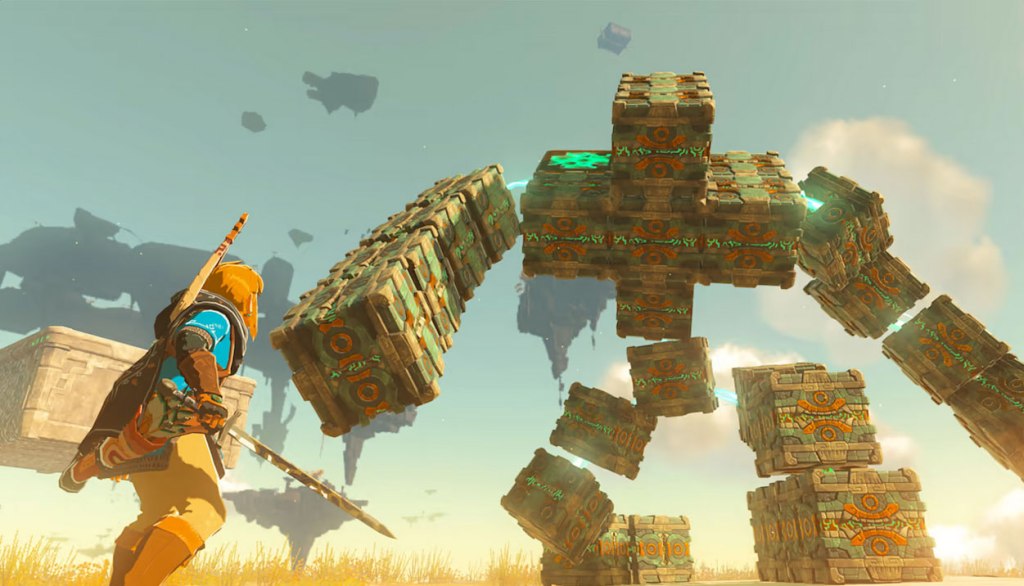
Probably the most noteworthy of these abilities is Ultrahand, which replaces the prior game’s Magnesis in a way that makes Magnesis completely obsolete. Not only will this let you grab and manipulate any inanimate object that isn’t bolted to the ground (not just metallic ones), but it will also allow you to glue them together to make your own custom structures or vehicles. These vehicles can be augmented using ancient devices to add fans, powered wheels, rockets, or numerous other gizmos and gadgets powered by a battery you keep on your person and can upgrade over the course of the game. You can find these devices littered on the ground, or you can purchase them from giant gacha capsule machines littered around the game’s world. Needless to say, this ability and these devices provide immense opportunities for creativity, and also make for some of the game’s most enjoyable puzzles.
The prior game’s Stasis ability is also replaced here with a similar but not identical ability, Recall, which allows Link to “rewind time” for any object in the environment, making moving objects repeat past actions in reverse, and making falling objects lift into the sky. As noted above, this means that it is now much easier to reach great heights simply by rewinding time on falling debris and hopping onboard, and once again, this makes for some really clever puzzles.
Possibly the most underrated ability in the game is Ascend, which looks up at the area directly above Link and allows him to jump up and through a ceiling immediately above him, to appear in the floor above. This ability has some significant limitations – it only works if the ceiling is directly above you, it only works if the ceiling isn’t too far away, and it only works if both the ceiling and the floor above it are relatively flat and not at too steep an angle. However, if the ceiling meets all these criteria, you’ll be given a green indicator and allowed to hop up to whatever is directly above you, even if there’s an entire mountain between you and the next floor. What’s really clever is that this ability can be combined with both others – you can use Ultrahand to move a plank into the air above you, then let it drop and use Recall to make it hop back above you as it goes back in time, then you can use Ascend while beneath it to hop onboard while it’s still moving back through time. On top of this, Ascend ensures that you’ll virtually never be trapped in a room as long as that room has a ceiling that isn’t too far away from you.
The final ability here, Fuse, is probably the least interesting of the bunch, even though it had some of the most potential. This ability enables you to take any weapon, shield, or arrow, and permanently attach another object to it, increasing its strength and durability, and adding additional effects or abilities. Attaching a rock to a sword gives you a strong hammer, attaching a sword or spear to another spear gives you an extra-long spear, and so on. While this sometimes makes for delightful combinations (try attaching a rocket to a shield sometime, or a bomb plant to an arrow), this ability doesn’t interact with the other abilities as much as the other three do. Also, while this did have the potential to act as a counter to the much-derided weapon degradation, you’ll still be swapping in and out weapons just as often, but now you’ll be further micromanaging them, scanning your inventory for a weapon to drop so you can fuse it to your current weapon now that the prior attachment broke. This isn’t to say that this ability is bad, but I’m not sure it works quite as well as the others.
Still, while I have minor complaints here and there are certainly places where the abilities feel limited, or like they could have been improved even further, the amount of flexibility they give the player is still fantastic.
.
A Kingdom Full of Other Stuff Too!
There’s so much other stuff I haven’t gone into here. Little moments spread throughout the game that make it something truly special. The approach to the major dungeon in the Rito area had to be one of the most thrilling, enjoyable sequences I’ve ever played in a Zelda game, and that dungeon’s boss was truly unique and wonderful too. Oh, and when you beat those dungeons, you get an AI-controlled sidekick avatar who’s super-helpful.
I once again found myself drawn to a massive dragon like in the prior game, only to be delighted in discovering that I could now follow it into a chasm underground to see its full journey. And on the topic of massive creatures you’ll see from afar, the enormous, malevolent, three-headed dragon Gleeok is truly a sight to behold… and to run from when it spots you.
In one village, I wandered in to use a goddess statue to expand my abilities, and ended up getting pulled into a bizarre mix of fashion and political intrigue as both a fashionista and a stodgy traditionalist begged for my help in winning an upcoming mayoral election, while their respective family members each begged me to look into potentially shady activities both seemed to be involved in, which ultimately led to me hopping into a well so I could use Ascend to pop up and spy on them while they remained unawares.
Oh! And that also gets me to talking about how this game’s story (both its major one and its minor side-quests) are extremely engrossing, with outstanding characters, something that was a delightful surprise after the prior game’s somewhat minimalist environmental story. I kept wanting to find out more about what the heck is going on with Zelda… but I kept getting charmed by an adorable pair of sisters hunting for mushrooms or a guy obsessed with his construction company’s president and trying to hold erect signs bearing the man’s likeness, or learning what had become of favorite characters from the prior game.
And every step along the way, new mysteries to solve, new intrigues, new twists and turns…
Oh, geez! I forgot to mention the music! While this game re-uses a lot of the themes and aesthetics from Breath of the Wild, some of the new orchestral music here is outstanding, particularly the new dungeon and boss music. Have a listen to the Wind Temple Theme, the Wind Temple Boss Theme, and the Water Temple Theme for a few great examples.
And you’re constantly finding new ways to do things, new twists to the gameplay, new ways that different elements can interact…
There is just so… so… so much…
.
Okay, But It’s Not a Perfect Game, Right?
Heck no! There’s a lot of stuff here that bugs me, some of which I’ve already mentioned. I hate that this game has performance issues, and I feel like it really shows how the Nintendo Switch hardware has aged. I think that weapon degradation is still annoying, and the Fuse ability doesn’t change that. As impressive as I think The Depths are, I’m disappointed at how empty they are of important things to do (save for a few extremely noteworthy story events), and how samey they appear.
As much as this game keeps giving me tons of new things to see and discover, I’m mildly annoyed that every now and then I’ll be running or climbing across a part of Hyrule that’s largely similar to the original game, sometimes even with exactly the same music playing. And in just that moment the game feels less like something new and original and more like a lazy rehash… until a moment later when I see something new and amazing and forget how jaded I was feeling just a few seconds prior.
As much as I’m thrilled by not knowing where to go or what to do to accomplish goals, there are times I definitely wish the game at least vaguely indicated where I should be looking for answers to questions I had, aside from the obvious answer to any question like this: “the internet”.
As much as I’m delighted by the ability to create your own vehicles, I’m frustrated at how limited this can be, with parts breaking after a while of use, with how you’re limited to whatever parts you can find around you or spend out of your inventory (one way or another).
And because yes of course I had to bring it up – I’m irritated that this game was released with a $70 price tag, despite not even having the excuse of being a big-budget game on new hardware.
.
Tears of Sadness, or Joy?
Despite these flaws, I think it’s going to come as no surprise when I say that I absolutely love The Legend of Zelda: Tears of the Kingdom. I do think this game is derivative in a way that makes me give the edge to Breath of the Wild, which was a true trailblazer, but Tears of the Kingdom is so absolutely stuffed full of creativity and delightfully new ways to explore that well-trod world we were introduced to six years ago.
The Legend of Zelda: Tears of the Kingdom is an absolute must-have game. It is a lesson in how you do a direct sequel, balancing reprising beloved old gameplay with refreshing new ideas. It is a lesson in how you expand in scope, making things truly even bigger and better the second time around. It is a lesson in how you do puzzle design, making exquisite use of the game’s phenomenal physics the outstanding potential of its new abilities. It is a lesson in how you can change the game’s design slightly to encourage players to become more involved in the game’s world. It is a lesson in how the Nintendo Switch is still capable of bringing us some of the best videogames that have ever been made. Unless you hated The Legend of Zelda: Breath of the Wild, do not hesitate to get this game.
tl;dr – The Legend of Zelda: Tears of the Kingdom is not just an Open-World Action-RPG that returns to the world we were introduced to in The Legend of Zelda: Breath of the Wild. This is a game that finds new, impressive, and truly compelling ways to explore that world. This is a game that balances the familiar world and gameplay of that incredible game with brilliant new gameplay ideas, a compelling new story, and a massive scope that’s not only far greater than what was in this game’s predecessor, but is even greater than Nintendo led us to believe it would be. If you hated Breath of the Wild, this game won’t change your mind. If you have not yet played Breath of the Wild, you should probably go play that first. For pretty much everyone else, you should consider this an absolute must-have game, and a reason to own a Nintendo Switch.
Grade: A++
.
This game has been nominated for one or more of eShopperReviews 2023 Game Awards:
Winner:
Game of the Year – This is surely the biggest no-brainer I’ve ever had in selecting a Game of the Year for these awards. What The Legend of Zelda: Tears of the Kingdom manages to accomplish here is nothing short of brilliant.
This game’s predecessor, The Legend of Zelda: Breath of the Wild, is still to this day one of the greatest videogames of all time. How do you follow an act like that? What’s more, this game reuses the gameplay, characters, assets, much of the music, and pretty much the entire world from the first game. How the heck could a game do that and not just be seen as derivative?
And yet, Tears of the Kingdom responds to each of these concerns by flying higher than anyone could have imagined, in some cases literally. Tears of the Kingdom makes what we already experienced in Breath of the Wild feel new again by recontextualizing everything with a new set of abilities. It expands on the massive world by not only bringing us new sky islands to explore, but also a whole new massive Depths area equal in size to the land above. And with its Ultrahand ability, it provides players with a toolkit for creating their own unique machines to not only travel around the land of Hyrule, but absolutely dominate it.
By now, I can only conclude you’ve been hiding under a rock if you haven’t seen YouTube videos of player-crafted mechs, helicopters, dune buggies, semi trucks, hoverbikes, deathtraps, and… crucified koroks? Yikes. Yeah, many a korok has been subjected to absurdly over-the-top cruelty in this game, and it has made for a great amount of hilarity this year.
This sort of customizability and the spirit of creativity that comes with it just further help to underline that while Breath of the Wild was about surviving in a hostile world and exploring it, Tears of the Kingdom is about mastering it.
Furthermore, with its retooled dungeons and fused weapons and shields, Tears of the Kingdom aims to address some of the biggest complaints about Breath of the Wild… to largely mixed results, to be sure, but this is nevertheless a game that doesn’t simply build on the success of its predecessor, but tries to improve it and use it as a springboard to greater heights (again, sometimes literally).
What’s more, where story was something of an afterthought in Breath of the Wild, told more through the environment than through the game’s characters, here the actual story is a major part of the experience, with the mystery of what actually happened to Zelda… well, not being much of a mystery, truth be told, but still absolutely compelling.
There are some moments in this game that are as epic as any Zelda game has ever had. When you first dive out of the sky, when you first plunge into The Depths, when you journey to the Wind Temple and then fight its boss, when you learn Zelda’s fate, when you finally get the Master Sword back, when you confront the final boss…
Yet, as powerful as these moments are, there are also plenty of other wonderful smaller moments sprinkled throughout the game. When you help a dedicated employee put his sign into place, when you work for a newspaper tracking down stories, when you play a pivotal role in a contentious election, when you help a little girl prepare for a long journey, when you free a town from pirates and help them rebuild.
And then there’s all the moments you create. When you realize that a puzzle you’ve been struggling with can be easily completed with a power you’ve been neglecting, when you create havoc in an enemy camp by tossing a muddle bud amongst the group and watch them fight each other, when you find a way to get past a shrine puzzle your own way, when you finally succeed in putting together a machine that does exactly what you want it to, when you first manage to create a machine that absolutely demolishes every enemy in your path.
I spent 223 hours playing this game in 2023. And this is a year in which I have reviewed over 900 games. So when I say I don’t usually spend a huge amount of time playing any one game, you know exactly what I mean. Yet, for months I was absolutely obsessed with this game, seeing every corner of its world, discovering all of its secrets, and toying around with Ultrahand creations for hours upon hours. This isn’t just my favorite game of 2023, it is one of my favorite games of all-time.
At this point, I think I’ve probably gushed enough about this game. Not that I really needed to – I’m hardly the only one declaring this to be the best game 2023 had to offer. However, just to add my voice to the crowd of people celebrating this game, I say it again – The Legend of Zelda: Tears of the Kingdom is one of the greatest games of all time. It is not just one of the best games on Nintendo Switch, it is a reason to own a Nintendo Switch. And there is absolutely no doubt or hesitation when I say that this was the best game on Nintendo Switch in 2023.
Best Action-RPG – After The Legend of Zelda: Breath of the Wild gave us one of the most incredible, epic quests of all-time, Tears of the Kingdom somehow managed to do this all over again. Do I even need to say more? All of the other games in this category were great, but The Legend of Zelda: Tears of the Kingdom was by far the most epic quest we adventured through in 2023, and more than that – it was one of the greatest of all time.
Best Song (Wind Temple Boss Theme – Colgera by Manaka Kataoka, Maasa Miyoshi, Masato Ohashi, and Tsukasa Usui) – Colgera is (small spoiler) probably the easiest boss in the entire game. Yet thanks to this music, your battle with this beast feels absolutely epic, starting off mournful and foreboding, and ending with the music building up to be triumphant, channeling inspiration from The Legend of Zelda: The Wind Waker. This was one of the absolute high points (both literally and figuratively) of this massive game’s sprawling quest, and it was thanks to this stirring music that this moment felt like a true highlight in a game absolutely filled with wonderful moments.
Best Sequel – When Nintendo announced they were working on a direct sequel to The Legend of Zelda: Breath of the Wild, everyone wondered, just how do you follow up one of the greatest games of all-time? What’s more, how do you keep it fresh and interesting while asking players to explore what is essentially the same world? To make a worthy successor, it seemed like Nintendo would have to do the impossible… and they did. Whether it’s crafting your own crazy vehicles, rocketing up to the highest sky islands, or plunging down into The Depths, The Legend of Zelda: Tears of the Kingdom recontextualized Breath of the Wild in ways that made the entire experience new and refreshing all over again. How could I not give this award to such an impossible feat?
Runner-Up: Best Sound Design, Best Voice Acting (Patricia Summersett as Princess Zelda), Best Graphics, Best Story, Best New Character (Addison)
.
The Nintendo Switch 2 Difference
The Legend of Zelda: Tears of the Kingdom – Nintendo Switch 2 Edition
Genre: Open-World Action-RPG
Players: 1
.
Review:
People still speculate whether Breath of the Wild or Tears of the Kingdom is the better game. Tears has numerous improvements over Breath, but it’s more derivative. The ability to construct your own vehicles completely recontextualizes and breathes new life into the world the first game introduced us to, but there’s something to be said for the quiet isolation of the first game. However, regardless of your position on the “which is better” debate, there’s no question that Tears of the Kingdom is one of the greatest games of all time. Now, alongside the launch of the Nintendo Switch 2 in 2025, we are receiving a remastered version of the game, with a number of improvements.
Players who own the Nintendo Switch version of the game can purchase a $10 Upgrade Pack to transform the older version of the game into this new and improved version, and everyone who is subscribed to the Nintendo Switch Online + Expansion Pack get free access to this upgrade for the duration of their subscription as long as they own the original game. However, players who have neither the original game nor the aforementioned subscription are looking at a $80 price tag.
I can tell you now that this is not just a minor upgrade. Upon loading up this version of the game, my reaction was instantaneous – the improvements to framerates, resolution, HDR lighting, textures, and loading times truly are impressive, and make a world of difference. Yes, this still looks and plays like the same game, but… well, better. And not just a little. This version of the game plays like this was the way this game was always meant to be played.
It’s not perfect, though. In my time playing the game, I did still notice brief moments of slowdown, particularly during heavy action with a complex machine I had constructed. However, make no mistake, while there are still very noticeable flaws here, overall this is still a massive improvement over the original.
There are more changes here than just performance, however. There are a few additional improvements, such as an added save slot (which honestly seems kinda’ gross – there’s no reason this couldn’t have been in the original game). However, almost all of these improvements haven’t been added to the game itself, but to the Nintendo Online smartphone app, and specifically a new part of that app called Zelda Notes.
Zelda Notes app must by synced with your copy of the game in the game’s options menu, but after doing so, it has multiple functions built into it, including functions to track your use of the game and stats, such as time spent playing, distance travelled, and rupees acquired. There’s also a Siri-style app to direct you to anything in the game you might be looking for, from shrines and koroks to a specific cooking ingredient you need. Some players may frown on this app as running counter to the core experience of the game, finding things for you instead of letting you encounter them for yourself. However, completionists and more novice players will likely appreciate this sort of function greatly.
The other new function here is a new type of collectable to find, “Voice memories”, where spots are hidden in the game for you to find that unlock a voice clip of Zelda, Rauru, and… Kogha? Er… any way, these are voice clips of one of those three reminiscing about something pertaining to that area. There is nothing in-game to signify this spot, and players must find these voice memories by using an in-app radar sound to find it, or the aforementioned Siri-style app.
Another function exclusive to The Legend of Zelda: Tears of the Kingdom – Nintendo Switch 2 Edition is the ability to share your “autobuild” saved versions of constructions, and download those created by others. So those builds you’ve seen of mechs and attack helicopters can now be much more easily shared to all, if the creator so chooses.
The app also includes a function to share items with friends, a photo studio to edit photos taken in-game, and… honestly, while I was using this app, I found many of its features helpful or interesting… but it all seemed extraneous to the game itself, something tacked-on, and that didn’t seem like it should require the Nintendo Switch 2 to do anything, since the app was pulling most of the weight.
Having said that… well, it kinda’ doesn’t matter. Even if we say that Zelda Notes is unnecessary fluff that’s not really adding to the game but just sitting alongside it, the improvements to game performance are profound enough that I strongly feel that they make this upgrade worth it in and of itself. If you have the original game and the Nintendo Switch Online + Expansion Pack subscription, it’s a no-brainer. If you have the game but not the subscription, it’s still worth it… well, if you plan to play the game again. I can understand how some players who spent hundreds of hours in the original release would feel like they’ve had their fill and don’t need to go back for more, even if this version is far, far improved.
And as for those who never got the game to begin with, and are now potentially looking at a $80 price tag? Yeah, I do think The Legend of Zelda: Tears of the Kingdom – Nintendo Switch 2 Edition is worth that much. This is the absolute best version of one of the greatest games of all-time. If you somehow missed this game when it first released, there is no better time to play it than now, and if any game is worth $80, this one is.
tl;dr – The Legend of Zelda: Tears of the Kingdom is an Open-World Action-RPG that remains one of the greatest games of all-time, and this release is absolutely the best version of this game ever made. It isn’t without its flaws, and many of its new features are superfluous and don’t add much, but even just the improvements to graphics and performance are enough to put this game well beyond the original release of the game. Unless you feel like you already got your fill of the original release, this is an absolute must-have.
Grade: A++
.
This game has been nominated for one or more of eShopperReviews 2025 Game Awards:
Runner-Up: Best Paid Nintendo Switch 2 Game Upgrade
.
You can support eShopperReviews on Patreon! Please click HERE to become a Sponsor!
This month’s sponsors are Ben, Andy Miller, Exlene, Homer Simpin, Johannes, Talissa, Eli Goodman, Gabriel Coronado-Medina, Ilya Zverev, Kristoffer Wulff, and Seth Christenfeld. Thank you for helping to keep the reviews coming!
 eShopperReviews
Leave a comment