
Sakuna: Of Rice and Ruin
Genre: Action-Platformer / Action-RPG / Simulation
Players: 1
.
Review:
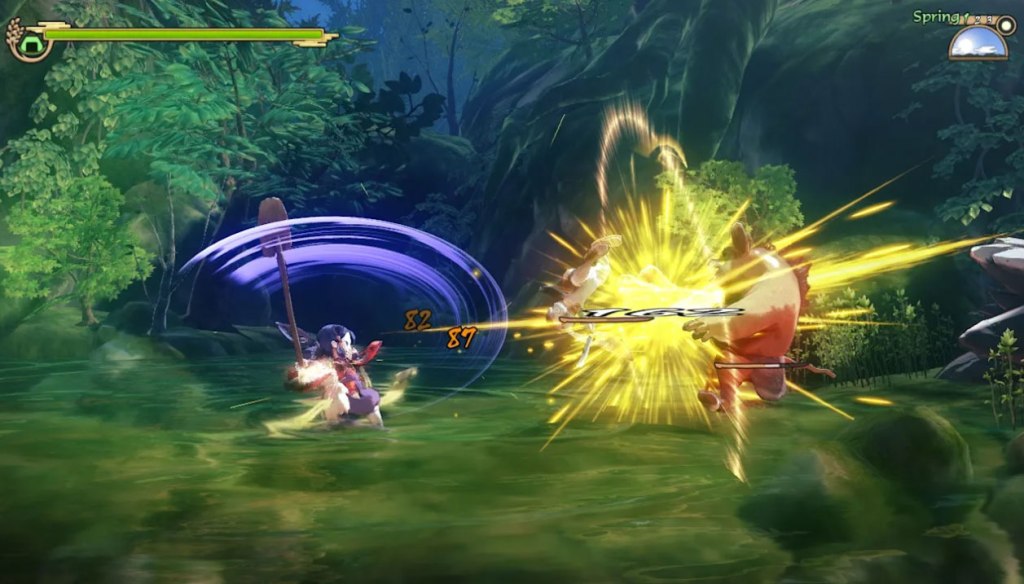
Sakuna: Of Rice and Ruin, released on PC, PlayStation 4, and Nintendo Switch in 2020, is a game that combines two very different elements. On the one hand, you have an Action-Platformer with some Action-RPG elements, where players fight through numerous self-contained levels full of animalistic demons. On the other hand, you have a surprisingly realistic traditional rice-farming Simulation. Despite that these two gameplay styles seem to have very little to do with one another, here they work in tandem and players will have to get some degree of skill with both to progress.
It isn’t just the gameplay that’s split into two different styles here, but also the presentation. While the entire game is rendered in 3D, the gameplay in Action-Platformer sections of the game is entirely in 2D, while the Simulation elements of the game are fully 3D, with the ability to freely move the camera. Both styles of play have somewhat cartoonish-looking characters with exaggerated features and very slight cel shading, resulting in a look that does a decent enough job conveying the characters’ personalities. And as for the locales, while the Action-Platforming sections look decent, it’s really the Simulation portion of the game that really stands out, and that’s thanks largely to the rice field itself.
Simply put, I don’t think that rice fields have ever been so lovingly rendered in a videogame before. It’s not exactly the sort of thing one tends to look for in a videogame, but here it’s hard not to notice it – the way the dirt deforms based on where and how well you till it, the way you can tell if the soil is damp by seeing how muddy it looks, the way small islands of this mud shrink as you fill the field with water, the way the water reflects the sunlight, subtly moves as you fill or empty the field, and its volatile look as rain splashes in it.
Ah, that’s another element of this game’s presentation – the passing of time is apparent not only in the look of your rice paddy and its surrounding farm, but also in all of the game’s levels, which change appearance based on the season and time of day. It’s a nice touch that helps everything in this game to feel even more interconnected.
This is backed by a traditional Japanese-inspired soundtrack that’s decent if a bit repetitive, as well as English voice acting for the characters that’s… well, suffice it to say I found it irritating. It doesn’t help that the game’s titular protagonist is a spoiled brat, and the supporting cast consists of a lazy oaf, an abrasive brat of a teenager, a “foreigner” (though it’s unclear where from) with stilted English, a loud baby, and… a prepubescent girl, perhaps the only one in the whole group that doesn’t grate on my nerves.
The story here is that a small group of humans, escaping war and famine, is crossing a mythical bridge to the spirit world, where the spirits are gathering for a celebration. One of those spirits, Sakuna, gets into a scuffle with the humans that results in a temple to the supreme goddess becoming set ablaze, resulting in the entire group being banished to an island of demons where they are tasked with fighting off the monsters and finding the source of their incursion onto the island. As this is no small task, the group settles in for the long haul, deciding to cultivate rice in the abandoned farm of Sakuna’s parents.
I have heard this game’s rice farming elements compared to the likes of Harvest Moon and Stardew Valley, and I think this comparison misses the mark by a fair margin. Where Stardew Valley is a “Farming RPG”, Sakuna’s rice farming is much closer to an actual Simulation, with players needing to attend to each step in the process, to the point where this game could almost act as a how-to guide for those wondering how to grow their own rice in real life. Players will plow the field, sort out the seeds, row the seeds into seedlings, plant each individual seedling, space them appropriately, attend to the water levels which need to be higher or lower depending on what part of the process the rice is in, must age the fertilizer before using it, pick weeds, remove insects, harvest the rice, dry it, thresh and hull the rice…
If you’re like most people, this will all seem like getting into the minutiae of a very dry and somewhat foreign concept. I certainly know that I personally have never been very interested in the process of traditional rice harvesting. And getting into such detail in this process seems from a distance to be the sort of thing that will be extremely fascinating for a very very small minority of players. However, Sakuna manages to make it interesting for those of us who aren’t enthralled by antiquated agrarian processes by making this process easy to understand, and by using this as a way to explore not just the mechanics of rice farming but also the culture, from a ground-up point of view, looking at elements such as the importance of rice farming songs and the very frightening prospect of a poor harvest making one choose between skimping on meals now or potential starvation later.
Of course, the other way gamers are made to be interested in this process is how it ties back into the Action-Platformer gameplay by making your character progression based partly on the quality of your rice harvest, with a good harvest increasing your stats, and your day-to-day meal intake giving you temporary bonuses that are vital to surviving the battles you’ll face to collect resources needed at home.
You might think that with all of this focus on the Simulation elements of the game, that these Action-Platformer elements would be an after-thought, but quite the contrary, clearly a lot of thought went into this half of the game too. Players will not only customize their character using upgrades from meals and harvests, but also equipment crafted from resources you find, various special moves unlocked by meeting various criteria, and players even gain bonuses by exploring more of the game’s levels.
The actual mechanics of traversal and combat are quite clever here too, thanks to the use of Sakuna’s magical raiment, a cloth scarf that acts as a grappling hook. This not only makes for some fun traversal and exploration, but it adds an extra element to the game’s combo-focused combat, allowing players to instantly fling themselves behind an enemy or latch onto them for a special attack.
While this combat system is mostly fantastic, it does also make for one of the game’s bigger flaws, as Sakuna can get “locked in” to facing a direction, making it difficult to attack behind her. This can be especially frustrating when a combo has her flinging herself into the air, only to discover that you’ve gone past your target, or quickly getting behind your opponent, only for them to turn around faster than you do – something you intended to get the drop on an enemy can all too easily help them to get the drop on you.
Another flaw here comes from the game’s Simulation elements. Yes, I think it’s quite a feat that this game goes into such detail in how everything works, and then ties it back to the other elements of gameplay. But while it may be realistic to depict rice farming as extremely labor-intensive work, that doesn’t necessarily translate into fun. Just because rice farming is grueling and tedious doesn’t mean a videogame about the process has to be. And here I suppose I should mention that this game does give players the option to let the supporting cast do this work for you, it also discourages the player from doing so, warning that you’ll get worse results than if you handle it yourself.
On balance, I think Sakuna: Of Rice and Ruin does a marvelous job of taking a very dry, very niche topic matter and turning it into something fascinating and compelling. What this game does well, it does extremely well, and the amount of passion that has gone into taking this topic and making it a fun and integral part of this game’s experience. That’s not the only part of this game that shines either, and the Action-Platforming elements provide a lot of good elements too. It’s not without some flaws that detract from the experience, but on the whole I think that if you like Action-Platformers, Action-RPGs, and farming Simulation-style games, this is a combination of those elements that works surprisingly well, and is well worth a look.
tl;dr – Sakuna: Of Rice and Ruin is a game that combines Action-Platformer, Action-RPG, and farming Simulation elements into a really unique game that does all of those things well. Of particular note is the game’s rice farming Simulation elements, which are lovingly crafted and do a great job of making this niche topic relevant, fun, and beautiful. This game certainly has its rough spots – the combat is mostly good but has moments of frustration, and the simulation can get a bit tedious. However, this is overall a unique exploration of its respective genres and well worth playing for fans of those genres.
Grade: B+
You can support eShopperReviews on Patreon! Please click HERE to become a Sponsor!
This month’s sponsors are u/punkgeek, Andy Miller, u/wonderponder, Johannes, Eli Goodman Ilya Zverev, and Stov. Thank you for helping to keep the reviews coming!
 eShopperReviews
Leave a comment