
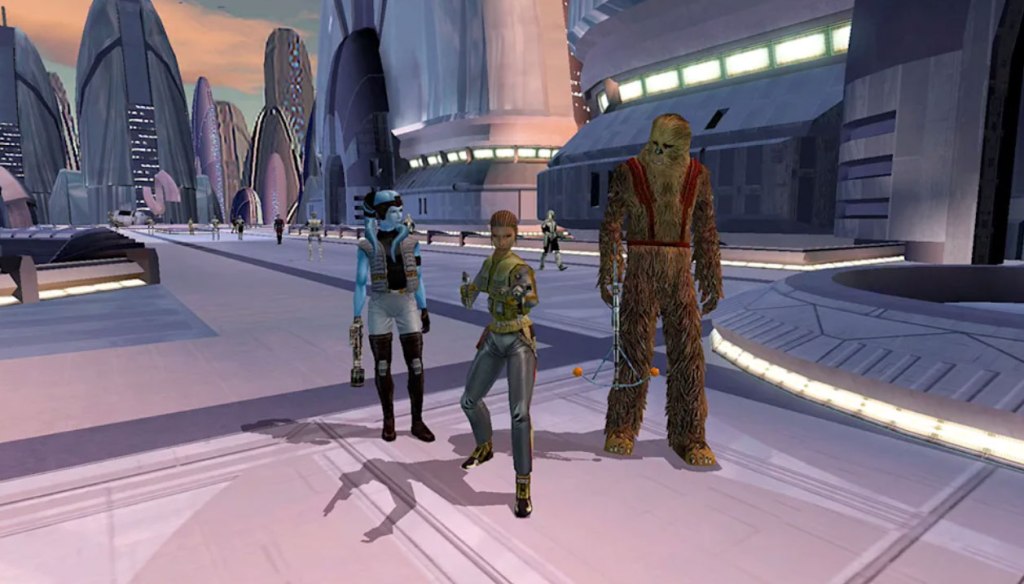
Star Wars: Knights of the Old Republic
Genre: RPG
Players: 1
.
Review:
(Note: There are multiple Star Wars bundles on Nintendo Switch. If you want a breakdown of which bundles contain which games, please check this page.)
Star Wars: Knights of the Old Republic is a game that comes with a sizable reputation for being not only one of the best Star Wars games ever made, but one of the best RPGs ever made as well. The game was originally released on PC and the original Xbox in 2003, and later in 2013 ported to iOS and then to Android devices in 2014. However, it is only very recently that this game has finally been brought to non-Microsoft consoles, with a remake of the game announced for PlayStation 5 to be released at some point in the future (no date known yet as of this writing), and a visually-updated port of the original game making it to the Nintendo Switch in 2021 that includes the Yavin expansion content that was in the PC version and added post-launch to the Xbox version of the game.
Being nearly two decades old, one would expect this game to have aged somewhat, and it definitely looks dated in some respects, but in others it has held up reasonably well, in part thanks to an excellent port. The framerates and resolutions have both gotten an upgrade here, making this a much smoother and cleaner-looking game. However, the low-poly 3D character models, sparse environments, clunky animation, and low-resolution textures definitely mark this as an older game. This is possibly the best that Knights of the Old Republic has ever looked, but it’s still polishing a very dated visual presentation.
The sound here fares much better. Not only do you have an excellent soundtrack from Jeremy Soule that does a good job building something unique that still fits with John Williams’ film scores, but every character in the game is fully-voiced. Some of the dialogue does seem a bit stiff and unnatural, but I suppose it’s generally not quite as awkward as what was in the Star Wars prequel films. Also, I should note that if you’re getting the digital version of the game, all that music and voicework comes at a cost, making this game take up nearly 12GB of space on your memory card.
For those who missed out on earlier releases of the games, Knights of the Old Republic takes place thousands of years before any of the films, before Anakin and Luke Skywalker’s stories, before the Galactic Empire… while players will see familiar races and locations, both the characters and the struggle for power in the galaxy are completely removed from anything set outside of the Knights of the Old Republic series.
The game is set in a time when the villainous Darth Malak and his former master Darth Revan have nearly demolished the forces of the Jedi prior to Revan’s defeat at the hands of Jedi Bastila Shan. However, Malak has taken up his master’s mantle and has continued hunting down the last remnants of the Jedi. Players take the role of a player-created character waking up on Bastila’s ship as it comes under attack by Malak’s forces. Barely escaping the ship’s destruction and landing on a nearby planet, the player must ally themselves with various characters as they seek to rejoin Bastila and find a way to covertly escape the planet and then scour the galaxy to find a way to turn the tables in the war.
One of Knights of the Old Republic’s most highly-touted features is its light side/dark side system. Throughout the game, players will often have multiple options in conversations, as well as different ways to solve problems they face. Their choices will sometimes net them “light side points” for benevolent actions and “dark side points” for selfish or malicious actions. Players of developer Bioware’s later series Mass Effect will undoubtedly recognize this as the precursor to that franchise’s Paragon/Renegade system, and while this system’s binary nature may seem a bit simple compared to more elaborate branching story paths in some modern RPGs, it still allows players some leeway in deciding how to tackle the game’s challenges, and how to influence the story.
Combat here is a bit clunky, with battles appearing to nominally take place in real-time, but the game makes it clear that everything is being dictated by “turns”, “dice rolls” and “saving rolls” in the background, much as you would find in a tabletop game like Dungeons and Dragons. Players can even opt to go into the settings menus to have the game automatically pause for each turn to strip away some of the real-time artifice, although even without doing so players are free to pause the action at any time to issue commands.
Honestly, I wish the combat here would have just picked a lane – the real-time presentation is made frustrating by characters frequently missing what should have been easy hits due to missed dice rolls. On the other hand, changing all of the settings to pause combat as often as possible still doesn’t give players a great turn-based experience as other characters in your party will automatically act on their own after you take action, whether you want them to or not. Also, trying to judge your choices in combat is harder when you only have icons without descriptions of what abilities do, something you have to consult pause menu screens to read into.
There are other areas where the gameplay has aged poorly. Locations in the game are fairly restrictive, with players feeling like they’re stuck in a series of corridors rather than large planets and sprawling cities. At times it’s not clear where to go to move forward a mission or side-quest, as the game doesn’t provide any kind of quest markers for progress, quest descriptions are often vague, and the game’s dialogue tracker only goes so far back before it cuts off, meaning that you’ll often be required to remember details from possibly hours earlier when you might not have had a proper context for those details.
The controls here are sufficient, but feel just a bit awkward and take some getting used to. The game doesn’t make use of the Nintendo Switch’s touchscreen or motion controls, either. I also wish the game allowed more control over the camera, which doesn’t allow for vertical movement. None of this is particularly terrible, but it’s still a tad frustrating.
Suffice it to say, this game has various issues, many of which are easier to see after nearly two decades of hindsight and evolution within the genre. However, despite this, it still remains an excellent and engaging experience. Not only is Knights of the Old Republic giving players a chance to explore a previously-unknown time period within the Star Wars universe, but it does an excellent job of world-building, with major and minor characters in the game’s various locales having plenty of personality and contributing to a feeling that you really are taking part in an adventure in a massive and intricate universe, even if you are only seeing a small part of it.
All things considered, Star Wars: Knights of the Old Republic has definitely aged somewhat in the years since its original release, and many of those cracks are showing here. However, it still shines bright as a superb RPG and an excellent use of the Star Wars license. Players will have to tolerate some clunky and dated design to enjoy it, but it’s still well worth a look even after all these years, especially for fans of Star Wars and RPGs.
tl;dr – Star Wars: Knights of the Old Republic is a solid port of the classic RPG. Both the graphics and the gameplay have aged poorly in some areas, but much of what made this game great nearly two decades ago still remains intact. While it’s far from perfect, this is still a superb RPG and a great exploration of the Star Wars universe.
Grade: B
You can support eShopperReviews on Patreon! Please click HERE to become a Sponsor!
This month’s sponsors are MB, Andy Miller, Johannes, u/RamboFox, Exlene, Eli Goodman, Ilya Zverev, Stov, Connor Armstrong, and K.H. Thank you for helping to keep the reviews coming!
 eShopperReviews
Leave a comment