
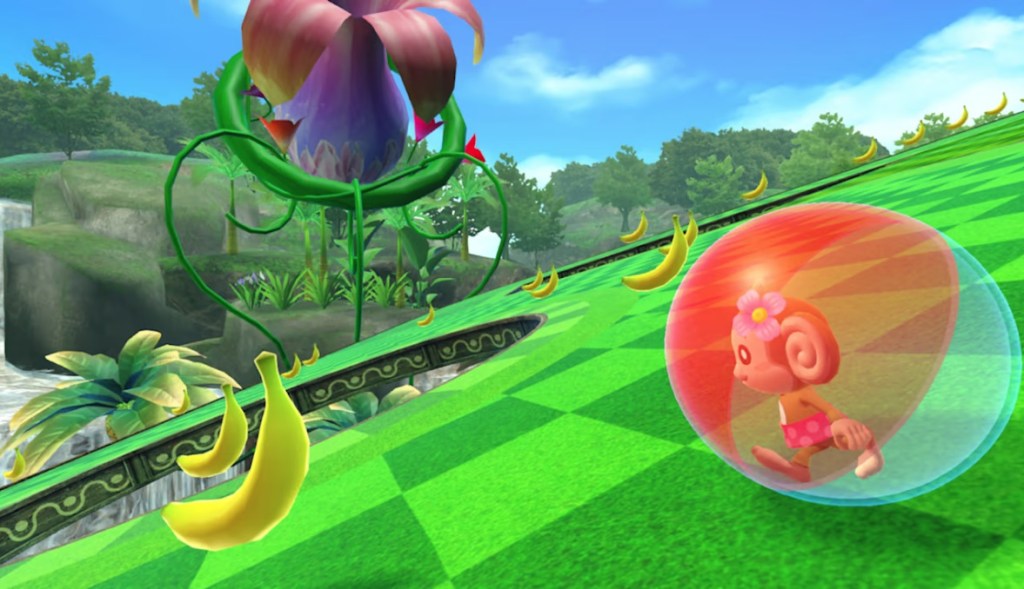
Super Monkey Ball Banana Mania
Genre: Compilation / Arcade / Party game
Players: 1-4 Competitive (Local, Local Split-Screen, Local Alternating), Online Leaderboards
.
Review:
The Monkey Ball franchise has a pretty strongly-opinionated fanbase, but for modern gamers it may not be quite clear why that is, exactly. Banana Mania marks the series’ 20th entry by Wikipedia’s count, yet without fail this series has been met with disdain and disappointment by both critics and fans for over a decade and a half. For someone new to this franchise, I don’t doubt that the passion for this series would seem inexplicable, not just due to the lack of quality releases in the franchise, but why did people get so interested in it in the first place? After all, on the surface, this would just seem to be a childish, cartoony game about rolling balls around with monkeys in them.
.
Getting the Ball Rolling
The original Monkey Ball, released in 2001, was an Arcade game which players controlled using a joystick shaped like a banana. It was an exercise in pure skill, challenging players to navigate obstacle courses with their ball, trying to reach each stage’s exit before time ran out, without falling off the stage’s sides. A part of the game’s core concept was that players weren’t really moving the ball-encased monkey itself, but rather tilting the entire stage, much as you would tilt a real-life marble puzzle.
While a Sega Dreamcast port of Monkey Ball was likely planned, the untimely death of the Dreamcast and Sega’s departure from the hardware side of the videogame industry meant that a home console port would have to go to one of Sega’s former competitors, and the decision was made to bring the game to the Nintendo GameCube as a launch title, making history as Sega’s first videogame on a Nintendo console.
While this represented a massive shift in the industry, many undoubtedly found the choice of the game for this groundbreaking moment to be somewhat odd, since this was a new and largely untested franchise, one without an established audience. Surely Sega would want to start off this new venture on the right foot with their beloved Sonic the Hedgehog franchise and not some childish monkey game?
.
Not Monkeying Around
Touting improved features including a variety of 4-player minigames, the GameCube version of Monkey Ball released in 2001 under the title of Super Monkey Ball. It was one of only three games released for the Japanese launch of the GameCube, and one of twelve games in the GameCube’s US launch. At the time, the GameCube launch was seen by many as a disappointment, being the first Nintendo console to launch without a proper Mario title. However, I think it would be fair to say that its launch lineup has aged fairly well – it included Luigi’s Mansion, Wave Race: Blue Storm, Star Wars: Rogue Leader, and even some decent ports of Tony Hawk’s Pro Skater 3 and the EA Sports lineup (yes, EA used to have decent support for a Nintendo console). Still, without any one headliner title grabbing all the attention, there were undoubtedly plenty of gamers willing to experiment with the selection of games available.
It was here, far more than the initial arcade launch of the game, that most gamers discovered the Super Monkey Ball franchise. Players were delighted by its simple colorful 3D visuals with smooth 60FPS framerates, its responsive controls, challenging physics-based gameplay with wonderful level design, and its outstanding selection of 4-player Party games. Despite the death of the Dreamcast, there’s an argument to be made that Super Monkey Ball still managed to be released on hardware that was perfect for the game, with the old-school Arcade-style roots and family-friendly presentation of the game appealing to Nintendo’s fanbase, and with the multiplayer-friendly console the perfect host for its new 4-player game modes.
.
Monkey See, Monkey Do
One year later in 2002, the game received a sequel on the GameCube that was seen as an excellent follow-up to the first game. Super Monkey Ball 2 kept much of what worked in the first game, but added plenty of new levels, new stage mechanics like switches, and a mix of party games from the first game as well as all-new ones.
This would also mark the last original game in the series from developer Amusement Vision, who would go on to develop the phenomenal F-Zero AX and F-Zero GX for Nintendo in 2003, and then would subsequently have their staff combined with Smilebit (best known for Jet Set Radio and the Panzer Dragoon series), eventually morphing into Ryu Ga Gotoku Studio, best known these days as the developer of the Yakuza franchise.
However, the Super Monkey Ball franchise continued on without Amusement Vision. New games in the series would be bounced around from developer to developer, sometimes handled by Sega internally, sometimes by an external developer. Initially, these games took the form of ports of the first two games, with varying levels of success.
In late 2002, Super Monkey Ball Jr. on the Game Boy Advance would do a mostly serviceable job of bringing the first game in the series to Nintendo’s handheld despite the system’s underwhelming 3D capabilities and lack of analog controls. The first game also got a port to the Nokia N-Gage and… well, let’s just move on, shall we?
In 2005, the content from first two Super Monkey Ball games would be packed together and re-released on the PlayStation 2 and the original Xbox in the form of Super Monkey Ball Deluxe, which would add a few more stages, as well as restoring some stages that were cut from the prior games. Some complained that the PlayStation 2 version of the game in particular suffered from load times and slowdown, but overall this release was seen as a great, comprehensive collection of the series up until that point.
After this, new entries would be quick to try to keep the series relevant by adding new gimmicks. 2005’s Super Monkey Ball: Touch and Roll on the Nintendo DS tried to compensate for the lack of analog control by adding touchscreen support. 2006’s Super Monkey Ball Adventure aimed to focus on the story, with players moving through a world that resembled something more like a traditional 3D platformer, with the Arcade-style levels taking a back-seat. Later in 2006, Banana Blitz on the Wii would bring motion control to the series, as well as boss fights and, controversially, a jump button.
Increasingly, this was a series that appeared to have its best days long behind it. So much of what made the first two games in the series great had been lost in these sequels – the fast-paced arcade-style gameplay, the focus on challenging physics, the precision controls. Sega and the developers they enlisted to keep this series alive seemed to have forgotten what made people fall in love with it in the first place. Fans longed for a return to the glory days of the series’ first two games, yet when the series made its return in 2019 after a 5-year hiatus, it was with a remake… of Super Monkey Ball: Banana Blitz.
As if to signal that they had no clue what to do with this series, Sega asked fans on their Japanese Twitter account what they’d like to see from this series. A remake of the first two games? Perhaps remakes of the 3DS and Vita entries in the series? Or how about a remake of Super Monkey Ball Adventure? Still, despite that the two most popular responses by far were either a remake of the first two games or an entirely new entry in the series (presumably one that would abandon the gimmicks the series kept trying to fold into the franchise), most who fell in love with this series during its glory days undoubtedly held little hope that these games would ever reclaim their former glory.
.
Well, I’ll Be a Monkey’s Uncle!
In mid-2021, Sega announced Super Monkey Ball Banana Mania, to be released a few months later. Fans of the series collectively braced for disappointment, only to find that for once, Sega had actually responded to what fans had been calling for. Developed by Ryu Ga Gotoku Studio, Banana Mania would combine together the levels from Super Monkey Ball, Super Monkey Ball 2, and Super Monkey Ball Deluxe, three games generally agreed to be the pinnacle of the series. What’s more, the visuals would be remastered, the game would include a collection of the most popular Party games in the series, and there would even be extra unlockables, including characters from other Sega franchises.
Since Super Monkey Ball Deluxe had already compiled the contents of the first two games into one package, it seems like it would almost be fair to say that this package more or less acts as a remaster of that game, although this game does distinguish between different versions of the included levels. The game’s Super Monkey Ball Deluxe content is included in a new Story Mode that has the game’s monkey characters watching a TV show where they fight a mad scientist villain and… you know, who cares? I highly doubt anyone ever played these games for the story. Suffice it to say, it’s childish and presented in a minimal fashion, and the overwhelming majority of players will likely skip it anyway. Meanwhile, the levels from Super Monkey Ball 1 and Super Monkey Ball 2 can be independently selected from a menu, allowing players to skip to the content of the game they prefer. Or, upon unlocking it, they can simply select the individual level they want to play.
The visuals in this game are faithful to the original games, which means that they’re colorful, have an excellent 60FPS framerate, but they’re also fairly simple. In fact, some of the backgrounds here really show their age in their simple appearance. I suppose I can’t fault this game for its faithful recreation of the classics contained within, but I don’t think I would have minded a little modernization in this regard. However, that’s not to say that there haven’t been any improvements – the character models look nicer here, and the textures and overall game resolution are certainly improved. However, the original game didn’t exactly blow anyone away with its visuals, and neither will this remaster. At the very least I found that this game made it delightfully quick and snappy to restart a level, something you will likely be doing time and again as you attempt the difficult challenges in the game.
The music here is all new, although players can opt to pay extra for the Anniversary Edition of the game or one of the game’s DLC packs, which contains all of the music from the original releases. This seems a little stingy, but given that the base game is $40 and the Anniversary Edition is $50, that doesn’t seem too terrible. However, while I have a soft spot for the classic music, I have to admit that the new music is pretty good too – the game’s cheerful new theme, Hello Banana!!, is really catchy (as is Hello Banana!! (Instrumental Version)). There are also some other solid new synthesized musical tracks that do a great job of fitting the classic levels while keeping the energetic tone of the game, like Volcanic Magma Stage Theme, Under the Ocean Stage Theme, Space Colony Stage Theme, Night Stage Theme, and Monkey Race Theme.
So for the most part, this game sounds great. I say “for the most part” because the character voices in this series will not be to everyone’s tastes – I could see the overly cheerful characters getting on some players’ nerves. Meanwhile, guest characters like Sonic and Tails aren’t voiced at all. And then there are odd quirks like the announcer in the Party games pronouncing the word “foul” in a way that sounds like “foal”. It’s not horrible, but it is odd and a bit distracting.
.
As Fun as a Barrel of Monkeys?
As for the gameplay, the folks at Ryu Ga Gotoku Studio have wisely made the decision to cut the difference between the classic games in the series and the new ones. Players can opt to make use of gyroscopic motion controls, and they can unlock an optional jump feature, but by default these games control more or less exactly how the originals did, with precision physics-focused control using the analog sticks. This release also cuts out the “lives” of the original game, giving players as many attempts as they need to try to beat the game’s stages.
There has been one significant change to the gameplay here, and that is the addition of camera controls using the right analog stick. Players can move the camera independent of how they move in the game, and this is… well, it’s a good addition, but it’s still extremely limited. One of the weak points in this series has always been its terrible camera, especially when players try to reverse direction, and unfortunately that still mostly remains true here.
One other nice addition to this game is the inclusion of “Missions” which have players aiming to meet certain goals within a stage, such as getting to the goal in a more limited amount of time, collecting all of the stage’s bananas, or getting to the stage’s alternate exit. Completing these missions, as well as just generally performing well in the game’s stages, gives the player points that can be spent to unlock additional levels (such as original arcade stages, and DX levels), various characters (like Sonic and Tails, Jet Set Radio’s Beat, and Yakuza’s Kazuma), customizable outfits, filters for the game’s “photo mode”, and the aforementioned “jump” feature. While it’s not a huge addition, Missions are a nice way of giving players a reason to replay levels they’ve already completed to unlock more content.
For the multiplayer Party games, this game brings back all 12 minigames that were featured in Super Monkey Ball 1, 2, and Deluxe, with all playable using 1-4 players (except Monkey Soccer and Monkey Baseball, which only support 2 players). Each game offers either a solo play mode or a mode where bots fill the empty slots for single-player play. The minigames are as follows:
| Game | Genre | # of Players | Grade |
|---|---|---|---|
| Monkey Race | Arcade Racing | 1-4 Competitive (Local) | B |
tl;drThis is actually a revised version of Monkey Race DX from Super Monkey Ball Deluxe, containing all of the courses from both Super Monkey Ball 1 & 2’s Monkey Race modes. This is a solid repurposing of the core gameplay of the series into a racing game. The only thing it really lacks is a bigger assortment of courses… and the option to turn off the frustrating bumpers. | |||
| Monkey Fight | Arcade / Party Game | 1-4 Competitive (Local) | C+ |
tl;drThis is actually a revised version of Monkey Fight DX from Super Monkey Ball Deluxe, containing all of the stages from both Super Monkey Ball 1 & 2’s Monkey Fight modes. This is a “King of the Hill”-style game where players try to knock each other out of an arena. It’s fun but somewhat chaotic. | |||
| Monkey Target | Arcade / Flight Simulation | 1-4 Competitive (Local Alternating) | C+ |
tl;drThis is actually a revised version of Monkey Target DX from Super Monkey Ball Deluxe, containing all of the stages from both Super Monkey Ball 1 & 2’s Monkey Target modes. This is a fan-favorite, but its alternating gameplay makes it a bit slow-paced for multiplayer, and the controls take some getting used to. Still a fun minigame, though. | |||
| Monkey Billiards | Sports (Pool) | 1-4 Competitive (Local Alternating) | B |
tl;drThis is actually a revised version of Monkey Billiards DX from Super Monkey Ball Deluxe, containing all of the game options from both Super Monkey Ball 1 & 2’s Monkey Billiards modes. This is actually a pretty solid game of Pool, even if it’s missing some of the more nuanced elements of the sport. | |||
| Monkey Bowling | Sports (Bowling) | 1-4 Competitive (Local Alternating) | C+ |
tl;drThis is actually a revised version of Monkey Bowling DX from Super Monkey Ball Deluxe, containing all of the game options from both Super Monkey Ball 1 & 2’s Monkey Bowling modes. This is a decent version of Bowling, though an extremely arcadey one. | |||
| Monkey Golf | Sports (Golf) / Sports (Mini-Golf) | 1-4 Competitive (Local Alternating) | C+ |
tl;drThis is actually a revised version of Monkey Golf DX from Super Monkey Ball Deluxe, containing all of the game modes from both Super Monkey Ball 1 & 2’s Monkey Golf modes (i.e. both Golf and Mini-Golf). The Mini-Golf mode is a fun, arcadey version of the Sport, but regular Golf feels like it could have used some additional refinement. | |||
| Monkey Boat | Arcade Racing | 1-4 Competitive (Local Split-Screen) | C+ |
tl;drThis minigame, first introduced in Super Monkey Ball 2, has players racing in boats. It’s decent, if a bit simple, and it unfortunately only has three courses. | |||
| Monkey Shot | Arcade / First-Person Shooter | 1-4 Co-Op / Competitive (Local) | C+ |
tl;drThis Shooting Gallery minigame, first introduced in Super Monkey Ball 2, is pretty good… except it only has 3 levels. | |||
| Monkey Dogfight | Arcade / Flight Combat Sim | 1-4 Co-Op / Competitive (Local Split-Screen) | C+ |
tl;drThis Flight Combat minigame, first introduced in Super Monkey Ball 2, is pretty simple but surprisingly fun… except it only has 3 levels. Also, it really feels like there could have been better air maneuverability. | |||
| Monkey Soccer | Sports (Soccer) | 1-2 Competitive (Local Split-Screen) | D |
tl;drThis Soccer minigame, first introduced in Super Monkey Ball 2, controls very strangely, with some pretty dumb AI players. | |||
| Monkey Baseball | Arcade / Sports (Baseball) | 1-2 Competitive (Local Split-Screen) | B- |
tl;drThis Baseball minigame, first introduced in Super Monkey Ball 2, plays sorta’ like a toy version of the Sport. It’s extremely simple, but it’s still fun. | |||
| Monkey Tennis | Sports (Tennis) | 1-4 Competitive (Local) | B- |
tl;drThis Tennis minigame, first introduced in Super Monkey Ball 2, is surprisingly deep, although it can take some time getting used to its mechanics. | |||
In short, none of the minigames is truly spectacular, but all of the minigames (with the exception of Monkey Soccer) are reasonably fun and worth playing. Throughout all of them, the biggest flaw is a lack of content – it would have been amazing if these classic minigames were all brought back with even more content, but I suppose we can at least be grateful that they’re all here.
In the end, Super Monkey Ball Banana Mania is exactly what fans have been asking for for over a decade – a well-made remaster of the first two games in the series, with the extra content from Super Monkey Ball Deluxe thrown in for good measure, along with a few extra bells and whistles as well. This isn’t a transformative game, it doesn’t do anything to greatly expand on the content that was in the original releases of these games. However, it manages to succeed in doing something this series hasn’t accomplished in sixteen years – it has recaptured what was great about this series in the first place.
tl;dr – Super Monkey Ball Banana Mania is an Arcade-style game that compiles all of the content of Super Monkey Ball 1, 2, and Deluxe into one cohesive package with remastered visuals, a new soundtrack, new features, and all of the great multiplayer Party games that were in the original releases. It doesn’t do anything especially new or transformative, but it does an excellent job of recapturing the magic that made people fall in love with this series in the first place two decades ago.
Grade: B+
.
This game has been nominated for one or more of eShopperReviews 2021 Game Awards:
Runner-Up – Best Port/Remake, Best Compilation/Collection, Best Multiplayer, Most Underrated, Best Music, Best Song (Main Theme – Hello Banana!! by Banana Fritters), Best Arcade/Party Game
.
You can support eShopperReviews on Patreon! Please click HERE to become a Sponsor!
This month’s sponsors are MB, Andy Miller, Johannes, u/RamboFox, Exlene, Eli Goodman, Ilya Zverev, and Stov. Thank you for helping to keep the reviews coming!
 eShopperReviews
Leave a comment