
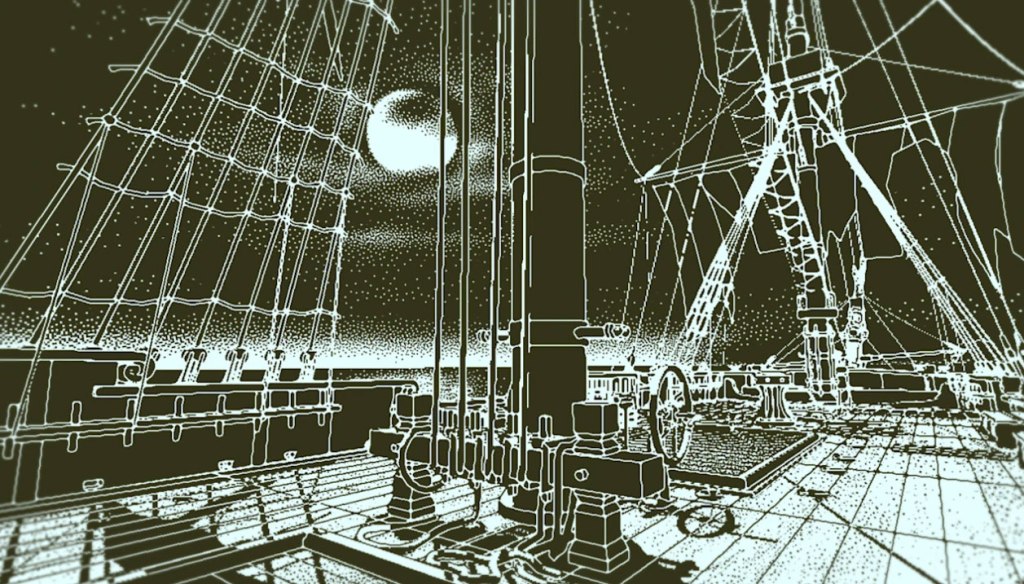
Return of the Obra Dinn
Genre: First-Person Graphic Adventure
Players: 1
.
Review:
Return of the Obra Dinn is a Graphic Adventure released on PC in 2018 and ported to multiple platforms including Nintendo Switch in 2019. Players board the titular naval ship adrift at sea tasked with investigating its remains, and must account for each of its crew and passengers on-board – where their body is, how they died, and who or what killed them. And while that may seem straightforward, just about everything else about this game is wildly unique and original.
This starts with the presentation, which has 3D visuals with an extremely high-contrast, low-fi “1-bit” monochrome look designed to mimic old two-tone computer screens (if you picture trying to play a 3D game on the original black and green Game Boy’s screen, you have a rough idea). This highly-stylized look is extremely unique, and is made more extraordinary in that throughout the game, players are invited to explore the instant of death of each of its crew, walking around while everything around you is frozen in time, pixels stuck in mid-air showing exactly where every mote of dust and drop of rain was at the moment this particular crewman died. Setting up the visuals this way enabled the game’s developers to bypass what would otherwise be technically unimpressive visuals to deliver some truly stunning vignettes where everything is alive with action around you while staying perfectly still.
These fascinating visuals are further enhanced by some truly excellent voice acting and sound work, with the cast of 60 characters superbly well-voiced and well-written, really lending to the feel of authenticity of the ship you’re exploring. This game has some of the best voice acting I’ve encountered this generation, and it’s a delight to hear each new scene unfold. Especially impressive is the way the ship depicts the multi-lingual crew, even going as far as to give different accents to characters of different nationalities – with this itself intended to be a clue for players to pick up on in their investigations.
Also, I can’t talk about the presentation without mentioning this game’s excellent story, one that makes use of a lot of the tropes common to its naval setting while still seeming fresh, intriguing, and outright thrilling – viewing a cursed voyage through the lens of each man’s death is in itself a truly excellent way to ratchet up the tension, and combining this with the amazing sound and voice acting really gives you a great feel of being in the moment during some truly thrilling encounters, all while allowing players to take the game at their own pace without their own character being in any immediate danger.
Overall, when it comes to the presentation, I am absolutely delighted with Return of the Obra Dinn, and only have two complaints – firstly, the low-fidelity visuals can at times interfere a bit with the gameplay, making it difficult to discern details. It’s never enough to be game-breaking, but there were times when I couldn’t see what was going on up-close in a struggle or make out figures at a distance and had to do a little guesswork to fill in details. And secondly… I do not care for this game’s soundtrack, which doesn’t always seem to fit the tense and dramatic themes of the events being depicted, and occasionally even gets a bit annoying.
If it were just the visuals that were unique here, that alone would set this game apart, but Obra Dinn does some extremely clever things with its gameplay that make it one of the best detective games I have ever played, if not the best outright. First, let’s start with the game’s clever gameplay hook – the pocket watch. This is the device that allows players to basically “scan” a nearby corpse to view the instant of death in a small radius around it. This turns out to be directly helpful in multiple ways – not only can players use it to get an idea of how someone died, but usually there’s a lot going on around them that can provide further information not only about their death, but learn about the others on the ship, as well as getting a better feel for the overall story of just what happened to the Obra Dinn.
However, the game is clever about this in other ways too – see, the pocket watch can also be used inside these visions of the past, meaning that if there’s another corpse present where this person died, you can piggyback off of one to see the other. In this way, the game can help control the flow of information to the player, and often this works to ensure that players see the events of each of the game’s “chapters” in roughly reverse order – you’ll find the most recent corpse, then see the one prior to that, and so on until you’ve seen every death in a series leading back to the first for each event. You can, for example, see a man get killed in one, then in the next one see him crawling to his final resting place, wounded, then later on see where he was first injured. There are other clever ways the pocket watch works too, but I won’t spoil that for you.
However, probably the most clever trick the gameplay here pulls is how the detective work here actually, well, works. Sometimes characters will use a name or title and you’ll be able to assign that name to its recipient, but other times you need to be very observant to try to track down these details to identify each person on the ship. Where are they on the ship? Who do they associate with? What are they wearing? Did someone else say something to them or about them that could reveal who they are? Sometimes you’ll need to deduce things using the map, or the manifest. Often one of your best tools will be a process of elimination.
This game is also extremely smart about how players can guess at this information – the game only reveals correct answers in sets of three, and only if you get all of the details about them correct, meaning that you actually need to figure things out rather than brute-forcing them… however, there’s no penalty for wrong guesses, and sometimes you’ll want to make a few guesses once you’ve narrowed things down to a few possibilities. For example, for two crewmates, I knew how both died and who killed them, and I knew the two were brothers, and had narrowed it down to two men with the same last name… but I didn’t know which was which, so I tried plugging the names into their portraits one way before flipping it and trying it the other way around, with the latter combining with a third correctly-identified body to reveal my deductions were correct.
As impressive as the game’s striking visuals and frozen-time mechanics are, it is this surprisingly good balance between deduction and guesswork that I found to be really impressive. Most Graphic Adventure games struggle with this balance – if you make puzzles too easy, there’s no sense of accomplishment, and if you make them too hard it’s easy for players to get frustrated… and adding in a “hint” system just feels like the game enticing you to skip over gameplay so you don’t get stuck. By making players truly deduce the majority of what’s going on, but allowing for a little guesswork, this game has some of the most balanced gameplay this genre has ever seen.
Of course, it’s not all perfect. Even beyond the sub-par music and the occasional frustration caused by the low-fidelity graphics, the walk speed is a tad too slow for my tastes. Also, there’s no touchscreen interaction, which seems like it would have been nice for this game. In addition, deducing the identities of some of the crew is surprisingly difficult and requires a lot of watching and rewatching various scenarios, to the point where you will have seen the full story play out countless times out of order long before you’re done actually solving all of the game’s puzzles.
What’s more, there’s no easy shortcut to watch any specific scene – to watch a scene, you need to walk over to wherever its associated body is first. A few scenes can only be accessed within other scenes too, making them even more inconvenient. Heck, it would have been nice to be able to play scenes from within the journal you record them in, or even to watch all discovered scenes in chronological order. Unfortunately, players are forced to put in the tedious legwork of walking back and forth over the ship if they want to do this, looking up the locations of bodies if they forget which one is associated with which chapter.
While this can be annoying, and makes the latter part of the game drag a bit, I was overall absolutely thrilled with Return of the Obra Dinn, and found myself glued to the game for its entire ten hour runtime, eager to find each body, catalog each interaction, and discern all of the ship’s secrets. The story is so thrilling, the gameplay so wonderful, and the overall presentation so compelling that even when the game’s flaws started to wear on me a bit, I found myself unable to put the controller down until I had unearthed every last secret it had to offer me. If you’re a fan of Graphic Adventure games, or looking for a really good detective game, you need to play Return of the Obra Dinn. This is a game that other games in the genre need to learn from, and even with its flaws I would still consider it to be one of the greatest games the genre has ever produced. Do not miss it.
tl;dr – Return of the Obra Dinn is a Graphic Adventure that has players using a magical pocket watch to investigate the deaths on a doomed ship at sea to try and match each of the bodies with their proper identities, cause of death, and killer. The presentation here is phenomenal and unique, the gameplay is absolutely inspired and cleverly balanced, and the story being told is truly thrilling. There are a few inconveniences that make the end drag on a bit, but overall this is an outstanding title that’s one of the finest games I have played in this genre, and a must-have for anyone looking for a truly great detective game.
Grade: A-
You can support eShopperReviews on Patreon! Please click HERE to become a Sponsor!
 eShopperReviews
Leave a comment