
Metroid Prime Remastered
Genre: First-Person Shooter / Metroidvania
Players: 1
.
Review:
Metroid Prime first released in 2002 on the Nintendo GameCube, taking a series known for being strictly 2D Metroidvania games and bringing it into First-Person in full 3D, all while keeping the series’ Metroidvania structure. I don’t think it is any great exaggeration to say that the results were a massive success – still to this day Metacritic lists this game as being one of the top 20 highest-rated games of all time.
In 2009, the game was included in Metroid Prime Trilogy on the Wii, packing it together with Metroid Prime 2: Echoes and Metroid Prime 3: Corruption, and updating the controls to make use of the Wii remote’s motion control capabilities, enabling players to use motion control for precision aiming. This Compilation was notoriously produced in small numbers, and skyrocketed in price on the secondhand market, but Nintendo later made this trilogy available on the Wii U Virtual Console (which you can still get if you have a Wii U… at least until the Wii U eShop closes next month).
Then, in 2017, shortly after the Nintendo Switch was released, Nintendo announced that Metroid Prime 4 was in development, an announcement that was met with much fan applause. Well… it is now nearly six years later and Metroid Prime 4 has clearly gone through development hell, having to be completely restarted from scratch at one point and handed over to a different developer (the original developer, Retro Studios), and as of this writing we have yet to even see a single screenshot of the game.
It is during this uneasy period of waiting that many speculated that Nintendo could port over Metroid Prime Trilogy to Nintendo Switch to fill the long wait Metroid fans have had to endure. Eventually, these rumors transformed into rumors that the Metroid Prime Trilogy was getting a full remake, and then that there would be a remake, but just of the first Metroid Prime. Fans were undoubtedly disheartened at this apparent downgrade, but at least it would be something… only none of it was ever confirmed by Nintendo. Since restarting development on Metroid Prime 4, Nintendo has said barely a peep about the Metroid Prime games, and fans were left to wonder if these rumors were yet more false hope.
Then suddenly, to the surprise of everyone, Nintendo not only announced and showed off Metroid Prime Remaster in the February 2023 Nintendo Direct, but they released the game on the same day, much to the shock and delight of fans (and right after finding out that both Metroid II: The Return of Samus and Metroid Fusion were both headed to Nintendo Switch Online, no less!).
So… for those who wanted a great remaster of this classic game, does it live up to those hopes? And for those who never played the original game, does it still live up to its reputation?
.
ReMAKEster
Firstly, I’ll say that calling this game a “remaster” is doing it a terrible disservice, as this game clearly had far more work put into it than updating the resolution and calling it a day. To be clear, the framerates still run at an unflinching 60FPS, and the resolution has now been increased dramatically from 480p on GameCube to 900p in docked mode and 612p in handheld mode in this release (thanks to ElAnalistaDeBits for the numbers), however, this is only a small part of the story.
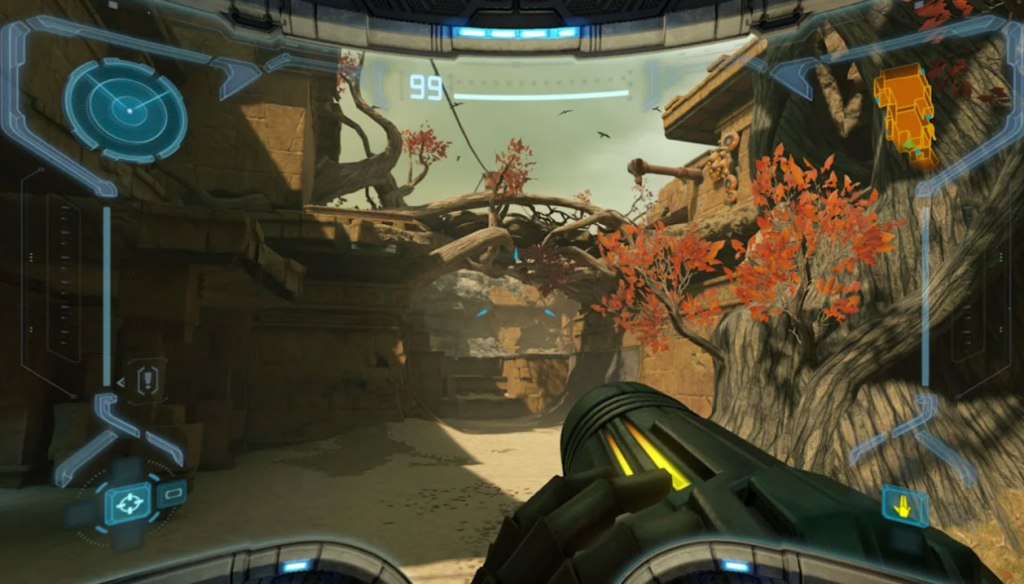
Textures have been updated to take advantage of the new higher resolution, even little things like the texture of water vapor spraying on your helmet and the static in the electrical shields on windows. However, even more surprising, the 3D models for a lot of the game have been remade with much greater detail. Even right from the start when your ship first approaches the frigate Orpheon in the opening, the change is immediately noticeable, and you’ll see more changes throughout the game. There are also new effects, like fires burning on the frigate where none existed before, a nice touch.
All of this is on top of the wonderful visual splendor that was already present in the game, the great attention to detail, the excellent lighting… Metroid Prime was without a doubt one of the best-looking games on the GameCube, and it visually holds up as a game that looks right at home on the Nintendo Switch today.
This is not to say that the game is graphically immaculate. In grassy areas, the detail in the grass is lacking, larger enemies noticeably fade away quickly after you shoot them down, and smaller enemies disappear entirely without so much as an explosion or pop of goo to transition between them being there and not being there. I noticed a little pop-in of environmental elements like grass, and a bit of aliasing (but not enough of either to be too distracting). Also, there are a few minor stylistic changes which may upset purists, like the halo of light surrounding the planet Tallon IV as viewed from orbit no longer being there.
In other words, if you’re looking for a full remake that brings Metroid Prime up to the graphical standards of some of the best games of the current generation, you’ll probably be disappointed. However, if you were just expecting a minor update to the visuals, you are likely to be blown away by just how much work was done here.
.
ReMaster Control
Of course, the next thing people are likely to wonder about is just how this remaster of Metroid Prime handles the controls. Are they like the original game on GameCube, with its unorthodox control scheme built mostly around the left analog stick? Is it based on the Metroid Prime Trilogy version’s controls, allowing players to make use of gyroscopic motion control to aim? Or have they been reworked to take advantage of the Nintendo Switch’s dual analog sticks, making it closer to how modern First-Person Shooters tend to control?
The answer is: All of the above. Metroid Prime Remaster actually has four default control schemes.
The default control scheme, Dual Stick, is pretty much exactly what you expect from modern First-Person Shooters, but with the added benefit of Metroid Prime’s lock-on mechanic. This control scheme works extraordinarily well, and feels so natural it makes the game seem like it was made with this controls scheme in mind to begin with.
Classic control scheme is for purists who want something akin to traditional GameCube controls (I haven’t been able to test for myself, but I’ve seen others confirm that the game does work with a GameCube controller via Nintendo’s adapter). Honestly, after trying the Dual Stick controls, I can’t imagine why anyone would go back to this, but it’s here if you prefer it.
Pointer control is designed to replicate the experience of Metroid Prime Trilogy’s Wii remote gyroscopic motion-sensing controls, and works fairly well in this regard. A word of warning, though – if you start this mode, be sure you calibrate your controllers while they’re facing towards the screen so you’re not stuck in an endless spin.
Finally, Hybrid control plays like a mix of Classic and Pointer controls, giving players a “what if” of sorts for anyone who wondered how a meshing of GameCube and Wii’s control schemes would work together.
Beyond these control schemes, the game gives players additional options that they can alter to their liking – you can graft gyroscopic motion control onto the Dual Stick control method, you can alter the way gyroscopic controls work so you can still move your aim even when locked on, you can swap out the inputs for selecting your visor and beam (something you’ll be doing a lot in this game), you can edit camera stick sensitivity… basically, short of reassigning the buttons, this game gives players the control options to get this game playing pretty much exactly how they want to play it, however that is.
.
ReMasterful Extras
If everything I’ve said already were the only changes this release made, it would be plenty, and more than we tend to expect from Nintendo. But surprisingly, there’s even more. As players play through the game, they’ll unlock content in a full gallery mode, including concept art (both for the original game and the remastered version), 3D models you can spin around and look at from different angles, and the full soundtrack for the game.
What’s more, players are given the option to make use of a new hint system that can indicate where they need to go next if they get stuck (don’t worry, you can shut this off), you have display modes for the colorblind, HUD settings, optional narration (apparently included in the Japanese and European releases of the game).
This is a surprisingly comprehensive selection of options, features, and bonus content for a remake from Nintendo, who just a few years ago seemed to barely put any effort at all into their Compilation release of Super Mario 3D All-Stars.
.
Still an Absolute PleasuRemaster?
Okay, so that all brings it down to one final question – how does the game itself hold up?
In short, it’s still absolutely brilliant.
Some of the truly ingenious things Metroid Prime does aren’t quite as revolutionary now as they once were. The use of optional “logs” to add worldbuilding and greater detail to the goings-on around you is something that many First-Person Shooters have since adopted as well, and it’s far more common to see First-Person Shooters with exploration now, and there are even a few other Metroidvanias in 3D, something that was almost unthinkable at the time this game first came out. Other First-Person Shooters have also made use of different types of vision like night vision and heat vision. And while the lock-on system may not be used in many First-Person Shooters, Third-Person Shooters use it often.
However, even if it’s not quite as novel as it once was, every facet of this game still shines brightly. The level design is phenomenal, the boss design is exceptional, the abilities you gain over the course of your journey are wonderfully creative and delightful to use. All of this works together to make it truly rewarding to explore this game’s world, uncover new areas and new secrets, find new abilities that enable you to get to even more new areas. This game still stands the test of time as a blueprint for all other 3D Metroidvania games to follow.
What’s more, this game does an amazing job building a coherent world that seems genuine and real. Scanning objects, creatures, and parts of the environment tell a story that is clearly played out in the way these environments are built, whether it’s learning about what happened on the frigate by studying the damage done to the ship and its inhabitants, or getting a feel for just what went wrong in the ruins on Tallon IV that seemed to have once been a thriving lush utopia but are now a dusty, acid-filled, crumbling monument. And this is enhanced even further with a truly great, atmospheric soundtrack that occasionally has some really great, memorable tunes too.
There are a few minor gripes I have here. It’s far too easy to accidentally jump when you’re trying to dodge (or vice versa), and there’s an end-game fetch quest of sorts that’s pretty annoying. However, overall I still say that Metroid Prime holds up as one of the greatest games of all time, even to this day.
.
The Student Becomes ReMaster
Even with a Metroid Prime Remaster being rumored, I don’t think many Nintendo fans expected it to be this good. Nintendo is known to be aloof and detached to its fans, and it’s easy to see a world in which Metroid Prime got only the most minimal of graphical updates and then shoved out the door, but that is absolutely not what happened here.
Instead, what we got was a remake that puts in the effort to ensure that this truly is the definitive version of one of the greatest games of all time. The graphics are not just better, they’re drastically better, and we don’t just get a good control scheme, we get practically any control scheme we could want (again, short of button reassignment). And all of this on top of a game that has aged impeccably well.
In terms of value, there may be some question whether Metroid Prime Remastered is worth the $40 price tag when the entire trilogy of games can still be purchased on the Wii U for $20 (at least for another month and a half). To this I say that while $20 for Metroid Prime Trilogy is still an insanely good deal, there are enough improvements in this release that $40 for just this one game still seems like a pretty good deal too.
To sum this all up – This is the definitive version of one of the greatest games ever made. I cannot say enough good things about Metroid Prime Remastered. It is truly sublime.
tl;dr – Metroid Prime Remastered is a remake of a game that combines First-Person Shooter Gameplay with Metroidvania game structure, first released on the GameCube. Not only has Metroid Prime aged incredibly well, but this remake is outstanding, going above and beyond in its graphical improvements, control options, and bonus content. The result is the absolutely definitive version of one of the greatest games ever made.
Grade: A+
.
This game has been nominated for one or more of eShopperReviews 2023 Game Awards:
Winner:
Best Port/Remake – Metroid Prime remains, in my opinion, one of the greatest games of all-time, and Nintendo could have easily gotten away with just re-releasing the original GameCube game without changing anything and it still would have been warmly welcomed. However, instead of taking this easy path, they reworked the game’s visuals to the point this was arguably a remake rather than a remaster, they included multiple control schemes to cover just about every possibility, and also threw in a gallery of extras. Multiple games in 2023 gave a classic a wonderful port or remake on Nintendo Switch, but Metroid Prime is a cut above the rest because Nintendo took an absolute masterpiece and somehow made it even better.
Runner-Up: Best Graphics
.
You can support eShopperReviews on Patreon! Please click HERE to become a Sponsor!
This month’s sponsors are Ben, Andy Miller, Exlene, Homer Simpin, Johannes, Talissa, Eli Goodman, Gabriel Coronado-Medina, Ilya Zverev, Kristoffer Wulff, and Seth Christenfeld. Thank you for helping to keep the reviews coming!
 eShopperReviews
Leave a comment