
Paper Mario: The Origami King
Genre: RPG / Puzzle
Players: 1
.
Review:
Paper Mario: The Origami King, released on Nintendo Switch in 2020, is either the fifth, sixth, or seventh game in Nintendo’s family-friendly Paper Mario series depending on how you count – depending on who you ask, Super Paper Mario might be considered its own thing, and Mario & Luigi: Paper Jam could be seen as a game in the Mario & Luigi series more than as a meshing of the two series.
Er… in any case, suffice it to say that this series is seen very differently by different players, often depending on when you started playing it. These games do not feature any sort of continuing story, so there’s no reason you couldn’t jump into them at any point – you could even make this your first Paper Mario game and miss out on nothing when it comes to the game’s completely original story. However, if you played the earlier games in the series, let’s just say you’re far more likely to be pessimistic about the more recent Paper Mario games.
Here’s the short version, for those not in the know: the original Paper Mario, released on the Nintendo 64, and its highly-celebrated successor on the GameCube, Paper Mario: The Thousand-Year Door, are generally seen as masterpieces that took the RPG genre, added some accessible real-time combat mechanics, and used the game to explore the quirky world of the Mario series through its surprisingly well-crafted story and characters.
Subsequent games in the series, meanwhile, have deviated from this simple formula. After the fairly unique reality-warping Super Paper Mario, which wasn’t really an RPG, every Paper Mario game released from then on would take the series away from its more traditional RPG roots, adding gimmicky mechanics, and generally requiring characters to be more cookie-cutter Mario characters rather than having their own unique identity. Players just discovering the series for the first time would often find themselves endeared to the series’ colorful and inventive spin on Mario’s world, and would often find themselves perplexed that so many of the series’ long-standing fans would react to each new entry in the series with disappointment that the Paper Mario games never returned to the magical formula of the first two games in the series..
If you’re one of those people who pines for a return to the classic days of the series… you’ll have to keep waiting. Paper Mario: The Origami King is not interested in returning to the winning formula of the past, instead intent on bringing something new to the table. And even for those who aren’t holding the new Paper Mario games to the standard of the first two games, this release is still a bit of a mixed bag, although I’ll say there’s more positive than negative here.
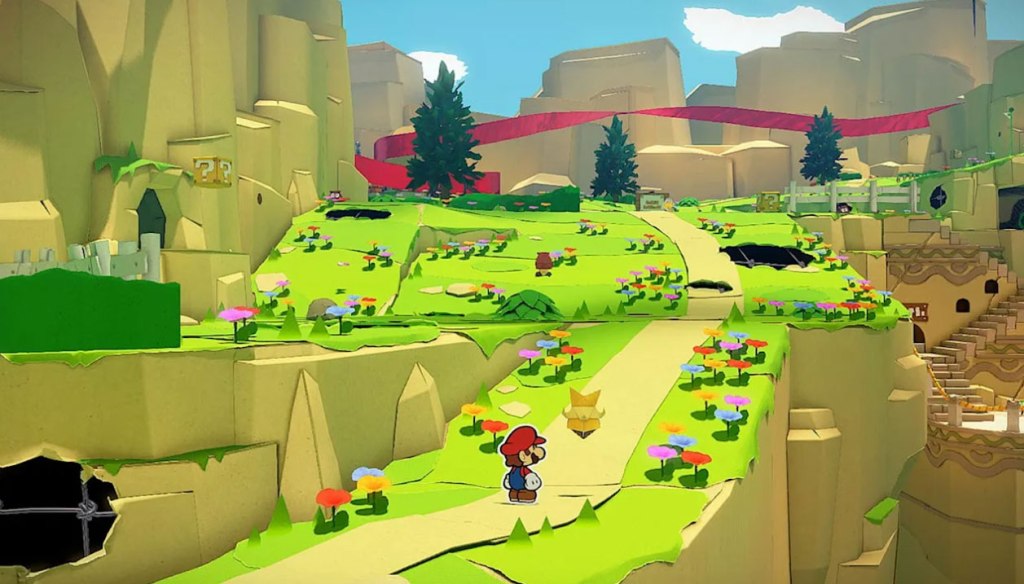
First, it should be said that Paper Mario: The Origami King is a beautiful game. Much in the same way that Yoshi’s Crafted World managed to make visually gorgeous environments out of crafting materials, so too does Paper Mario: The Origami King, giving us a gorgeous, detailed, colorful 3D world made out of paper, cardboard, and other crafting materials. While Mario and other friendly Mushroom Kingdom characters are depicted as simple 2D models printed on paper and moving using simple animations, these animations are augmented by the subtle way the paper they’re printed on moves, flapping in the wind, curving to turn, and often due to this game’s themes, being folded into various shapes. The objects in the game are given a great sense of depth and realism by some really nice lighting and good textures on many of the materials that makes them look real, and even though this is a game that’s not going to blow anyone away visually, it’s still beautiful to look at.
Likewise, this game touts yet another superb soundtrack with themes ranging from great orchestral works to simple piano and strings themes, to catchy pop-inspired themes. I particularly liked the Toad Town theme, which changes as you progress through the game (here is one of the earlier versions of the theme).
In addition, I have to say that the story here is fun, compelling, well-written, and repeatedly made me smile as I played through the game, with a plot about an origami usurper who starts transforming the Mushroom Kingdom’s denizens into origami. While this game generally avoids giving traditional Mario characters their own unique names and appearances, it still frequently gives them their own distinct personalities. And then of course there’s the characters introduced here that are new to the Mario universe, namely your new companion, Olivia, who’s fun, light-hearted, inquisitive, and amusingly oblivious at times.
Mainly the issues I have with this game come in when dealing with the gameplay. It’s not terrible, but it’s extremely scatterbrained. Some things work better than others, and in many cases you’re left scratching your head at some of the choices that were made here.
Combat is one of the biggest head-scratchers here. Encountering an enemy in Paper Mario: The Origami King brings you into a battle that’s almost more of a Puzzle game than a typical RPG battle. Characters all have hit points and take turns attacking, but generally the focus is on the game’s ring system that has you moving enemies into position using concentric rings around Mario, with the aim being to move them into tidy rows or blocks of four. Do this correctly and often you’ll likely win the battle on the first turn.
When you first encounter this system, it seems clever and original. By the time you reach your fiftieth battle, it will seem needlessly tedious and time-consuming. The game seems to realize this and eventually lets you automatically skip battles with particularly weak enemies, but this just raises the question, if the game’s designers knew this battle system wasn’t fun, why didn’t they, you know, fix it?
Players will find themselves avoiding battles whenever they can, not only because combat is annoying, but because fighting serves little purpose. Defeating enemies doesn’t reward players with experience points and levels as in most RPGs (and indeed, as the first two Paper Mario games did), nor does it give players weapons or useful items. Some battles are necessary to progress, but most battles reward players with one of the game’s two currencies – coins and confetti. Both are plentiful and often easily obtained out of battle, so players will often find themselves avoiding enemies wherever they can because… well, what’s the point?
Boss battles offer a slight variation on the combat formula, where players aren’t trying to arrange enemies around Mario, but are trying to arrange rings to clear a path for Mario to get to the boss in the center of them. These boss battles are fairly fun and creative, but a part of me wonders if I only think so because I only encounter one every once in a while, rather than having to go through the motions every few minutes like the normal enemy encounters.
On another note, the confetti I mentioned before is another new gameplay system here that’s inventive in theory, but in practice it just works out to be tedious and frustrating. Throughout the world, players encounter holes that need to be fixed by filling them in with confetti you collect as you go about your adventure. However, players can only carry a finite amount of confetti, which means that encountering a hole often means heading to the nearest tree and wacking it repeatedly to fill your confetti bag. This can be time-consuming, and it’s odd that players would be forced to grind for the stuff. Even more frustrating, it’s not often used very creatively. See a hole, fill the hole, and then get rewarded coins for doing so. That’s it.
Yet another new mechanic introduced here is the 1,000-Fold Arms, which has Mario’s arms becoming stretchy accordion-shaped things in context-sensitive situations. This, again, had the potential to be interesting, but the context-sensitive nature of this mechanic means that it never feels like you’re being especially creative or clever when doing it – you saw a glowy circle, you pressed the button in the circle, and you used the pointless motion-control to move the arms around until you found whatever it is you were meant to interact with.
There are a few other mechanics introduced here that just don’t work well, but I did at the very least want to point to one that does – the hidden Toads. Throughout the game, you’ll find hundreds of Toads hidden away throughout the world, and players are encouraged to find them all. The way these little mushroom-headed guys are hidden is so varied and clever that it’s one of the most joyous parts of the gameplay here, making use of the origami theme to fold these characters into all sorts of different things that the player needs to be on the lookout for. While many of this game’s mechanics seem like they’re trying really hard to be creative, I felt like this was the only one that unambiguously works.
So what does that mean, in the end? Well, Paper Mario: The Origami King certainly isn’t a failure of a game. Its beautiful world, great story and writing, and the fun of exploration highlighted by the game’s hidden Toads all make this game a joy to play… it’s just that this joy is heavily hampered by tedious combat and other tedious mechanics that seem more interested in being novel than being fun. If you’re a fan of the first two Paper Mario games wondering if Origami King is a return to form, I can tell you now it is not. If you’re a fan of newer Paper Mario games or a newcomer curious to try the series and wondering if this game is worthwhile… I can say that yes, it’s a good game worth playing, despite its flaws. Not all of its ideas work, and not all of them mesh well with each other, but what does work is excellent and well worth playing, even if it means putting up with the other junk.
tl;dr – Paper Mario: The Origami King is a family-friendly game that mixes RPG and Puzzle elements. While it is decidedly not a “return to form” that series die-hards have been hoping for, and many of the experimental mechanics here are more trouble than they’re worth, these flaws are more than made up for by the game’s beautiful world, fun characters, compelling story, and some excellent exploration elements.
Grade: B
You can support eShopperReviews on Patreon! Please click HERE to become a Sponsor!
This month’s sponsors are Lee, Andy Miller, Stov, u/wonderponder, Johannes, Ilya Zverev, Eli Goodman, and KC. Thank you for helping to keep the reviews coming!
 eShopperReviews
Leave a comment