
Griftlands
Genre: Turn-Based Card RPG / Roguelike
Players: 1
.
Review:
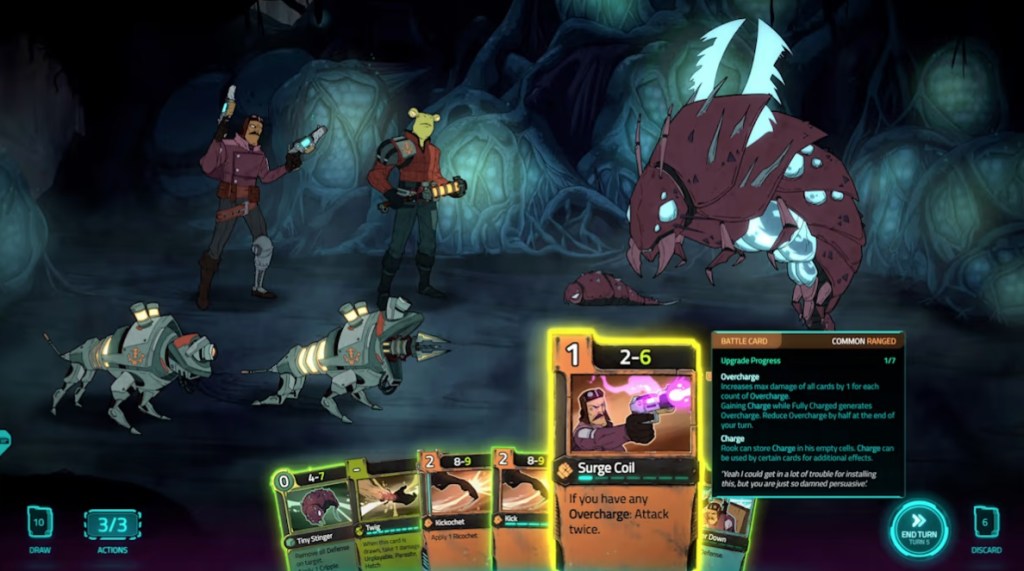
Griftlands is a Turn-Based Card RPG with Roguelike elements released in 2021 on PC, PlayStation 4, Xbox One, and Nintendo Switch. This game has players taking the role of one of various characters in a setting strongly reminiscent of Star Wars’ Mos Eisley, with players taking odd jobs, befriending or upsetting various locals and factions, and getting into fights and arguments.
Before I even go on, these days one can’t talk about a Deck Building Roguelike without mentioning the reigning king of the genre, Slay the Spire. At this point, it is inevitable that any new game of this type will be compared to Slay the Spire, with many of the questions about the new challenger directly tying back to the reigning champ of the genre. So let’s address those questions:
.
Does Griftlands Play Like Slay the Spire?
In many ways, yes. In fact, I would say that Griftlands hews closer to Slay the Spire than most games in the genre in many respects – players start each run by choosing one of multiple unlockable characters, each with their own starter deck and unique skill. As they progress through the game, they will add cards to that deck as well as upgrade existing cards in the deck. There are also “boons” that can be gained here that are much like Slay the Spire’s artifacts that add passive enhancements during gameplay. Players can even be saddled with unwanted cards they’ll be looking for ways to unload if they can. And much like in Slay the Spire, players are given an indication of what enemies will do on their next turn in battle, giving them an indication of how to best approach that turn.
In addition, the Roguelike elements here are handled somewhat similarly – gameplay is separated into “days” much in the same way that Slay the Spire is separated into floors, with each day giving players an opportunity to recharge their health, with damage persisting from one battle to the next. They’ll also be weighing risk and reward when it comes to the use of coin – they can play conservatively and use money at regular intervals to heal wounds, but doing so may deprive them of other opportunities that can only be bought with cash, not to mention cards they may potentially want to buy.
.
How is Griftlands Different Than Slay the Spire?
First and foremost, in the last few paragraphs, I sorta’ told a lie. That is because Griftlands does not have players managing only one deck, they’ll actually be managing two – there’s one deck of cards for combat, and another for arguments, and players must find a balance between the two, as some encounters will require one type of conflict or the other to resolve.
What’s more, both of these types of conflict play somewhat differently, with each one dealing damage to a different kind of vitality – combat has its health points, and arguments have resolve. Combat is close to what players may be used to from Slay the Spire – there are attack cards, defense cards, buffs, status effects, and the like. However, there are some differences here, such as the ability to gain additional party members to assist you.
Debates, on the other hand, have players frequently deploying supplemental arguments that provide a bonus to the player or detract from the opponent. Players must carefully decide whether to target an opponent’s main argument, one of their supplemental arguments, or whether they’ll defend their own arguments.
Another element that makes things interesting here is that while Slay the Spire offered an upgraded version for each card, Griftlands offers multiple upgrades for each card, with these upgrades becoming available as players use a card more frequently. The game will randomly choose two potential upgrades for cards that have seen enough play, with players only able to select one of those two. As you can imagine, this adds a lot more variety to the different runs players will make through the game.
Also, this game does some interesting things with the various characters you’ll encounter throughout the game – you’ll frequently have the choice to make a friend or an enemy out of a character, and this will affect your dynamics with other characters. A friendly character may grow to love you, offering one of the boons I mentioned earlier. However, earning the enmity of a character will likewise give players a bane, a passive negative attribute. The game takes things even further by giving players the option to slay or spare an opponent in combat. Killing an enemy will give you a card owned by that character, and take them out of your hair for good… but it will also earn you the enmity of that character’s allies. Again, more choice here equals more variety, making for plenty of variety in runs of the game.
.
What Does Griftlands Do Better Than Slay the Spire?
I’ve already mentioned numerous ways that Griftlands adds variety into its gameplay, making for the potential of wildly different runs. What’s more, the added choice that much of this variety offers really is liberating, giving players more flexibility with how they want to proceed.
Another element I haven’t touched on is Griftland’s focus on story. While Slay the Spire had some fascinating lore, it simply wasn’t a game that was very interested in story or character, with those details merely background noise with the focus on the gameplay. Griftlands, on the other hand, is very focused on story, with some well-written characters that make the game’s branching choices of who to make an ally or enemy also playing out a little like a branching storyline.
Also, some elements of the presentation here are really nice, with some well-drawn character portraits full of personality, and I think this game’s 2D animation is marginally better than Slay the Spire’s. The game also adds flavor to its world by having its characters speak snippets of voiced dialogue in a fictional language during their conversations. However, while other elements of the presentation are good, I would argue that this game’s instrumental soundtrack isn’t quite as memorable as Slay the Spire’s, though still decent.
.
What Does Griftlands Do Worse Than Slay the Spire?
I think Griftlands’ biggest problem when compared to Slay the Spire is that it adds a lot of complexity that can muck up what was elegantly streamlined in Slay the Spire. It feels like there are a lot more nuances and details to learn about Griftlands’ gameplay systems, and a lot more factors to keep in mind for any given decision.
Of course, that’s a natural byproduct of giving a player more options. Unfortunately, Griftlands does a poor job teaching the player about its various gameplay elements, making for a fairly steep learning curve right from the start.
Another major issue that compounds this problem is that Griftlands does a terrible job of presenting information to the player. Players will not only find a lot of icons on-screen that don’t fully convey their meaning, and this will result in players doing a lot of highlighting things to check to see what they mean, and often they’ll still be confused even then.
Yet another issue that adds to this core problem is that this game has been poorly-optimized for play on a console. Not only are players required to move an on-screen cursor to check many of the gameplay elements on-screen, but button assignments are inexplicably absurd. Checking a card to see a detailed description of what it does and explanations for its status effects, for example, requires pressing the ZR button, then holding ZL and pressing down on the right analog stick to scroll the text. For comparison’s sake, doing the same thing in Slay the Spire only requires players to highlight the card and the pertinent information pops up. Oh, and those hoping the Nintendo Switch’s touchscreen will at least resolve the tedium of moving an on-screen cursor will be disappointed to learn that this game doesn’t use the touchscreen at all.
.
Okay, So How Does Griftlands Stack Up Against Slay the Spire
As far as I’m concerned, it’s no contest – Slay the Spire’s more streamlined gameplay and better presentation of information to the player wins by a mile. When a game is all about making choices that could lead to victory or defeat, it is absolutely vital that these choices be properly conveyed to the player in a way that’s easily understood, and Griftlands stumbles hard in this area.
However, Griftlands still offers a unique experience that’s well worth playing in its own right, especially for those who have already played Slay the Spire and are looking for something with more variety and nuance. While I would argue that players new to the Deck Building Roguelike genre will be much better served by heading straight to Slay the Spire, there’s still plenty to like here, and once you get past the game’s initially steep learning curve, you’ll find this to be an excellent take on the genre that does some creative things that make it a solid addition to your collection.
tl;dr – Griftlands is a Turn-Based Card RPG with Roguelike elements that bears a lot of similarities to Slay the Spire. By contrast, it offers a lot more nuance with its two-deck mechanic, variety of characters to befriend or oppose, and its focus on story. However, it suffers from doing a poor job conveying information to the player, and the controls are terrible. On balance, this is still a solid game that does multiple creative things with the genre, but it doesn’t come close to unseating the king.
Grade: B
.
This game has been nominated for one or more of eShopperReviews 2021 Game Awards:
Runner-Up: Best Card Game
.
You can support eShopperReviews on Patreon! Please click HERE to become a Sponsor!
This month’s sponsors are MB, Andy Miller, Johannes, u/RamboFox, Exlene, Eli Goodman, Ilya Zverev, Stov, Connor Armstrong, and K.H. Thank you for helping to keep the reviews coming!
 eShopperReviews
Leave a comment