
Hellblade: Senua’s Sacrifice
Genre: Graphic Adventure / Action
Players: 1
You can find a video of this review here!
.
Review:
Hellblade: Senua’s Sacrifice is a game that is part Graphic Adventure, part Action game, with gameplay going back and forth between both types of gameplay throughout the course of the game. The game is heavily plot-driven, and the story is very much the focus, but the action and puzzles presented here are not insignificant either.
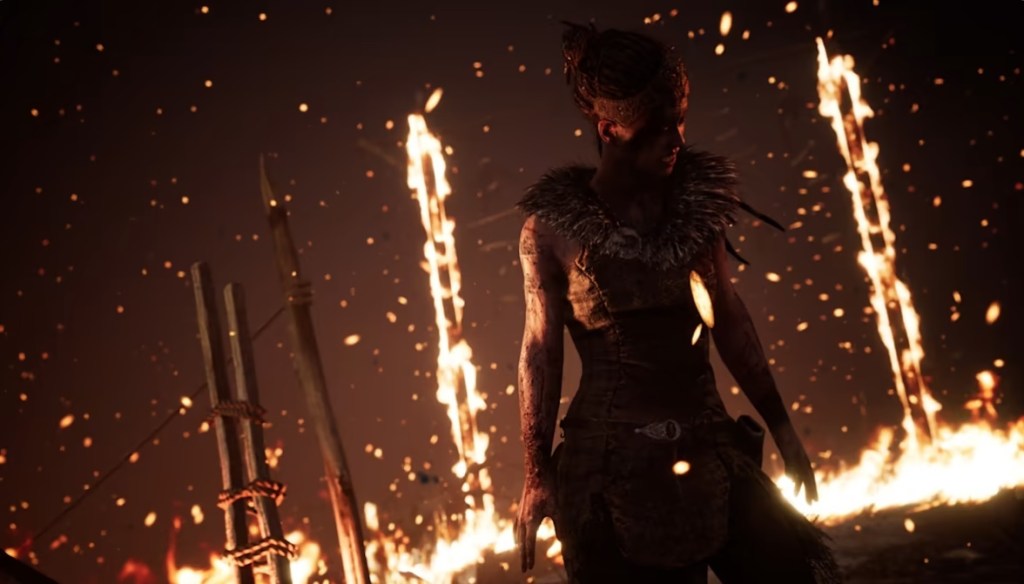
Probably the first thing you’ll notice about this game is that the presentation is absolutely phenomenal. This is without a doubt one of the best-looking games on the Nintendo Switch, especially when it comes to its detailed character models, which seamlessly transition to pre-rendered and live-action cutscenes so smoothly that it’ll be easy for many players to miss the difference. The Nintendo Switch version of the game isn’t quite on par with other versions – the textures are occasionally less detailed and some of the visual effects have been removed in this version, but it’s still impressive to look at, nonetheless.
This spectacular presentation extends to the game’s sound, which ties into the game’s themes and story. Senua, the game’s titular protagonist, is a Celtic warrior who suffers from psychosis, and whose village has recently been ravaged by vikings. In the wake of this, she heads off on a quest to challenge the Norse goddess Hela for the soul of her beloved. However, the farther she travels into the mythical world of Hel, the farther she travels into her own psychosis.
In practice, this results in the game playing audiovisual tricks on both Senua and the player themselves. Players will constantly be barraged by voices surrounding them, shouting warnings, expressing fear, giving encouragement, laughing at you, questioning your actions… the game’s designers went to a great deal of trouble to consult both psychiatric experts as well as real sufferers of psychosis throughout the development process, and it shows – this is an extremely immersive experience that places you right in the role of someone with a severe mental illness.
It’s also left to the player to decide how much the fantastical events Senua experiences are the result of her illness, and how much is due to the influences of the gods she challenges, and the ethereal realm she is walking through. At multiple points during the 6-8 hour game, players must hunt down symbols to unlock gates baring their path, with these symbols being cleverly hidden in the environment around them. Is this a magic ritual needed to pass an arcane test? Or is it another sign of psychosis, the pattern-searching tendencies of that illness expressing themselves? Throughout the game, the waters between the fantastical and the psychotic are constantly muddied, to the point where one wonders if, in Senua’s world, there even is a distinction between the two.
Of course, having lived through real horrors, and being on a quest through the hellish… well, Hel… much of what Senua sees through the course of the game is horrifying. A land riddled with corpses burned, flayed, and put through unspeakable tortures, human bodies used as decoration or architecture… I was never really scared playing this game, but there were definitely times I was creeped out, and I could certainly see this being classified by some as a horror game. In short, this ain’t a game for the kiddies.
While much of the game is puzzle-solving and experiencing Senua’s story, there are occasional points where you stop for combat, and this is probably the game’s weakest point. Senua can use weak and strong sword attacks, as well as a kick to knock back enemies and eventually a charged sword strike to do extra damage or take on more ethereal foes. She can also shield or dodge, or run toward an enemy to surprise them with a charging strike.
This all works well enough, but it can feel a bit clunky and slow, and having the ability to change focus to a different enemy mapped to the right stick is less than ideal. Combat in this game simply feels a lot more stiff than a game like, say Bayonetta. Often it seemed most effective to just keep dodging until there was an opening to get in a quick strike or two, then dodge again before one of the multiple surrounding enemies got a swipe in. Rinse, repeat. It’s not horrible, but I wish that more effort was put into developing it into something more involving, or conversely that it was dropped altogether in favor of the game’s focus on puzzles and story, which are consistently good.
Even with the combat being less than spectacular, the other elements of Hellblade: Senua’s Sacrifice make it an absolutely must-play title. This is a well-told story, an audiovisual treat, and a more thoughtful and immersive look into mental illness than you’re likely to see just about anywhere else. And while the Nintendo Switch version is scaled back from other versions of the game, it still looks and sounds fantastic, and if you haven’t played it already, and aren’t bothered by the game’s topic matter, you should absolutely give it a try.
tl;dr – Hellblade: Senua’s Sacrifice is an absolutely fantastic Graphic Adventure that delivers an incredibly immersive experience as players are put in the shoes of someone with severe mental illness on a journey into a hellish fantasy domain. The Switch version isn’t quite as impressive as what’s on other platforms, but it still looks fantastic – one of the best-looking games on the Switch. And while the action sequences aren’t quite up to par with the rest of the game, on the whole this is a superb experience that is a truly must-play game.
Grade: A
.
This game has been nominated for one or more of eShopperReviews 2019 Game Awards:
Winner:
Best Sound Design – Players are brought into Senua’s psychosis through amazing use of voices surrounding the player, both helping and hindering them. This is a game that you absolutely want to play with a surround sound setup, preferably surround sound headphones if you have them. The sound in this game is a major part of the experience, both in building its world and telling its story, and without the powerful force that sound plays in this game, it wouldn’t have had anywhere near the lasting impact it does.
Best Story – This was a game that told an amazing story in a way that no other medium can, by taking you inside the head of its protagonist, and forcing the player to experience her psychosis and leaving the player wondering what was real and what was just another element of Senua’s madness, even after the game ends and the credits roll.
Best Graphic Adventure Game – This shouldn’t come as a surprise to anyone who saw my massive review of the game, or the follow-up video review I did. Hellblade tells an amazing interactive story that gets into your head, literally. The use of sound and visuals here is superb, with some excellent visual-based puzzles. I count this game in this category instead of the Action category because this is where the game truly shines.
Game of the Year: Bronze Award (Third Place) – This game wowed me in a way that few others did this year, with a stunning audiovisual presentation that delivered the game’s story in a way that just about no game ever has. Players aren’t just transported into Senua’s world, they are brought into her mind, and the journey is a shocking, emotional, and truly amazing one. There’s a reason I gave this game not one, but two lengthy reviews this year.
Runner-Up: Best Port/Remake, Most Underrated, Best Graphics
You can support eShopperReviews on Patreon! Please click HERE to become a Sponsor!
 eShopperReviews
Leave a comment