
Dragon Quest
Genre: Turn-Based JRPG
Players: 1
.
Review:
Dragon Quest is a Turn-Based JRPG, and in fact it is arguably the grandaddy of all JRPGs. While not technically the first game in the genre, it was the one that made the genre explode in popularity in Japan, alllll the way back in 1986 on the Nintendo Entertainment System, and pretty much every game in the genre since then owes much of its design to this game. To some extent it helped to popularize the genre in the US as well, being released here three years later in 1989 as Dragon Warrior, and becoming a cult favorite in part thanks to a giveaway by Nintendo Power magazine a year later. JRPGs wouldn’t become huge in Western territories until the release of Final Fantasy VII some time later, but they would still garner a pretty strong following of fans, and again, this game was largely the start of all of that.
However, that’s the history of the game and its influence, and it says nothing about the game itself, how well it has aged, and how it plays today. After all, the game is 34 years old now – does it hold up?
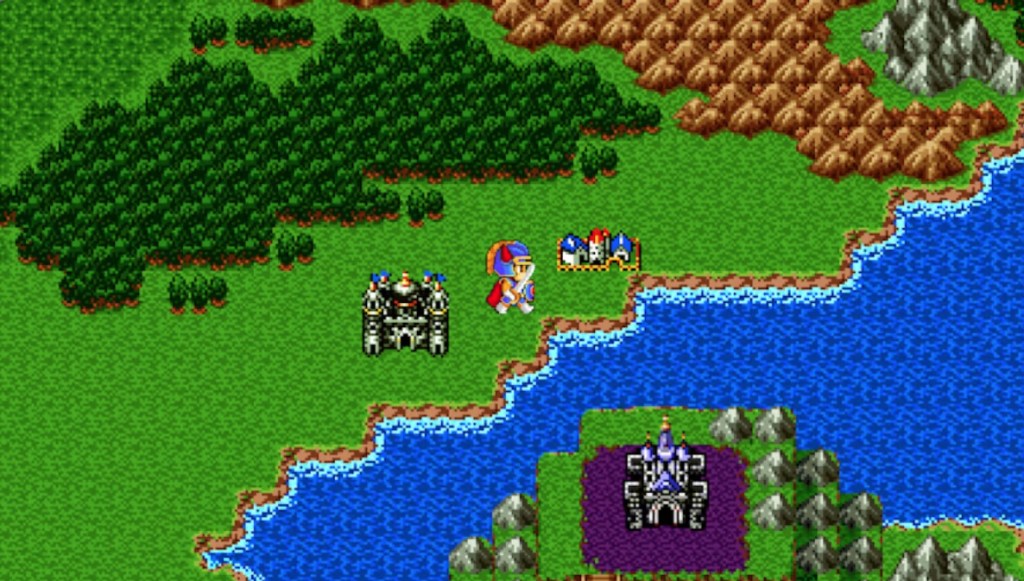
Well, before answering that, it bears mention that this isn’t quite the same game that was released all those years ago. Rather, this version of the game, based on the 2014 smartphone release of the game, improving the game’s visuals, text, and music to be… well, not nearly in line with today’s standards, but at least somewhat less archaic. The new presentation is a bit of a mixed bag. On the one hand, the redone soundtrack is superb, and one of the better things about this game. On the other hand, the visuals seem a bit “noisy”, and the combination of highly-pixelated with somewhat less-pixelated character sprites seems a bit odd and off-putting. In addition, the screen scrolls in a slightly-shuddering way that’s really distracting, though you do get used to it eventually.
As for the game’s story… well, there’s only so much you can do with a story written for a 1986 videogame. You’re talking the sort of stuff that’s pretty well-worn territory by now – a kidnapped princess, an evil Dragonlord threatening the peace of the world, and a nameless hero given a quest by a king to save the day. This generic, cliched story is both given personality and made more absurd with the insistence on language that fills sentences with Elizabethan-sounding words in an attempt to class up the affair, although with a child’s view of what “classy” is. Expect a lot of “thou”s and “thy”s.
And the gameplay… well, again, what do you expect? This was one of the earliest games in the genre, and as such it is extremely basic by today’s standards. There’s no party, it’s only one character. There’s a set character progression with skills learned automatically at certain levels. There’s little strategy or thought to the game’s battles – it’s mostly just grind until you can afford new equipment and/or level up a sufficient amount, then venture into a new area, raid the local dungeon, and then repeat the process.
This would all be somewhat understandable, except this game really emphasizes the “grind” bit. Grinding takes forever in this game, with enemies being extraordinarily stingy about handing out gold and experience. There are other elements here that are frustrating as well, such as the need to return to the castle at the start of the game to save (players can create a quicksave in this version, but are only allowed one quicksave for all of their save files).
In the end, Square Enix has clearly made a good attempt to modernize Dragon Quest without abandoning its roots, and that attempt is much appreciated, especially in the game’s wonderful soundtrack. However, in other areas, this modernization has had mixed results, and there’s only so much you can do with a game that has aged considerably since its original release. Dragon Quest still has its charms, and fans of JRPGs might find it worthwhile to rediscover one of the most important games in the genre, but by today’s standards this game is clearly lacking in numerous ways.
tl;dr – Dragon Quest is the game that codified the JRPG genre in Japan all the way back in 1986, and this release seeks to polish it a bit for modern audiences. In some areas, like the wonderful soundtrack, this game still shines. However, in numerous others, it definitely shows its age, from the graphics to the story, to the grind-heavy gameplay. It still has a classic charm to it, but by today’s standards it is definitely lacking some basic features we’ve come to expect from the genre.
Grade: C
You can support eShopperReviews on Patreon! Please click HERE to become a Sponsor!
 eShopperReviews
Leave a comment