
Fairune Collection
Genre: Compilation / Puzzle / Action-RPG / Shmup
Players: 1
.
Review:
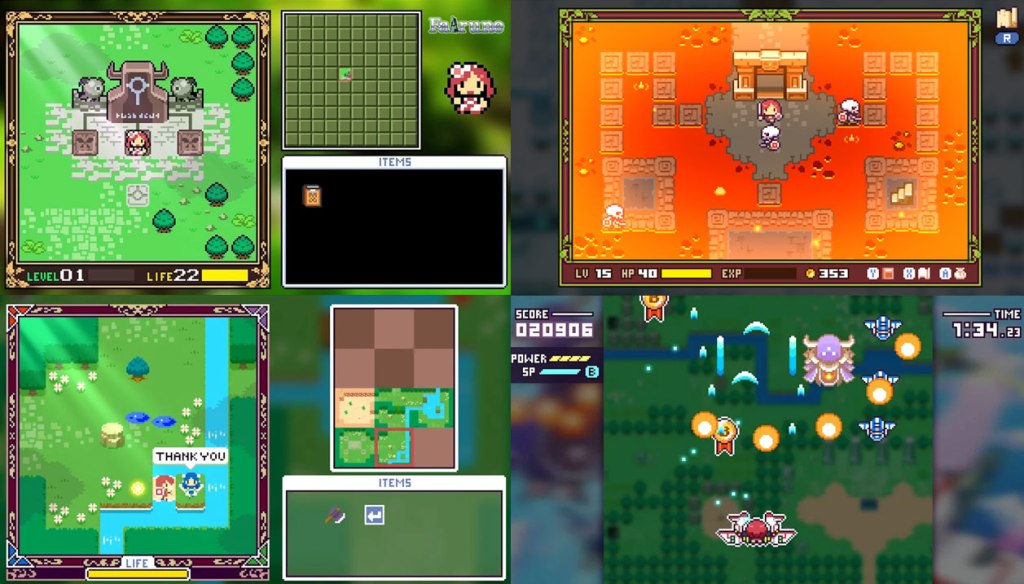
Fairune Collection, released on PC and Nintendo Switch in 2018, is a compilation of four games: Fairune, first released on iOS in 2013, and Fairune 2, first released on 3DS in 2016, as well as Fairune Origin and Fairune Blast, both created for this collection and with Blast only being playable if players complete all three other games first. The first three games combine elements of Puzzle games and Action-RPGs, while Fairune Blast is a Shmup, no doubt inspired by the final bosses of Fairune and Fairune 2.
Rather than breaking down these games individually and rating them separately, I’ll just discuss them as a whole, because Fairune 1, 2, and Origins all play extremely similarly. Picture an Action-RPG like the classic 2D Zelda games, but where instead of fighting enemies, you simply walk into them. Enemies that are beneath your level or equal to it are automatically destroyed, while enemies above your level damage you without you having an effect on them. However, only enemies at roughly the same level as the player will provide experience when defeated so the player can level up. As such, a part of the game is specifically finding and targeting the right kind of enemies to level up. Thankfully, the game lets you know which ones are currently on your hit list, via a helpful talking “codex”.
Finding the correct enemies to kill is something these games generally use to indicate the player is on the right track, as players are not only powering up their character, but also progressing through the game by solving environmental puzzles, discovering items to use and figuring out where they need to be used. Maybe your path is blocked by a withered tree, and you’ll need to come back later after finding an axe, for example. This is where the majority of Fairune’s gameplay is situated – exploring the world, finding useful tools, and figuring out where to use them.
These puzzles can actually be pretty clever… but they can also be maddeningly mystifying. Sometimes, the game simply doesn’t make it clear that you can go to a place, or makes it very difficult to see where a hidden passage is – a hidden passage that you need to take, because it leads to an item that you cannot progress without. Suffice it to say, this is a game you will likely want to play with a walkthrough guide handy, because there are certainly places where it seems absurd that the game expects you to figure out what it wants you to do.
The other problem here is the grinding. Yes, it’s clever that the game has you hunting down specific monsters to progress, and initially I absolutely loved that mechanic. However, the problem is that once you find that monster, you need to kill dozens of them to level up, which means moving back and forth from one area to another to get them to respawn so you can farm them. You must do this dozens of time through the course of the game, and it doesn’t take long for this to get very, very tiresome.
Then there’s also the aforementioned Final Bosses for Fairune 1 & 2, which as previously mentioned take the form of… Shmup battles. Despite that nothing in the game up until that point was a Shmup. The change in gameplay styles here is inexplicable, and players who made it to the end by using their wits and observation will undoubtedly be frustrated to find they need a test of hand-eye coordination to complete these games.
All of the games in this compilation feature pixel art visuals that imitate the style seen in the Zelda series, with Fairune Origins having really simplistic 8-bit-style pixel art visuals, Fairune 2 and Fairune Blast having 16-bit-style pixel art visuals, and the original Fairune having visuals that lie somewhere in-between those. These are paired with a pretty catchy chiptune soundtrack that feels appropriate for each of the games in question. I may have some complaints about the games in this collection, but the presentation isn’t one of them, this collection looks and sounds like a real nostalgia trip.
As for how all these games differ in their gameplay, Fairune 1 and 2 are pretty similar, with Fairune 2 adding a few subtle adjustments like a dedicated codex button and coins the players can collect for cutting grass, a la Zelda. Fairune Origins dispenses with the need to farm enemies for experience – now you automatically kill anything you walk into, and anything that walks into you damages you. This disposes of one of the more fun and unique elements of Fairune 1 & 2, but at the same time it also disposes of the need to grind that those games had. Fairune Origins also has no real final boss fight, which seems more appropriate yet also… well, disappointing.
Finally, when players complete Fairune 1, 2, and Origins, they unlock Fairune Blast, which is actually a pretty fun little Shmup that doesn’t quite play like the final bosses from the first two games, even though it was clearly inspired by them. Players can select one of three ships, each capable of powering up multiple times, and fight their way through the enemies of the series re-imagined as Shmup enemies. It’s cute, it’s fun… but of course, there’s a catch.
Here’s the thing… if you played Fairune 1 & 2 and wanted to get this collection to play Origins and Blast, I will say that you should prepare to be very, very disappointed. Don’t get me wrong, both Fairune Origins and Fairune Blast are fun takes on the franchise, but where the original Fairune was about 2-3 hours long, and Fairune 2 is about 4-5 hours long, Fairune Origins can be easily completed in under 15 minutes… and Fairune Blast can be completed in under 3 minutes. So one might almost consider these fun little extras rather than complete games.
So perhaps it’s clear now why I didn’t approach this review by rating each of the games on its own, because… just how do I grade a game that can be completed in 3 minutes? And what’s more, a game that can only be unlocked when the others are complete? Don’t get me wrong, it’s a delightful 3 minutes… but it’s three minutes.
That’s not to say this collection is a rip-off. Fairune 1 and 2 are sizable enough that they’ll take players at least 6-9 hours or so to complete (more if you insist on not using a walkthrough guide), and the $10 price tag seems pretty reasonable for what’s on offer here. Just don’t look at this as a collection of four games, because it’s really not – it’s two games plus a few fun little extras.
In the end, despite how misleading this package may be, I enjoyed my time with Fairune Collection, but that enjoyment was interspersed with a lot of frustration. It’s fun to explore and solve puzzles in this game’s Zelda-like Action-RPG world… but it’s not so fun to get stuck wondering where to go, or have to take a few minutes to grind monsters, or suddenly find yourself playing a completely different sort of game at the final boss. There’s a lot to like in this collection, but there’s just as much to dislike. On balance, I’d say it’s probably worth it, but know what you’re in for going into this.
tl;dr – Fairune Collection is a compilation of 4 games… although if we’re being honest it’s more like 2 games with some extras. Fairune 1 & 2 are Action-RPG Puzzle games, Fairune Origins is a 15-minute distraction in the same vein, and Fairune Blast is an unlockable Shmup that takes 3 minutes to complete. So clearly Fairune 1 & 2 are the meat of this collection, with gameplay that’s a little like 2D Zelda games with a focus on exploration and puzzle-solving. When it works, it’s really fun, but these games all have a slew of problems that lead to a lot of frustration. In the end, I’d still recommend it to fans of the classic Zelda series, but only if you’re prepared for this game’s numerous issues.
Grade: C
You can support eShopperReviews on Patreon! Please click HERE to become a Sponsor!
This month’s sponsors are Lee, Andy Miller, Stov, u/wonderponder, Johannes, Ilya Zverev, Eli Goodman, and KC. Thank you for helping to keep the reviews coming!
 eShopperReviews
Leave a comment