
Fire Emblem: Three Houses
Genre: Turn-Based Strategy-RPG
Players: 1 (with some online elements)
.
Review:
(Note: This is my 1000th review for eShopperReviews! Please take a moment to look over a collection of articles I’ve prepared to mark the occasion!)
Fire Emblem: Three Houses is a Turn-Based Strategy-RPG in Nintendo’s long-running series, and in many ways this is a rebirth of the series, not only focusing on a completely new group of characters and separate area from prior games (Three Houses taking place within the kingdom of Fódlan), but featuring new gameplay mechanics, and an entirely new focus on character interactions and world-building that takes place outside of battle, in the Garreg Mach Monastery that acts as a military training academy and base of operations for the game’s huge cast of students and teachers. This game was released in 2019 for the Nintendo Switch.
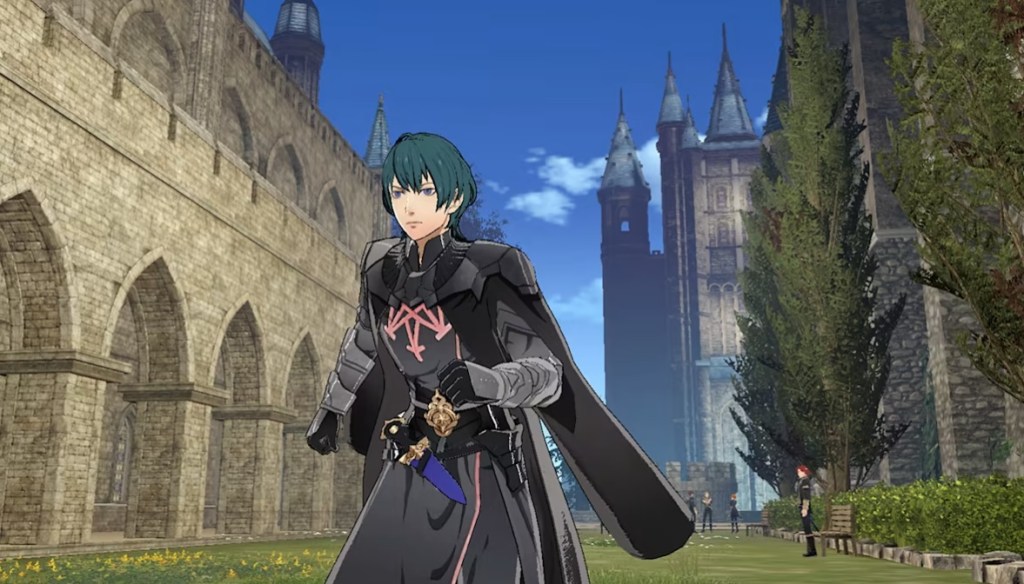
In terms of presentation, Fire Emblem: Three Houses is a mix of the outstanding and the mediocre. Let’s talk about the mediocre first – the graphics. While by no means bad, Fire Emblem: Three Houses is not a stunning game to look at. With most of the game’s environments being sparsely decorated, some textures being a bit blurry, and the game having some nasty aliasing, it could have definitely used a bit more polish in these areas. At the very least I can say that the game’s character designs are quite good, although they too have some blurry textures and suffer from flapping mouths that don’t even attempt to match the dialogue. Also, arguably the game’s most central character, Garreg Mach Monastery itself, has an abundance of personality to it, even if it’s not impressive on a technical level. I should note that while there’s nothing impressive going on visually in this game, and in a few places it even looks a bit ugly, it’s serviceable and doesn’t interfere with the gameplay.
However, that’s the bad news. The good news here is that the game’s writing, characters, and voice work is phenomenal. This is a game absolutely loaded with characters, featuring a cast of roughly three dozen students and a half a dozen teachers, and yet all of these characters are not only unique, but clearly have unique relationships with each other. Stoic Dudue, for example, is the devoted servant of his liege, Dimitri, who is somewhat vexed at Dudue treating him as a lord and not as a friend. Meanwhile, Dimitri’s childhood friend Felix has nothing but disdain for Dudue due to some pretty overt racism caused by childhood conflict where Dudue’s people assassinated much of Dimitri and Felix’s royal families. Meanwhile, Dudue finds himself surprised when, during a chance conversation with the skirt-chasing Sylvain, he finds his classmate to have a sharp mind for the politics of the kingdom, revealing him to be a deeper man than his outward behavior would indicate.
This is just a select portion of some of the connections that one character in this game has, and it seems like virtually every character in the game forms unique relationships with every other character, or at least every other character in their own house. And every last one of these conversations is voice acted superbly, with each character having their own distinct personality reflected in their voicework.
As for the overarching story, the way this game sets up its academy houses, combined with the important role that politics and political backstabbing play in the plot, give this game a vibe that feels a lot like what you might get if you had a Game of Thrones-esque story set within the halls of Harry Potter’s Hogwarts. And while the characters and story definitely have a more accessible, anime-esque plot, it is nevertheless one that is well-told and the characters are compelling enough that you’ll actually want to play through the game multiple times to fully experience each of the game’s houses and explore all of those character interactions. And just to be clear, this is a game that will take you 40-60 hours to complete one playthrough, with completionist runs estimated to take close to 200 hours.
Yeah, if you’re looking for bang for your buck in terms of quality gameplay that will give you plenty to do over a long period of time, Fire Emblem: Three Houses has it in spades. The game’s progression is tied to an in-game calendar that’s always moving forward, ensuring that you’ll have to pick and choose what events you want to spend your time doing, since that time is limited. To be clear, there’s no in-game clock, so you can take your time deciding, but once you select a time-consuming task, you expend some of the limited time you have available. Do you explore the monastery’s grounds and speak with the students and staff, building up bonds and improving your own standing as a teacher? Do you drill your students in the classroom to raise their skill levels? Do you bring them out into the surrounding area to battle local bandits and gain experience to level up? Or perhaps you give your students time to rest so that their exhaustion doesn’t overtake their enthusiasm. All of these are viable options, and in fact you’ll do best if you balance them out well so you can take advantage of the benefits of each.
Exploring the monastery is actually one of the most significant parts of the game here, nearly as much as the battles themselves, giving players the ability to check in with not only your own students, but the students of other houses and teaching staff as well. You can do this by simply talking with them, by finding and returning lost items, giving gifts you believe the individual in question will like, or engaging in shared activities with them like tea parties and choir practice.
Because of this, this section of the game has been compared by many to a dating sim, and there’s a good reason for this, as it’s a great way not only to improve synergy with your own classmates, but it also gives you the opportunity to snipe classmates from other houses to convince them to join your own, with the potential to recruit the teachers as well for events that happen later in the game. Like that cute girl from another house who seems like she’d be great in the saddle (literally)? Find out more about her personality, give her gifts that appeal to her, and build up a skill set that she respects, and she’ll come begging to join your crew. Want your armored knight and your healer to get along better with each other? Invite them both to a meal with you and all three of you will improve the bond you share with one another.
As for the battles themselves, on the surface they seem much the same as prior Fire Emblem games – this is turn-based combat where characters move on a tile-based grid, with different classes having different strengths and weaknesses, and different terrain providing different benefits. However, there are a few things that are different this time around. Fire Emblem: Three Houses introduces Battalions, which act as an entourage for a character that provides them with bonuses and special moves called Gambits. In addition, Fire Emblem: Three Houses disposes of earlier games’ “weapon triangle” system – swords are no longer inherently weak to lances or strong against axes. Instead, individual weapons can be strong against a certain type of unit, and every unit type can equip any type of weapon, allowing for a lot more flexibility in making your own custom team.
In fact, this malleability extends throughout the entire game – not only can you recruit whoever you want (save for House leads and their loyal vassals), you can also train them to have whatever skill set you want them to have, transitioning them into whatever class you deem fit. However, some classes will make more sense for a character than others. A character skilled with a bow might not take too well to being made to train as a heavy armor-bearing knight, and a skilled magic user might voice their frustration with you if you keep insisting on training them to use an axe they have little interest in bearing. It’s up to the player to decide if they should listen to their students’ preferences, or train them to fit a role the player prefers, with the caveat that training students in areas that don’t suit them will make that training go more slowly… and once again, you are limited in your time.
When it comes to complaints, mostly what I have to say isn’t major, but it does deserve mention. Beyond the visuals and one particular missed opportunity I’ll get to in a moment, my main complaint here is that many of this game’s systems aren’t very well-explained, or they hide important information regarding them. Want to see the difference in stats between two classes? You’ll need to jump back and forth between multiple menus to do so, and these menus aren’t always readily accessible when you need to make decisions in which class plays a factor. Want to woo a character to your house? It’s not exactly clear how much your gifts to them have swayed them, nor how high they want your stats to be before they decide to join you. And I must admit that the Brigade and Gambit system took me a little while to fully understand. To the game’s credit, it does try to gently and gradually guide the player through its many complex systems, but even so it sometimes feels like it’s not explaining things as clearly as it could.
A few other things I should note before wrapping up here. Firstly, if you’re planning to play this game in handheld mode, know that it’s not an ideal experience on the small screen. Not only is the text and other details somewhat small (though still readable), but the game makes no use of the touchscreen whatsoever, despite that this seems like it’d be a good game for that sort of thing. However, while that’s a bit disappointing, there are some other nice features the game does offer.
For one, players with Amiibo will find these figures are supported by an in-game “Amiibo Gazebo” (that they called it this made me giggle with glee when I first saw it), giving the players bonus items. Also, players who connect the game online can send students out on trade missions where they’ll interact with other players. What’s more, if you have online play enabled, battlefields will highlight spots that other players and enemy characters fell, rewarding the player with an item or extra experience if they move to that spot. As there’s no direct interaction with other players, I wouldn’t say this constitutes multiplayer in any way (and more’s the pity, because it’d be fantastic to test your team’s mettle against other players), but it’s still a nice optional feature, regardless.
All told, between all the different character interactions, the freedom to mold your class how you see fit, and the deep strategic possibilities of battles, Fire Emblem: Three Houses is an absolute joy of a Strategy-RPG that will keep you busy for potentially hundreds of hours. The gameplay here is top-notch, and the characters and story keep the game compelling enough to make you want to dive back in and play it multiple times. This game isn’t perfect – it has underwhelming visuals and it sometimes seems to make important information hard to come by. However, overall this is a must-have for fans of Strategy-RPGs, and especially for players looking to really dig into a game with great characters and story that will keep them engaged for a very, very long time.
tl;dr – Fire Emblem: Three Houses is a fantastic Turn-Based Strategy-RPG that mixes the series’ strategic gameplay with a fantastic plot and setting that feels like a mix of Harry Potter and Game of Thrones, with deep gameplay that has you bolstering character relationships to build up your team of students over multiple long, rewarding campaigns. The graphics aren’t all that impressive, and sometimes the game isn’t as forthcoming with information as I’d like, but overall this is an absolute must-have entry for fans of the genre, as well as those looking for a game with great story, and also those looking for a game they will be playing for a very, very long time.
Grade: A
You can support eShopperReviews on Patreon! Please click HERE to become a Sponsor!
 eShopperReviews
Leave a comment