
A Normal Lost Phone
Genre: Visual Novel / Simulation
Players: 1
.
Review:
Note: This game is included in two compilation packages: It is included in Lost Phone Stories along with Another Lost Phone: Laura’s Story. It is also included in Accidental Queens Collection along with Another Lost Phone: Laura’s Story and Alt-Frequencies.
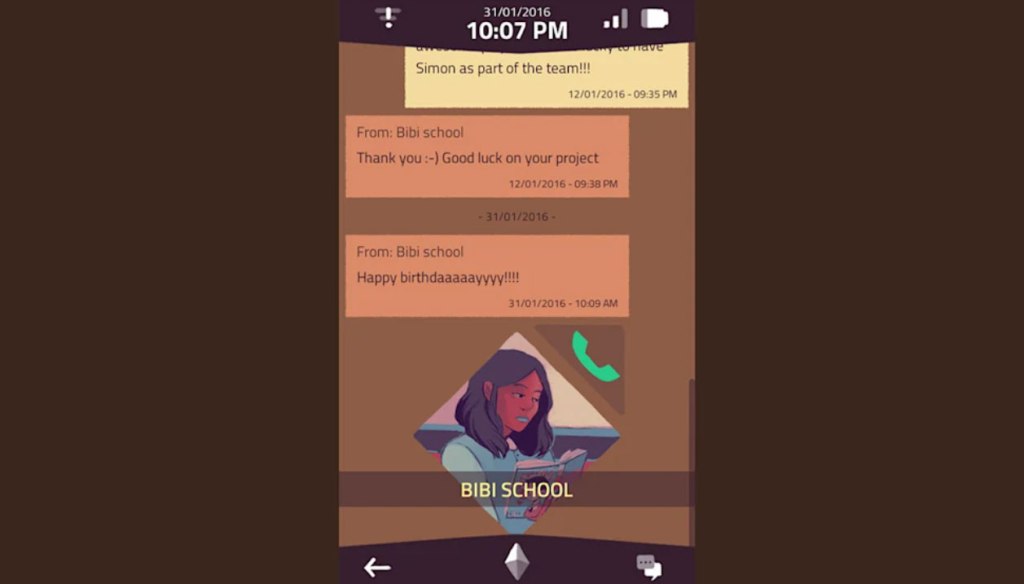
A Normal Lost Phone is a Visual Novel presented in the form of a Simulation of a smartphone. Players take the role of a random person who found a smartphone and is trying to figure out who it belonged to, what led to them losing the phone, and possibly how to return it to them. This game was released on mobile devices and PC in 2017, and ported to Nintendo Switch in 2018.
The presentation here is good, presenting a mostly reasonable facsimile of a smartphone, although not one with an OS that resembles anything that exists in real life. There are a few omissions and exceptions that slightly break this simulation – there’s no address book for starters, although that may be a necessary evil to prevent players from having a plausible way to instantly solve the problem of what return address to send it to. Also, all of the “photographs” on the phone are somewhat amateurishly-drawn artwork, something that becomes particularly noteworthy when characters compare these photos to what is actually supposed to be hand-drawn artwork, and the lack of distinction between the two makes this needlessly confusing. Overall, the visuals here are good, but could be better.
The sound is handled in a clever way – the game’s soundtrack is technically diegetic, with the phone playing through the phone’s music tracks right from the start, but at any time players can go to the simulated music player to shut it off, go to a specific track, or play a song in shuffle or turn on shuffle mode. Failing to do the latter means that once the game runs through all of the music, you’ll be listening to dead silence until you head into the music player and start it up – again, a nice touch. However, doing things this way means that the game can’t possibly play music fitting to what you’re reading at any given time, making for some mood dissonance. In any case, what’s here is a good mix of some nice indie music and later some instrumental music that’s introduced through the course of the game’s story. Some of the noteworthy tracks here include Airs, Breath, Can You Hear Me, Far Away, and Turquoise.
The story here is told in a nonlinear fashion that’s still cleverly set up to only allow players to access certain information once they’ve properly processed other parts of the story – passwords players need to get to some of the more sensitive information must be gleaned from information conveyed through various messages and other information within the phone (or, for the impatient or those who get stuck, a Google search), which allows players to gradually get exposed to the story’s secrets.
Here’s the short, non-spoilery version – the events depicted on the phone take place between January 2015 and January 2016, with the final messages the phone received being earlier on the same night you found it – January 31, 2016. The phone apparently belongs to someone named Sam, who seems to get along well enough with family, had a loving girlfriend who seems to have had a falling out with Sam recently, friends and school clubs, normal teenager stuff. Or at least, that’s how it appears, but of course if that’s all that was going on here there wouldn’t be much of a story. The game opens with the phone receiving messages from Sam’s dad, worried – Sam has gone missing, and a part of the mystery is exactly what happened.
Overall, I would say this feels like a mostly-organic, well-told and grounded story, one with some good emotional weight to it and some strong, memorable characters. The “mostly” bit comes in the form of some of the late-game messageboard posts players will find themselves reading through, which feel more like a lecture or a seminar than a story that unfolds organically. Now, while I understand the desire to inform some of the audience about the concepts and misapprehensions about some of the topic matter in this game, I wish more of an attempt had been made to work this into the story rather than basically dropping it as only slightly dressed-up exposition.
Another issue with this game’s story is one of the ethical implications involved with even playing the game – you are basically a stranger who graduates from trying to find the phone’s owner to someone snooping into this person’s life, to outright stalking them via any means available to uncover their hidden secrets. There’s a message in the epilogue essentially excusing this behavior, but it does so after the fact, and I couldn’t blame some players for getting a bad taste in their mouths just based on the game’s premise alone.
There are a few other areas where this game isn’t quite as ideal as one might hope. Firstly, as mentioned before, some of the puzzles here are a bit vague, and players might find themselves puzzled over where to even look for the information they need. Again, Google to the rescue, I suppose. The other issue here is one that couldn’t very well be helped – as a simulation of a smartphone, the ideal platform to play this game on is… well, a smartphone. The Nintendo Switch version of the game does its best to support the simulation – in docked mode the game works fine with a controller (though the vertical orientation makes the writing a bit smaller than would be ideal), and in portable mode the game not only works very well with touchscreen controls (clearly the ideal way to play this game), but even allows for the screen to be viewed in vertical orientation, basically turning the Nintendo Switch into a giant simulated smartphone.
While the Nintendo Switch isn’t the ideal platform to play A Normal Lost Phone, it’s undoubtedly the best platform to play it on other than an actual Smartphone. And overall, this is a solid Visual Novel that tells its story in an interesting way, and that story is largely a well-written and grounded one, even if later parts of the game feel more like a lecture than a story. It’s a short game, easily completed in two hours or so depending on your reading speed, but for $6 it may well be worth a look, especially if you’re looking for a realistic, down-to-Earth drama.
tl;dr – A Normal Lost Phone is a Visual Novel told in the form of a Simulation of a smartphone that players have found and are trying to look through to uncover the story of what happened to its owner. It’s a good, emotional, well-grounded story told in a clever way, and it’s well worth a look if you’re a fan of Visual Novels. The ideal platform for this game is still undoubtedly the smartphone it’s intended to emulate, but the Nintendo Switch makes for an adequate substitute.
Grade: B-
You can support eShopperReviews on Patreon! Please click HERE to become a Sponsor!
This month’s sponsors are Andy Miller, u/wonderponder, Johannes, Stov, Ilya Zverev, Eli Goodman, and KC. Thank you for helping to keep the reviews coming!
 eShopperReviews
Leave a comment