
Another Lost Phone: Laura’s Story
Genre: Visual Novel / Simulation
Players: 1
.
Review:
(Note: This game is included in two compilation packages: It is included in Lost Phone Stories along with A Normal Lost Phone. It is also included in Accidental Queens Collection along with A Normal Lost Phone and Alt-Frequencies.)
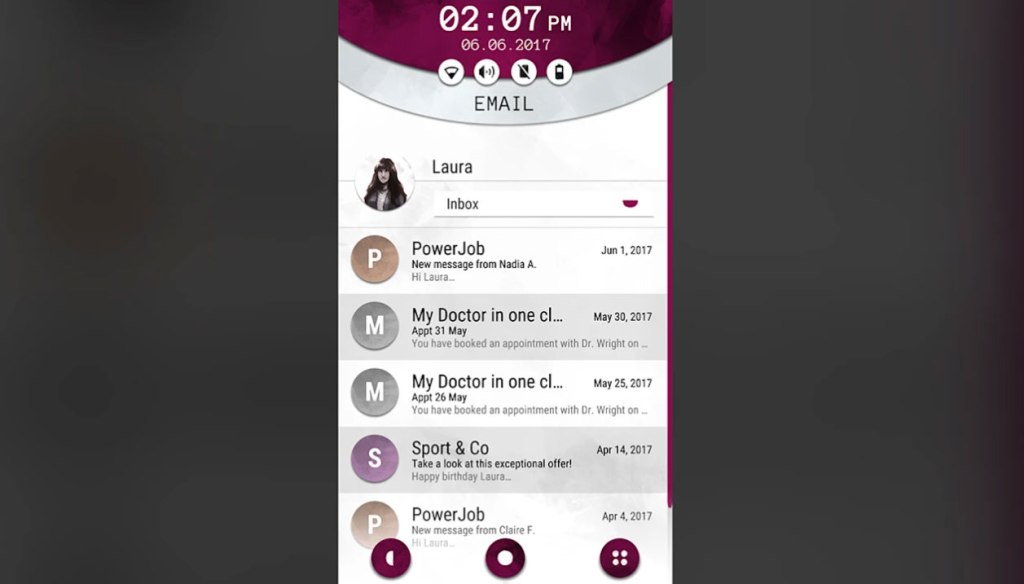
Another Lost Phone, like its predecessor A Normal Lost Phone, is a Visual Novel presented in the form of a Simulation of a smartphone. Players take the role of a random person who found a smartphone and is trying to figure out who it belonged to, what led to them losing the phone, and possibly how to return it to them. This game was released on mobile devices and PC in 2017, and ported to Nintendo Switch in 2018.
Like the first game, the presentation here is good, presenting a mostly reasonable facsimile of a smartphone, although not one with an OS that resembles anything that exists in real life. There are a few omissions and exceptions that slightly break this simulation – there’s no address book for starters, although that may be a necessary evil to prevent players from having a plausible way to instantly solve the problem of what return address to send it to. Also, all of the “photographs” on the phone are hand-drawn artwork. Overall, the visuals here are good, but nothing truly impressive in any way.
The sound is handled in a clever way – the game’s soundtrack is technically diegetic, with the phone playing through the phone’s music tracks right from the start, but at any time players can go to the simulated music player to shut it off, go to a specific track, or play a song in shuffle or turn on shuffle mode. Failing to do the latter means that once the game runs through all of the music, you’ll be listening to dead silence until you head into the music player and start it up again, a nice touch. However, doing things this way means that the game can’t possibly play music fitting to what you’re reading at any given time, making for some mood dissonance. In any case, what’s here is a good mix of some nice mostly subdued indie music as well as some instrumental themes. Some of the noteworthy tracks here include Another Train, True Love, and Rain Sticks
The story here is told in a nonlinear fashion that’s still cleverly set up to only allow players to access certain information once they’ve properly processed other parts of the story – passwords players need to get to some of the more sensitive information must be gleaned from information conveyed through various messages and other information within the phone (or, more likely, a Google search, though I’ll get back to this in a moment). This allows players to gradually get exposed to the story’s secrets.
Here’s the short, non-spoilery version – the events depicted on the phone take place between August 1, 2016 and June 6, 2017. Players are introduced to the game with messages to the phone’s owner, Laura, from her boyfriend, Ben. Laura has disappeared and Ben is worried sick about her. Further exploration of their conversations reveals Laura and Ben had a dream love life, but Laura was apparently having problems with work. Or at least, that’s how things appear at first, but as with the first game, there’s more going on here than initially seems to be the case.
Overall, like the first game, I would say this feels like a fairly organic, well-told and grounded story, one with some good emotional weight to it and some strong, memorable characters. I should note that while this game has the same basic gameplay premise as the first game, the story, characters, and topic matter of this game are completely different and unconnected to A Normal Lost Phone, so don’t expect to find any continuation of their story here. On the whole, I think I liked this story a little bit better than A Normal Lost Phone, as I felt like the late-game content was handled a bit better here, and there are multiple possibilities in this game for what could be behind the mysterious events, keeping players guessing what’s really going on for longer than in the first game.
While mostly I find this game’s story better, it does still have the issue of the same ethical implications involved with even playing the game – you are basically a stranger who graduates from trying to find the phone’s owner to someone snooping into this person’s life, to outright stalking them via any means available to uncover their hidden secrets. There’s a message in the epilogue essentially excusing this behavior, but it does so after the fact, and I couldn’t blame some players for getting a bad taste in their mouths just based on the game’s premise alone.
However, while I find the story here to be better, the gameplay is unfortunately worse.
Let’s start with the controls. As with the first game, since it’s a simulation of a smartphone, the ideal platform to play this game on is… well, a smartphone. Once again, the Nintendo Switch makes for a solid second choice when playing the game in handheld mode – the touchscreen works well here, and the game supports playing in a vertical orientation to make it like playing on an extra-large smartphone.
Unfortunately, things are different in docked mode. While the first game used serviceable gamepad controls to navigate the smartphone, this time around players must use a single Joy-Con’s gyroscopic motion controls to simulate a touchscreen. More realistic? Sure. But also far more inconvenient, especially with all the text scrolling players must do in the game, requiring players to move the pointer up on the screen, hold down a button, and drag it down. Doing the same action in the first game only required pressing down on the analog stick, which seems to be disabled in this game. While I understand the desire to simulate realism as much as possible, gameplay should always come first in a game, and this game’s gameplay suffers due to these changes.
That’s not the only way the gameplay here is worse, either. Where the first game occasionally required players to do a lot of hunting around and guesswork to find the passwords needed to progress the story, this game makes that process exponentially more complex, forcing players to hunt down information from multiple sources at a time to pass these progress gates, often with it being unclear where to retrieve the necessary info. If you’re playing the game with a walkthrough or simply Googling the answers, you shouldn’t have to rough a time with it, but trying to deduce this game’s passwords through the game itself is a hellish process that saps the fun out of the experience.
In the end, like its predecessor, Another Lost Phone is a game that’s better when played on a smartphone, but this time around things are worse due to terrible controls in docked mode and puzzles that require collection of obscure information from so many places, you’re pretty much forced to look up answers on Google. It’s a shame because I like the story in this game better, and $6 for roughly 2 hours of solid story seems like a pretty good deal, but overall I can’t ignore the fact that this is a worse experience due to the gameplay changes that were made, and unless you were a fan of the first Lost Phone game, I’d say you’re better off avoiding its sequel.
tl;dr – Another Lost Phone is a Visual Novel told in the form of a Simulation of a smartphone that players have found and are trying to look through to uncover the story of what happened to its owner. The story here is excellent, but the changes made to the interface and puzzle design this time around make for a much worse experience. If you play this game in handheld mode and don’t mind keeping a walkthrough on hand for the puzzles, you may enjoy this game, but everyone else is better off avoiding it.
Grade: C
You can support eShopperReviews on Patreon! Please click HERE to become a Sponsor!
This month’s sponsors are Andy Miller, u/wonderponder, Johannes, Stov, Ilya Zverev, Eli Goodman, and KC. Thank you for helping to keep the reviews coming!
 eShopperReviews
Leave a comment