
Atelier Ayesha: The Alchemist of Dusk DX
Genre: Turn-Based JRPG
Players: 1
.
Review:
Note: This game is included in the Atelier Dusk Trilogy Deluxe Pack bundle along with Atelier Escha & Logy: Alchemists of the Dusk Sky DX and Atelier Shallie: Alchemist of the Dusk Sea DX.
For those unfamiliar with the Atelier franchise, an atelier (it’s a French word that’s normally pronounced “uh-tell-ee-yay”, but the characters in these games pronounce the word “at-lee-ur”) is a workshop or studio used by a craftsman or artisan… or in these games, by an alchemist. The Atelier games are a franchise of JRPGs that focuses on young, almost exclusively female adventurers who seek ingredients they can combine and use to enhance their items, with these crafting mechanics forming a central part of the game.
These games have each been released in a subset series that ties them together with a few of the other games in the franchise both in terms of mechanics, but also in terms of the storyline. I know that for many, the Atelier series can seem somewhat intimidating, but BarrelWisdom.com thankfully has a helpful guide to introduce players to the series. However, for the purposes of this review I’ll try to address where this game fits both into the Atelier franchise as a whole, as well as within its individual sub-series.
.
Atelier Primer: Dusk Series
Atelier Ayesha, originally released on PlayStation 3 in 2013, is the first game of the Dusk series, the sixth series of games in the Atelier franchise, which also contains Atelier Escha & Logy, first released on PlayStation 3 in 2014, and Atelier Shallie, first released on PlayStation 3 in 2015, with all of these games getting improved remakes on the PlayStation Vita in 2015, 2016, and 2017 respectively, with new difficulty modes, new party-switching options, new enemies and costumes, as well as all additional content originally released as DLC. These improved versions were all ported to the Nintendo Switch, PlayStation 4, and PC in 2018, with all platforms getting an Atelier Dusk Trilogy Deluxe Pack Compilation containing all three.
The Dusk series gradually gets away from the overarching time limits the Atelier games are known for, with each successive game in the series having a more casual overall time limit compared to earlier entries in the series, and Shallie removing this limit entirely. They’re also slightly darker in tone than the Arland series.
.
Aye Ayesha?
Well, well.. another Atelier review, another bad pun…
Atelier Ayesha continues the more intense time limits seen in Atelier Totori and Atelier Meruru, where not only does every quest come attached to an in-game time limit it needs to be done by, but every significant in-game action like fighting enemies or grabbing up spell components spends time, requiring players to carefully consider where to invest that time to ensure that goals are completed before their deadline. This game is a bit more relaxed about these goals than prior entries, but it still remains a stressful element looming over your actions.
While Atelier Ayesha is the first game in a new series, in terms of gameplay mechanics this game is fairly reminiscent of Atelier Meruru, and it’s hard not to compare the two. You once again have good pacing and a healthy amount of structure, meaning you’re rarely uncertain where to go and what to do (in fact, you’ll often have multiple goals to pursue at once). And while this game does lack the town-building elements of Meruru, there are some other nice mechanics in its place, like a journal system where players get points for building character relationships that can be spent on character upgrades. On balance, I still prefer Meruru’s approach, but this game’s mechanics have their charms too.
The combat this time is slightly improved, offering more opportunities for assist attacks that were technically present in earlier games, but far less prominent. However, overall Atelier Ayesha is still fairly straightforward and shallow when it comes to combat, and while players now have a better indication when going to a new area will further the plot, exploration is still not nearly as compelling as in other RPGs, with these areas still segmented and relatively small compared to other games in the genre, not providing any truly satisfying feeling of exploring a world, instead of simply going to a new nook of that world to plunder it for resources.
While many parts of Atelier Ayesha are roughly on par with Atelier Meruru, one area that seems to have severely dropped in quality is the game’s story. As this is the first game in a new trilogy, there’s absolutely no need to have played prior games in the series to have a full understanding of this game’s story, for what it’s worth. While the tone of Atelier Ayesha is generally a tad darker, the characters this time around feel poorly-written and one-dimensional. I feel like the localization here is partly at fault for that – at one point in the game’s intro, a character repeatedly offhandedly remarks “I’m under no obligation to tell you this, but…”, something that seems straight out of a poorly-localized anime.
It’s a shame too, because the premise of the story here had potential – Ayesha has a chance encounter at her sister’s grave where she discovers that her sister may not actually be dead, but trapped somewhere that only unlocking the secrets of alchemy can find. Realizing this, she resolves to pack up her things and head out into the world, hoping to find clues about her sister’s situation and develop her skills as an alchemist.
It doesn’t help the story that the voice acting this time around is really grating. However, on the bright side, this game’s soundtrack is excellent. While it still has some annoying “whimsical” tunes, there are also some really excellent instrumental melodies like Reminiscent Hill, Alluring Flower ~ Spring, Sylpheed, If You Walk Down Main Street, North Wind Musette, Laughter in the Frontier, and Fainter Than the Mist. This game is generally seen as having one of the best soundtracks in the series, and it’s easy to see why.
.
So It’s a Delight For Your Ears… But Is It Also a Feast For the Ayesha?
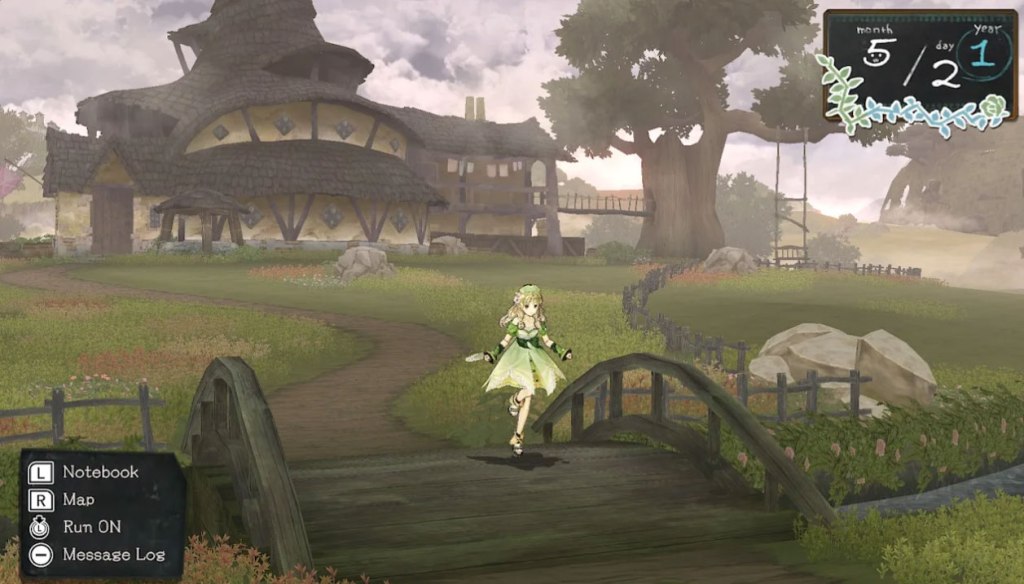
The graphics in this game are a bit of a mixed bag. This is definitely the best-looking game in the series up to this point, with even more detailed and elaborate environments, along with the same excellent cel-shaded anime-style characters the series has down to an art at this point. Unfortunately, this comes with some pretty nasty framerate drops in some areas, despite that this game still doesn’t have anything going on with its visuals that would justify such a hit to the performance. Also, one small but noteworthy issue – the font this game chooses to use is harder to see than prior entries in the series, which can particularly be a pain if you play your Nintendo Switch in portable mode. And of course I once again have to make my complaint about the lack of camera controls, with this leading to being ambushed by enemies as a result.
And of course, here comes my usual comment about how players hoping for features making use of the Nintendo Switch hardware, like gyroscopic motion controls or the touchscreen will not find them here.
Ultimately, while Atelier Ayesha being the start of a new saga gave this Turn-Based JRPG a chance to start anew, it’s so similar to Atelier Meruru in many respects that it’s hard not to compare the two. And while there are certainly areas that show improvement, the terrible story and surprising performance problems make this a game that I feel is on balance worse than its predecessor. It’s still a JRPG with a lot to offer fans of the genre, but that offer comes with quite a lot of issues and problems that bog the game down.
tl;dr – Atelier Ayesha is the first game in the sixth series of Atelier games (the Dusk series), a franchise of JRPGs with a focus on crafting. Even though Atelier Ayesha is the start of a new trilogy, it feels very similar to the prior game, Atelier Meruru. And while this game’s excellent soundtrack and improved visuals are a point in its favor, the terrible story, bad voice acting, and performance issues on Nintendo Switch pair with the series’ focus on deadlines to make for a game that’s not only niche in its appeal, but on balance a worse game than its predecessor. Fans of the Atelier series will likely enjoy this game, but most JRPG players are better off aiming for one of the better games in the franchise.
Grade: C+
You can support eShopperReviews on Patreon! Please click HERE to become a Sponsor!
This month’s sponsors are MB, Andy Miller, Johannes, u/RamboFox, Exlene, Eli Goodman, Ilya Zverev, and Stov. Thank you for helping to keep the reviews coming!
 eShopperReviews
Leave a comment