
Atelier Lulua ~The Scion of Arland~
Genre: Turn-Based JRPG
Players: 1
.
Review:
For those unfamiliar with the Atelier franchise, an atelier (it’s a French word that’s normally pronounced “uh-tell-ee-yay”, but the characters in these games pronounce the word “at-lee-ur”) is a workshop or studio used by a craftsman or artisan… or in these games, by an alchemist. The Atelier games are a franchise of JRPGs that focuses on young, almost exclusively female adventurers who seek ingredients they can combine and use to enhance their items, with these crafting mechanics forming a central part of the game.
These games have each been released in a subset series that ties them together with a few of the other games in the franchise both in terms of mechanics, but also in terms of the storyline. I know that for many, the Atelier series can seem somewhat intimidating, but BarrelWisdom.com thankfully has a helpful guide to introduce players to the series. However, for the purposes of this review I’ll try to address where this game fits both into the Atelier franchise as a whole, as well as within its individual sub-series.
.
Atelier Primer: Arland Series
Atelier Lulua, released in 2019 on PC, PlayStation 4, and Nintendo Switch, is the fourth game of the Arland series, the fifth series of games in the Atelier franchise, which also contains Atelier Rorona, originally released on PlayStation 3 in 2010, Atelier Totori, originally released on PlayStation 3 in 2011 and Atelier Meruru, originally released on PlayStation 3 in 2012, with all of these games getting improved remakes on the PlayStation Vita in 2013 and 2014 with balancing tweaks, as well as all additional content originally released as DLC. These improved versions were all ported to the Nintendo Switch, PlayStation 4, and PC in 2018, with all platforms getting an Atelier Arland Series Deluxe Pack Compilation containing all three. Lulus acts as a sequel to the original trilogy.
The Arland series fits in the Atelier franchise as a “traditional” series of Atelier games, meaning they have an overarching time limit requiring some degree of resource management over the course of the game (except for Lulua, which abandons this element entirely).
.
Please Excuse Me For a Moment While I Make a Trip to the Lulua…
(no, my dedication to this running gag of bad puns in my reviews of Atelier games is not meant to be an indictment on this game’s quality)
While Atelier Lulua is a direct successor to the Arland trilogy, many of the elements of this game make it play much closer to the most recent prior game in the series, Atelier Lydie & Suelle. While the classic games made use of overarching calendar deadlines that the series was once notorious for, Lulua is more in line with modern entries in the franchise, limiting these deadlines to more minor optional side-quests.
Unfortunately, one element of Lydie & Suelle that didn’t carry over to this game was the new Puzzle game-influenced crafting system, with Lulus’s crafting system closer to what was in the games in the series prior to the Mysterious saga. This is okay, it works, but it feels like a step backwards. At the very least, the combat this time around gets a good improvement in the form of a limited ability for Lulua to interrupt the battle even when it’s not her turn to use items, something that makes perfect sense given the importance of alchemists in this setting.
However, when it comes to new gameplay elements, probably the biggest one is a mysterious book Lulua has (no, not that one) that gradually fills with new recipes that must be deciphered using clues almost like a detective game of sorts. While this element is a bit limited, it’s a promising new addition to the Atelier franchise that could be amazing if it’s built on in future installments… which probably means that it won’t be, given what we’ve seen with [previous promising innovations in the series](LINK HERE).
The story this time is once again fairly low-stakes compared to some other entries in the Atelier franchise, but I would say that the quality of writing and the characters are some of the best in the series, with Lulua herself having quite a lot of personality compared to so many interchangeable protagonists throughout the series. And as you might expect, characters from the Arland trilogy make appearances throughout this game, although players don’t need to have played earlier games to understand what’s going on here. Having said that, Lulus being directly related to Rorona makes this one of the games with the strongest ties to another game in the franchise, and as such it is one in which you’ll likely benefit the most from having played previous games in its series.
The story of Atelier Lulua follows Lulua, the daughter of Rorona (yes, [that Rorona](LINK HERE)), who is trying to live up to the legendary status her alchemist mom has achieved. However, at the outset of this story, she’s arrogant, impulsive, irresponsible, and her actual skills as an alchemist are lacking. However, her situation changes when she suddenly finds her path colliding with a mysterious book (as in, it literally hits her in the head) that seems to hold the potential to teach her new and exciting alchemy recipes. Meanwhile, she finds her skills being enlisted by a wealthy new patron that results in her heading on a new adventure.
In the sound department, Lulua’s Japanese dub is decent enough, from what I can tell (not speaking the language myself). And when it comes to the soundtrack, there are some excellent instrumental themes here, like the following examples (with names I unfortunately don’t know, because they’re all in Japanese): 1, 2, 3. Overall, the music in this game is quite good for the series, although I would still say it’s not the best this series has ever had.
.
I Would Compensate You For All These Puns, But Instead You Get Another Pun In Lulua Of Payment
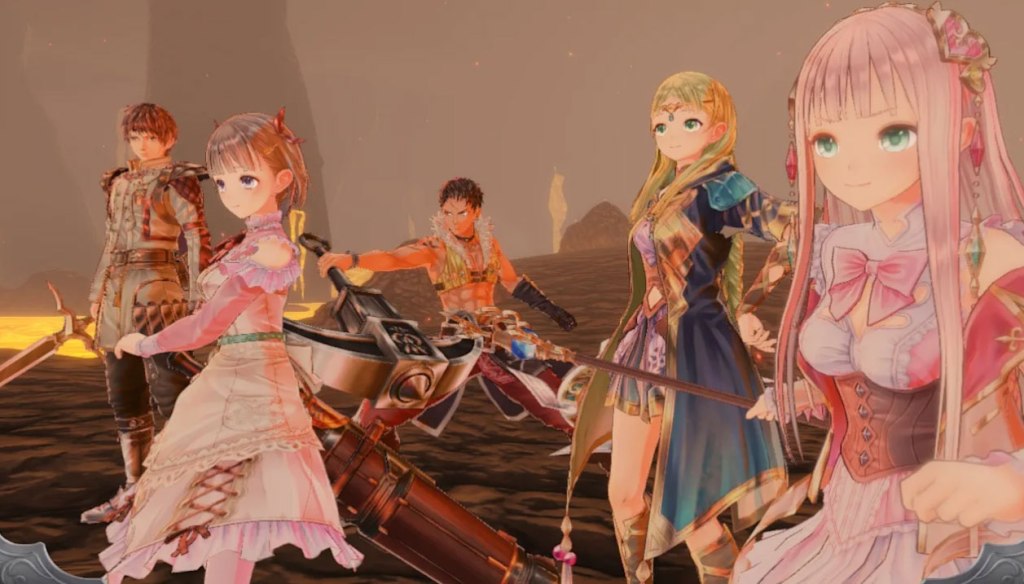
When it comes to graphics, this game once again compares to Atelier Lydie & Suelle, both in good ways and bad. As per usual, the cel-shaded characters look magnificent, and they’re joined by absolutely beautiful, detailed environments with wonderful textures, nice-looking water, good lighting, and I would argue even more detail than Atelier Lydie & Suelle had. This is a very nice-looking game… for the most part.
Much as with Lydie & Suelle, there are occasional framerate drops (particularly in cutscenes), and the return the extremely distracting use of excessive dithering in docked mode (though it once again doesn’t seem to be a problem in handheld mode). Anyway, this issue isn’t terrible enough to make the game look outright ugly, but it definitely mars the otherwise solid presentation of this game.
And now for my usual comments about camera controls (they’re fine here), as well as touchscreen and gyroscopic motion controls (still not present). So… you’re welcome?
I like Atelier Lulua, but it seems like once again the series is delivering a game that makes improvements in some areas, but falls behind prior titles in other areas – the story this time around is great, the improvements to combat are very welcome, and the need to do some detective work to uncover new recipes is an inspired addition to the franchise. Unfortunately, the crafting system seems like a step backwards after the Mysterious trilogy, and the game still has many of the graphical issues that were present in Atelier Lydie & Suelle. Still, even with these issues, Atelier Lulua is one of the best games in the series, and an excellent crafting-focused Turn-Based JRPG.
tl;dr – Atelier Lulua is the fourth game in the fifth series of Atelier games (the Arland series), a franchise of JRPGs with a focus on crafting. A sequel to the original Arland trilogy, this follows the story of Rorona’s daughter Lulua, with some of the best writing and characterization in the series. There are other improvements here too, such as nice additions to the battle system, and the requirement to do some detective work to discover new recipes. Unfortunately, the crafting system isn’t as enjoyable as what we had in the Mysterious series, and the game still has the same performance issues that were in Atelier Lydie & Suelle. Also, for those new to the Atelier franchise, know that you can play this game without playing earlier entries in the series, but this is one of the more continuity-heavy installments in the series. Overall, one of the better entries in the Atelier franchise, but not without its flaws.
Grade: B+
You can support eShopperReviews on Patreon! Please click HERE to become a Sponsor!
This month’s sponsors are MB, Andy Miller, Johannes, u/RamboFox, Exlene, Eli Goodman, Ilya Zverev, and Stov. Thank you for helping to keep the reviews coming!
 eShopperReviews
Leave a comment