
Atelier Meruru ~The Apprentice of Arland~ DX
Genre: Turn-Based JRPG
Players: 1
.
Review:
Note: This game is included in the Atelier Arland Series Deluxe Pack bundle along with Atelier Rorona ~The Alchemist of Arland~ DX and Atelier Totori ~The Adventurer of Arland~ DX.
For those unfamiliar with the Atelier franchise, an atelier (it’s a French word that’s normally pronounced “uh-tell-ee-yay”, but the characters in these games pronounce the word “at-lee-ur”) is a workshop or studio used by a craftsman or artisan… or in these games, by an alchemist. The Atelier games are a franchise of JRPGs that focuses on young, almost exclusively female adventurers who seek ingredients they can combine and use to enhance their items, with these crafting mechanics forming a central part of the game.
These games have each been released in a subset series that ties them together with a few of the other games in the franchise both in terms of mechanics, but also in terms of the storyline. I know that for many, the Atelier series can seem somewhat intimidating, but BarrelWisdom.com thankfully has a helpful guide to introduce players to the series. However, for the purposes of this review I’ll try to address where this game fits both into the Atelier franchise as a whole, as well as within its individual sub-series.
.
Atelier Primer: Arland Series
Atelier Meruru, originally released on PlayStation 3 in 2012, is the second game of the Arland series, the fifth series of games in the Atelier franchise, which also contains Atelier Rorona, originally released on PlayStation 3 in 2010 and Atelier Totori, originally released on PlayStation 3 in 2011, with all of these games getting improved remakes on the PlayStation Vita in 2013 and 2014 with balancing tweaks, as well as all additional content originally released as DLC. These improved versions were all ported to the Nintendo Switch, PlayStation 4, and PC in 2018, with all platforms getting an Atelier Arland Series Deluxe Pack Compilation containing all three. It also bears mention that there was one more game in the Arland series, released long after the other three – Atelier Lulua, which released on PC, PlayStation 4, and Nintendo Switch in 2019, and is a sequel of sorts to the earlier trilogy of games.
The Arland series fits in the Atelier franchise as a “traditional” series of Atelier games, meaning they have an overarching time limit requiring some degree of resource management over the course of the game (except for Lulua, which abandons this element entirely).
.
A dream? Or a nightMereru?”
Hmm… I seem to be using a lot of puns in these Atelier reviews… wonder if I can keep that up…
Atelier Meruru once again brings back Totori’s extra-high level of time limits, where not only does every quest come attached to an in-game time limit it needs to be done by, but every significant in-game action like fighting enemies or grabbing up spell components spends time, requiring players to carefully consider where to invest that time to ensure that goals are completed before their deadline.
However, this time around, the game brings back the structure that was present in Atelier Rorona and completely lacking in Atelier Totori, and it certainly helps to deal with the stress of a time limit when you have a better idea of what you’re supposed to be doing. In fact, one of this game’s features is that you’re shown real signs of your progress, as your goals in the game are represented by helping the kingdom you’re in to flourish, resulting in new residents moving in, something reflected in the game’s hub town. And due to all of this and a much better pacing, Meruru has a much better feeling of progression than either of the two games that preceded it.
Meruru also brings back the quality-of-life elements that were inexplicably stripped out of Atelier Totori, such as fast travel and the ability to see your home’s storage even when not at home, both extremely welcome features I’m glad to see returning, though it seems strange to celebrate this since I can’t fathom why they were removed from Atelier Totori in the first place.
However, while Atelier Meruru does make some good improvements over its two predecessors, one area that’s as dull and old-fashioned as ever is the game’s combat system, which is still quite shallow, and there’s still little in the way of meaningful exploration beyond accessing new areas purely for the purpose of finding a wider range of ingredients.
However, for the first time in the Arland saga, I actually find myself enjoying the game’s plot. While nothing truly groundbreaking within the genre, Atelier Meruru’s strong characters and good writing are the best in this series so far, bringing not only the same kind of charm that shone through the weak plot of Atelier Rorona, but also getting you invested in the story, which follows the titular Meruru, the young princess of a small kingdom and apprentice to a slightly-older version of the previous game’s Totori, with the young princess striving to fulfil her dream of being an alchemist while trying to balance that out with the responsibilities of serving her kingdom.
The voice acting this time around is once again excellent, and while the eclectic soundtrack still seems like it can’t decide whether it wants to be whimsical or grandiose, modern or old-fashioned, there are actually a few themes this time that are quite good, like Cadena (Instrumental), Cloudy (Instrumental), Atelier Meruru, and Forest Dance.
.
Taking a Long Look in the Meruru
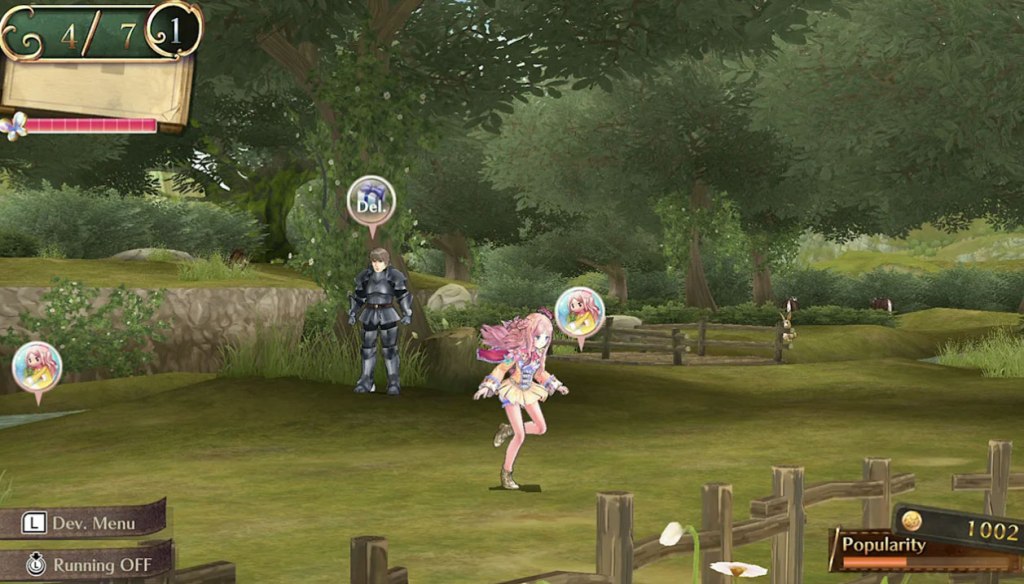
And then, finally, for the first time we have an Atelier game that actually looks like it belongs in this generation, or at least in the mid-to-late PlayStation 3 generation, marking a huge leap over the previous two games. The cel-shaded character designs are once again gorgeous, but this time around the game also offers 3D environments that have some good detail as well, with a lot of personality. It’s still far from anything impressive, but at least this series is starting to look respectable by modern standards, albeit with a caveat – I did notice the framerates dropping slightly at some points. This game also once again stubbornly refuses to let players do anything with the camera other than slightly zooming in, making it easy for enemies to sneak up on you from off the camera.
However, once again players hoping for features making use of the Nintendo Switch hardware, like gyroscopic motion controls or the touchscreen will be disappointed – this game uses neither.
Still, while it has its rough spots, and the strict in-game time limits may not be to everyone’s liking, Atelier Meruru is a strong entry in the Atelier franchise. After the endearing but underwhelming Atelier Rorona, and the outright disappointing Atelier Totori, Atelier Meruru brings to the series a much improved pacing, as well as a presentation that’s far superior to its predecessors. If you’re looking to enjoy a more “traditional” Atelier game that maintains the series’ looming deadlines, Atelier Meruru is an excellent starting point. I know that some may balk at the idea of jumping into a trilogy in the third entry, but I’d argue that the Arland trilogy is light on story, and this game is such a marked improvement over the previous two games, so there’s little reason not to jump straight to Meruru.
tl;dr – Atelier Meruru is the third game in the fifth series of Atelier games (the Arland series), a franchise of JRPGs with a focus on crafting. Meruru is a marked improvement over the prior two games in multiple ways – it features a much better pacing and feeling of progression, it brings back quality-of-life elements that were stripped out of Atelier Totori, it has a better soundtrack than either of the two prior games, and much better graphics. This still isn’t going to be a game for everyone – the overbearing deadlines on quests are still likely to frustrate more casual RPG players. But for those wanting a “traditional” Atelier game, this is the best one yet in the series.
Grade: B-
You can support eShopperReviews on Patreon! Please click HERE to become a Sponsor!
This month’s sponsors are MB, Andy Miller, Johannes, u/RamboFox, Exlene, Eli Goodman, Ilya Zverev, and Stov. Thank you for helping to keep the reviews coming!
 eShopperReviews
Leave a comment