
Atelier Ryza: Ever Darkness & The Secret Hideout
Genre: JRPG
Players: 1
.
Review:
For those unfamiliar with the Atelier franchise, an atelier (it’s a French word that’s normally pronounced “uh-tell-ee-yay”, but the characters in these games pronounce the word “at-lee-ur”) is a workshop or studio used by a craftsman or artisan… or in these games, by an alchemist. The Atelier games are a franchise of JRPGs that focuses on young, almost exclusively female adventurers who seek ingredients they can combine and use to enhance their items, with these crafting mechanics forming a central part of the game.
These games have each been released in a subset series that ties them together with a few of the other games in the franchise both in terms of mechanics, but also in terms of the storyline. I know that for many, the Atelier series can seem somewhat intimidating, but BarrelWisdom.com thankfully has a helpful guide to introduce players to the series. However, for the purposes of this review I’ll try to address where this game fits both into the Atelier franchise as a whole, as well as within its individual sub-series.
.
Atelier Primer: Secret Series
Atelier Ryza, released on PC, PlayStation 4, and Nintendo Switch in 2019, is the first game in the Secret series, the eighth series of games in the Atelier franchise, which also includes Atelier Ryza 2, released on PC, PlayStation 4, and Nintendo Switch in 2021, and Atelier Ryza 3, released on PC, PlayStation 4, and Nintendo Switch in 2023. Unlike many of the games in the Atelier franchise, these games contain no overarching time limits, and feature an “ATB” system that has players selecting commands from menus in real-time.
.
The Ryza of a New Age
Thanks for sticking with me through all of these puns…
Atelier Ryza is a huge leap in the series, more than any other entry prior. So much was changed this time, addressing many of the complaints that have been made about the franchise over the years, and as a result, this is a game that has been celebrated even outside of this series’ usual fanbase, all while not only retaining the charm this series is known for, but bringing that charm into the modern generation of games on the level with other major franchises.
The calendar deadlines of past games in the franchise are gone. The segmented environments of prior games, while still present here, feels much more contiguous, with large areas that do a better job of flowing into one another – this game doesn’t feel quite as vast and open as Atelier Firis did, but it stretches in that direction, and with environments far more filled with their own unique personality.
The crafting system this time around uses a new “material loop” system that has a lot of depth and gives players plenty of options when crafting items. However, it is nowhere near as user-friendly and intuitive as the Mysterious trilogy’s Tetris-like crafting system, and even after this game takes you through the process step by step, you still may want to consult a wiki to get the most out of it.
However, the biggest gameplay change in Atelier Ryza may be the combat system, which has been completely reworked while still remaining faithful to the core mechanics to combat in prior games. As mentioned above, combat now uses an “ATB”-style system that has players selecting their combat actions in real-time while allies and enemies don’t wait for the player to make their moves.
What’s more, this game makes use of multiple new mechanics that add an immense amount of depth and strategy to combat, with players having an ability point gauge that grows with each normal attack and can be expended on special attacks, saved up to upgrade your party’s attacking ability for the remaining duration of combat, or used to have a character jump in out of turn to quickly use an item or a special attack. In addition, players can now equip to each character a small assortment of items that can be infinitely re-used, but must be re-charged by a trip back home after a finite number of uses. This latter system works itself back into the game’s crafting, encouraging players to craft the most powerful items possible, and similarly encourages them to make liberal use of those items.
These new mechanics make Atelier Ryza’s combat not only the best this series has ever seen, but some of the best combat I’ve seen in a JRPG. And while it’s now all so fast-paced that it can be easy to get lost in the flurry of actions, the wealth of options available to players in combat is truly fantastic.
In addition to the confusion regarding the new crafting system, I do have one other complaint about the gameplay, and that is that it’s not clear how players are supposed to make money in Atelier Ryza. Money earned through combat is minimal, gathered and synthesized items sell for a pittance, and there doesn’t appear to be any sort of job board like previous games had. My attempts to find answers to this question led me to fans suggesting that players spend an hour grinding at a water source to then turn around and sell the infinitely-gathered resource and… no, I’m not going to do that. Grinding in a videogame is one thing, but just staying in one spot and endlessly tapping one button is not gameplay, it’s work.
While the gameplay has its ups and downs, the story in Atelier Ryza is leaps and bounds beyond prior games, with far more three-dimensional characters, and an overall more cinematic approach to storytelling than prior games. Ryza is a young island-dwelling girl who feels stifled by her hometown, and dreams of someday leaving the island and seeking adventure. One day, while sneaking off with her friends, they have a chance encounter with a group of real adventurers, which opens their eyes to new possibilities. Ryza’s muscular friend Lent is stunned at the fighting ability of the adventurers, and finds himself craving to learn how to improve as a combatant. Ryza’s scholarly friend Tao is overjoyed at the discovery that one of the adventurers speaks the language he’s spent his life hoping to translate. But Ryza herself immediately falls in love with the art of alchemy, which she sees as a way to open a door into the life she had always dreamed of having. Overall, the story here is relatively slow-paced and low-stakes, but it is so well-told and its characters are so instantly endearing (particularly Ryza herself) that it’s hard not to be instantly charmed by it.
Like other recent games in the series, Atelier Ryza is dubbed only in Japanese. However, even not speaking the language myself, the difference in the acting this time around is palpable. Again, Ryza herself is the real star here, with voice actress Yuri Noguchi doing so much great emotional work with the character that it reaches across language barriers. And all of this is backed by an absolutely beautiful instrumental soundtrack with a lot of good piano and brass parts, with wonderful songs like Solramimi, Before the Second Star Lights Up, Quiet Wind, Dreaming Ruins, and Count the Constellations, to name a few. In short, this game sounds gorgeous, and gives the game the feel of a Miyazaki film, which is perfectly-suited to this game’s story and the rest of its presentation.
.
Ryza Against the Machine?
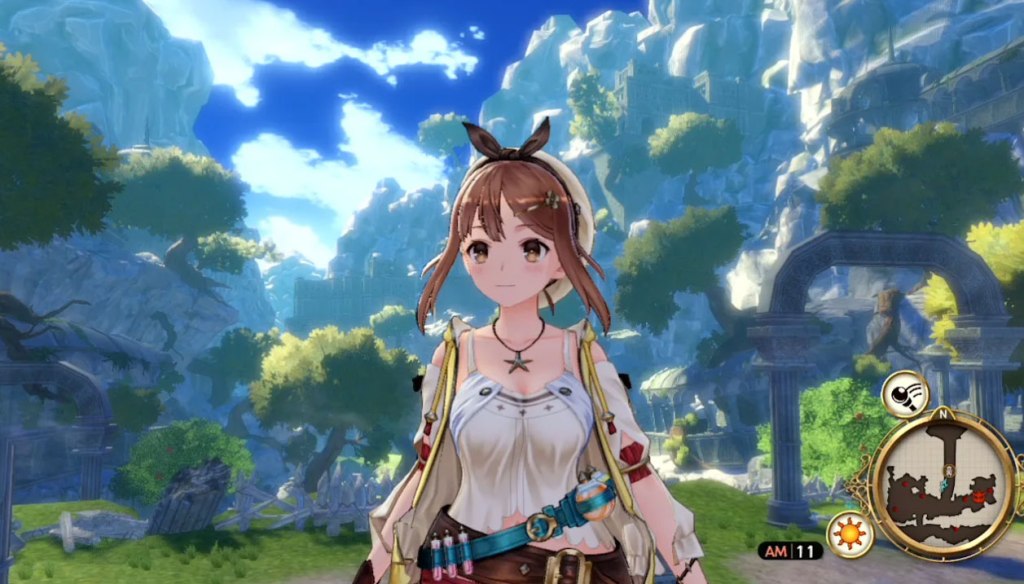
When it comes to the graphics, I have some nitpicking to do, but first I have a lot of praise. Save for the issues I’ll address in a moment, Atelier Ryza is quite simply a gorgeous game, leaps and bounds beyond prior entries in the series. Of course I have to mention the game’s great cel-shaded anime-style characters, but by now that’s nothing new for the series. What is new, however, is just how gorgeous this game’s environments are. The amount of detail and personality invested into these locations is magnificent, the wonderful use of lighting and shadow, great-looking water. And all of this in service of a truly excellent artistic design that again embodies a spirit reminiscent of a Miyazaki film.
However, now’s where I talk about those issues I mentioned a moment ago. The Nintendo Switch version of Atelier Ryza has a number of graphical and performance issues that mar the otherwise spectacular presentation somewhat. Now, I should mention that many of these issues are also present in the playStation 4 version of the game, but they’re still worth noting here. Atelier Ryza has a lot of nasty aliasing, and while the shadows do a lot to build the atmosphere of the game, the quality of those shadows in the Nintendo Switch version is greatly lacking, with low shadow resolution and a fair amount of shadow flickering.
However, these issues are once again overshadowed by a greater problem that has plagued the Atelier franchise for at least the last few installments – some really nasty, overbearing dithering. Thankfully, this issue is far less noticeable in handheld mode. And even with all of these issues, this game still looks pretty close to the PlayStation 4 version of the game, and it’s still an absolutely gorgeous game, even if the technical issues make me hesitate to say it’s one of the best-looking games on Nintendo Switch.
At this point, I only mention the camera controls, touchscreen, and gyroscopic controls to keep these Atelier reviews consistent, but here goes anyway. The camera works fine here, no complaints. And there’s no touchscreen or gyroscopic motion controls.
There is one other thing I should note here, actually. I’ve reviewed numerous entries in the franchise thus far, and for a few of those games, I’ve pointed out that the game I was reviewing would make a good entry point for the series, and I stand by that. However, players looking for one definitive place to dive into the series, this is it. By this point, the series has shed many of the issues of its past, but even more than that, Ryza comes into its own as a truly spectacular JRPG, and not just a good Atelier game. I cannot stress enough how Atelier Ryza is leaps and bounds beyond prior entries in the franchise, in its gameplay, its story and characters, and in its graphics and presentation.
This game is so very close to an ideal that the Atelier series has been striving for, but it just barely misses that mark due to a few obtuse and confusing gameplay elements and a few graphical issues on Nintendo Switch. Do not get me wrong, Atelier Ryza is still a magnificent, must-play JRPG, it just pains me to see these issues holding it back when otherwise this is an absolutely brilliant game. Still, if you’re a fan of JRPGs, do not let those complaints keep you from getting this game – it is still an absolutely beautiful experience that is a delight to play on Nintendo Switch.
tl;dr – Atelier Ryza is the first game in the eighth series of Atelier games (the Secret series), a franchise of JRPGs with a focus on crafting. Ryza is leaps and bounds beyond prior games in the series, both in terms of the quality of its gameplay, its wonderful characters and story, and in its absolutely gorgeous presentation. This is not just a great Atelier game, this is a great, must-play JRPG, full stop. It is only some frustrating graphical issues and a few confusing gameplay elements that keep this from being a contender for the title of best JRPG on Nintendo Switch.
Grade: A-
You can support eShopperReviews on Patreon! Please click HERE to become a Sponsor!
This month’s sponsors are MB, Andy Miller, Johannes, u/RamboFox, Exlene, Eli Goodman, Ilya Zverev, and Stov. Thank you for helping to keep the reviews coming!
 eShopperReviews
Leave a comment