
Atelier Sophie 2: The Alchemist of the Mysterious Dream
Genre: Turn-Based JRPG
Players: 1
.
Review:
For those unfamiliar with the Atelier franchise, an atelier (it’s a French word that’s normally pronounced “uh-tell-ee-yay”, but the characters in these games pronounce the word “at-lee-ur”) is a workshop or studio used by a craftsman or artisan… or in these games, by an alchemist. The Atelier games are a franchise of JRPGs that focuses on young, almost exclusively female adventurers who seek ingredients they can combine and use to enhance their items, with these crafting mechanics forming a central part of the game.
These games have each been released in a subset series that ties them together with a few of the other games in the franchise both in terms of mechanics, but also in terms of the storyline. I know that for many, the Atelier series can seem somewhat intimidating, but BarrelWisdom.com thankfully has a helpful guide to introduce players to the series. However, for the purposes of this review I’ll try to address where this game fits both into the Atelier franchise as a whole, as well as within its individual sub-series.
.
Atelier Primer: Mysterious Series
Atelier Sophie 2, released in 2022 on PC, PlayStation 4, and Nintendo Switch, is the fourth game of the Mysterious series, the seventh series of games in the Atelier franchise, which also contains Atelier Sophie, released on PlayStation 3 in Japan only and later brought to the West on PlayStation 4 and PlayStation Vita in 2016, Atelier Firis on PlayStation 4 and PlayStation Vita in 2017, and Atelier Lydie & Suelle on PC, PlayStation 4, and Nintendo Switch in 2018, with all of these earlier games getting improved remakes on the PC, PlayStation 4, and Nintendo Switch in 2021, with all additional content originally released as DLC, as well as new content, with all platforms getting a Mysterious Trilogy Deluxe Pack compilation containing all three games.
The mysterious series is generally fairly light on the overarching time limits the Atelier games are known for, with Atelier Sophie 1 & 2 and Atelier Lydie & Suelle not having any overall limit, and Atelier Firis having a fairly relaxed overarching time limit.
Having said that, there are a few other elements that tie together the Mysterious trilogy. Each of these games adds a Puzzle game-style element to the alchemy creation process, effectively having the player slot Tetris-like pieces into a grid, with each of the games doing this slightly differently. The Mysterious games also change the way you acquire new recipes – instead of getting them in recipe books, you get them when “inspired” through the completion of tasks.
.
Sophie-rior to Its Predecessor?
That’s right, I haven’t forgotten my heavy use of puns in these reviews…
When I reviewed the original Atelier Sophie, I complained that it was bland and unambitious, with tired mechanics and an extremely low-stakes story. Thankfully, Sophie 2 is an improvement in both of these areas.
When it comes to gameplay mechanics, Sophie 2 adds a new controllable weather system giving players access to different versions of the same area – for example, a rainy version of an area may have a path submerged under water and may provide some resources that aren’t present when things are sunny. There’s also a new combat mechanic, the Twin Action system, which enables players to set up combo attacks between a designated “front line” and “back line” of your party, or to have back line combatants step in to take a hit meant for a front line combatant with some damage reduction. It’s nothing extraordinary for the genre, but it’s interesting enough to make this game’s combat engaging.
This game also provides some fairly large areas for players to explore and search for resources in, and while not quite an Open-World game, the environments still allow for a lot of freedom. Plus, the game’s weather system pretty much guarantees that you’ll be exploring these areas multiple times.
And as mentioned earlier, this game sees the return of the “Tetris-like” alchemy crafting system, probably my favorite in the series, which has players carefully considering each ingredient they use not only for its potency and effects, but also its shape on the game’s ingredient grid. Players don’t have to concern themselves with the deeper mechanics of this alchemy system if they don’t want to, but it’s wonderfully rewarding for players who are more detail-oriented.
The other major change this game received is to its story… which is to say that this time, it has one. Okay, okay, that may be a bit harsh – the original Atelier Sophie did have a story, as dull and disposable as it may have been, and Atelier Sophie 2 even kindly offers players a recap of that story on the main menu. The short version is that titular protagonist and designated alchemist Sophie comes across a magical alchemy book that’s alive and calls itself Plachta, and Sophie must do a bunch of alchemy to try to return its memories and, hopefully, its humanity. Eventually, the pair confront the villain responsible for transforming Plachta into a book, and Sophie finds a makeshift solution to Plachta’s plight by transforming book-Plachta into lifesize doll-Plachta.
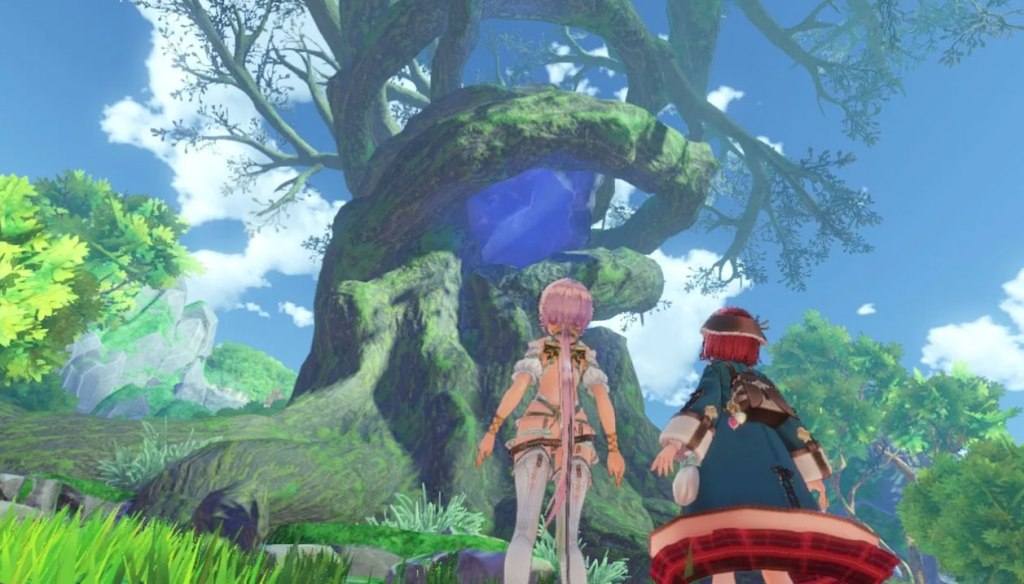
Atelier Sophie 2 (which takes place after Atelier Sophie and before all the other games in the Mysterious series), follows Sophie and doll-Plachta as they leave Sophie’s home and travel the world looking for some way to return Plachta to her actual human body. In their journey, they encounter a magical tree that opens a portal that whisks them off into another world, supposedly a land of dreams. Upon arriving at the dream-town of Roytale, Sophie finds herself trying to figure out just where she is, and she quickly seeks the help of the town’s friendly residents to find Plachta, who has gone missing. However, Sophie soon finds out that this mysterious place seems to have ties to both hers’ and Plachta’s past.
As Atelier stories go, this is far from top-tier, but it’s a fair sight better than one of the worst stories in the Atelier franchise. The characters are still somewhat lacking in distinct personalities (it’s all just variations on “friendly, helpful, and enthusiastic”), but I’ll take what I can get.
.
A True VirtuoSophie?
Atelier Sophie continues the series’ current trend of including only untranslated Japanese vocals. Mostly these are fine, though it can definitely get annoying when you’re thinking your way through an alchemy synthesis and Sophie just won’t shut the heck up. On the bright side of things, the instrumental soundtrack this time around is quite nice, with some really catchy and occasionally moving pieces like Somewhere In Between and its nighttime counterpart, Sometime In Between, Sunny Piacere, So Much Fun, and Chained Dreams, to name a few.
The graphics are pretty good too. The cel-shaded character models, of course, still look fantastic (the series never seems to fail in this regard), though I will note that the animations and facial expressions could use some work – these characters seem a bit too unnatural and robotic to my eye. In addition to this, you have some really great environmental detail, and environments that actually look somewhat imaginative at times now (unlike the extremely generic locales of the first Atelier Sophie). There are even some conceptually beautiful sights, like a beautiful night sky and some appropriately magical forest lighting.
On the performance side, there is some noticeable pop-in, and there are some times where the framerate dips for a brief moment, and sometimes the game’s heavy use of blurring to show camera focus gets to be a bit too excessive and doesn’t exactly play well with the cel shading. However, mostly this is a very good-looking game on Nintendo Switch, and one that thankfully doesn’t dip into the franchise’s frequent use of heavy dithering.
Oh, and since I’ve been continuously commenting about the camera controls in this series, the camera in Atelier Sophie 2 is… fine. Yeah, by this point, these games actually have a working camera to the point where I only mention it here for the sake of consistency.
And of course, it wouldn’t be an Atelier review without me mentioning the lack of Nintendo Switch features like gyroscopic motion controls or the touchscreen. And… yup, they’re not here either, even when it would seem to fit the new puzzle elements of the alchemy synthesis system pretty well.
All in all, Atelier Sophie 2 isn’t quite my favorite Atelier game (the Ryza games’ gorgeous soundtracks, great characters, and exciting world to explore still make them the franchise’s pinnacle in my mind), but it’s one of the better ones, and a huge improvement over the original Atelier Sophie. It’s biggest flaws are probably its uninteresting characters and its still somewhat lacking originality. However, even with these issues, this is still a solid JRPG well worth playing.
tl;dr – Atelier Sophie 2 is the fourth game in the seventh series of Atelier games (the Mysterious series), a franchise of JRPGs with a focus on crafting. Sophie 2 is a huge improvement over its predecessor, with a more interesting story, some fun new gameplay mechanics, and the same great crafting system the original game did so well. Its characters are still a bit uninteresting, and it still largely plays things a bit too safe, but despite this Atelier Sophie 2 is a solid entry in the franchise, and a very good Turn-Based JRPG.
Grade: B+
.
This game has been nominated for one or more of eShopperReviews 2022 Game Awards:
Runner-Up: Best RPG, Best Music, Best Song (Somewhere In Between, by Kazuki Yanagawa, Daisuke Achiwa, Tatsuya Yano, and Ryudai Abe)
.
You can support eShopperReviews on Patreon! Please click HERE to become a Sponsor!
This month’s sponsors are Andy Miller, Exlene, Homer Simpin, Johannes, Talissa, Eli Goodman, Francis Obst, Gabriel Coronado-Medina, Ilya Zverev, Kristoffer Wulff, and Seth Christenfeld. Thank you for helping to keep the reviews coming!
 eShopperReviews
Leave a comment