
Atelier Totori ~The Adventurer of Arland~ DX
Genre: Turn-Based JRPG
Players: 1
.
Review:
Note: This game is included in the Atelier Arland Series Deluxe Pack bundle along with Atelier Rorona ~The Alchemist of Arland~ DX and Atelier Meruru ~The Apprentice of Arland~ DX.
For those unfamiliar with the Atelier franchise, an atelier (it’s a French word that’s normally pronounced “uh-tell-ee-yay”, but the characters in these games pronounce the word “at-lee-ur”) is a workshop or studio used by a craftsman or artisan… or in these games, by an alchemist. The Atelier games are a franchise of JRPGs that focuses on young, almost exclusively female adventurers who seek ingredients they can combine and use to enhance their items, with these crafting mechanics forming a central part of the game.
These games have each been released in a subset series that ties them together with a few of the other games in the franchise both in terms of mechanics, but also in terms of the storyline. I know that for many, the Atelier series can seem somewhat intimidating, but BarrelWisdom.com thankfully has a helpful guide to introduce players to the series. However, for the purposes of this review I’ll try to address where this game fits both into the Atelier franchise as a whole, as well as within its individual sub-series.
.
Atelier Primer: Arland Series
Atelier Totori, originally released on PlayStation 3 in 2011, is the second game of the Arland series, the fifth series of games in the Atelier franchise, which also contains Atelier Rorona, originally released on PlayStation 3 in 2010 and Atelier Meruru, originally released on PlayStation 3 in 2012, with all of these games getting improved remakes on the PlayStation Vita in 2013 and 2014 with balancing tweaks, as well as all additional content originally released as DLC. These improved versions were all ported to the Nintendo Switch, PlayStation 4, and PC in 2018, with all platforms getting an Atelier Arland Series Deluxe Pack Compilation containing all three. It also bears mention that there was one more game in the Arland series, released long after the other three – Atelier Lulua, which released on PC, PlayStation 4, and Nintendo Switch in 2019, and is a sequel of sorts to the earlier trilogy of games.
The Arland series fits in the Atelier franchise as a “traditional” series of Atelier games, meaning they have an overarching time limit requiring some degree of resource management over the course of the game (except for Lulua, which abandons this element entirely).
.
We’re Not in Kansas Anymore, Totori
Where Rorona attached a time limit to every goal and quest, Totori steps up this element of the series by making even small tasks cause time to pass – every turn in a battle takes time out of your day, and every time you gather resources, you’ll see this element dwindle down. At this point, this element of the series feels almost punitive.
Given how rigorously Atelier Totori wants players to watch their schedule, it seems oddly lax in its progression, with players early on sometimes left wondering what to do next, or stumbling into seemingly random events evidently necessary to trigger progression. It’s frustrating that a game so demanding that players keep track of their in-game time simultaneously seems to be so nonchalant about wasting their real time.
This frustration follows through to the removal of quality-of-life elements that were in Atelier Rorona – gone are the convenient fast-travel town options, as are the ability to quickly check your home’s storage from within town. It’s absurd that I would be talking to a character offering a quest and find myself wondering if I have the necessary items to complete the quest… and have to trudge all the way back to my character’s home (at least three loading screens away) to find out.
And once again, were it not for this micromanagement of resources, Atelier Totori would be a fairly by-the-books Turn-Based JRPG. The battle system is still quite shallow, there’s still little in the way of meaningful exploration beyond accessing new areas purely for the purpose of finding a wider range of ingredients, and you’re still not likely to play this game for its plot.
On that note, Atelier Totori’s plot, characters, and overall presentation once again fail to be compelling, but this time around much of the charm that was in Rorona is gone, with more one-dimensional characters and even more poorly-localized writing. The plot in this game takes place five years after Atelier Rorona, and follows Totori, a former apprentice of Rorona herself, now aspiring to use her skills to be an adventurer. This is much to the chagrin of her sister, as that lifestyle saw their mother go missing some years ago. While it’s a good setup for a story, it ultimately seems to amount to the two of them squabbling, making for a lot of arguments that boil down to “No!” “But I wanna!” “I said no!” “But I wanna!”
Perhaps in part due to the underwhelming story, the voice acting this time around leaves a lot to be desired. And once again, the soundtrack isn’t particularly great either, with music that can’t seem to decide if it wants to be standard adventurous JRPG fare, or something more whimsical, and as a result often sounds like a confused jumble of half-finished melodies.
.
Totally Totori Repulsive?
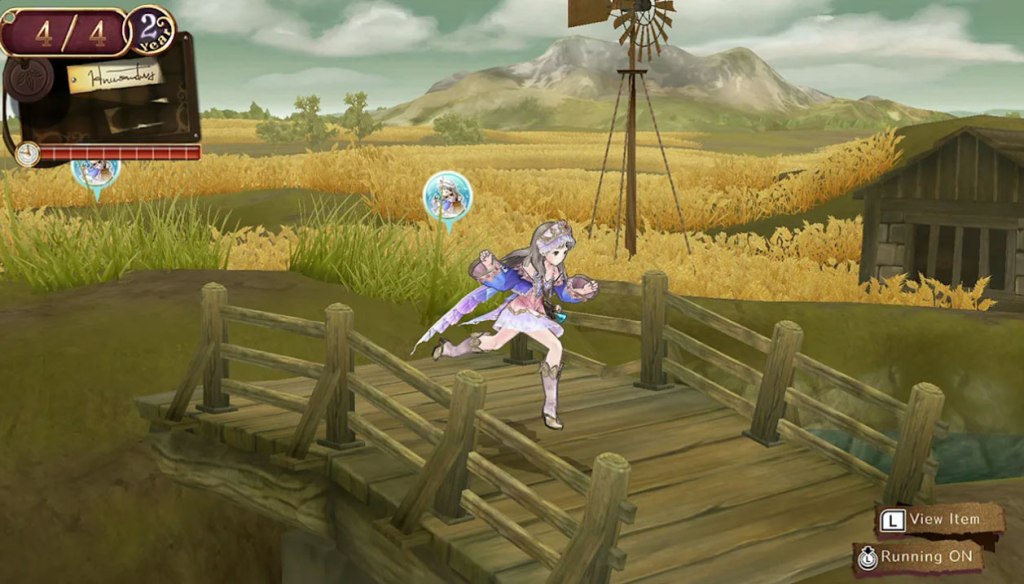
Then there’s the graphics. To its credit, Totori does show some improvement over Rorona’s underwhelming visuals, but this improvement is marginal. The game’s cel-shaded character designs are still quite good (especially Totori herself, whose outfit is absolutely gorgeous), but animations are often ungainly and odd-looking. Environments have a bit more detail to them, but are still far short of what we had come to expect from games even in the PlayStation 3 era this game was originally released into. And yet again, we have a camera that the game absolutely does not want players messing with, resulting in players getting ambushed by enemies they can’t see. At the very least this time around I didn’t notice any of the performance issues that Atelier Rorona had, but that’s hardly a cause for celebration when there’s so little going on here.
Oh, and once again, for players hoping for features making use of the Nintendo Switch hardware, like gyroscopic motion controls or the touchscreen… you won’t find anything like that here.
It’s probably obvious from my tone at this point, but I found Atelier Totori to be a huge disappointment as a follow-up to Atelier Rorona. While Rorona had some issues of its own, it at the very least had a lot of potential to build on. Yet, in most ways, Totori seems like a step backwards for the series, removing many of the positive features Rorona had, and then adding in more frustrating elements instead, all while leaving the flaws of Atelier Rorona well in place, if not expanding those flaws. In short, unless you absolutely loved Atelier Rorona and want to see another story in that world (and don’t mind dealing with a mediocre experience to do so), skip Atelier Totori.
tl;dr – Atelier Totori is the second game in the fifth series of Atelier games (the Arland series), a franchise of JRPGs with a focus on crafting. Totori may be a sequel set in the same world as Atelier Rorona, but in many ways this game feels like a step backwards, removing some of Rorona’s better features and replacing them with elements seemingly designed to frustrate. There are still some good elements here, but the only ones who are likely to enjoy them are players who absolutely loved Atelier Rorona and want another game set in that world, even if it’s a worse game.
Grade: C-
You can support eShopperReviews on Patreon! Please click HERE to become a Sponsor!
This month’s sponsors are MB, Andy Miller, Johannes, u/RamboFox, Exlene, Eli Goodman, Ilya Zverev, and Stov. Thank you for helping to keep the reviews coming!
 eShopperReviews
Leave a comment