
Brigandine: The Legend of Runersia
Genre: Turn-Based Strategy-RPG / Turn-Based Strategy
Players: 1
.
Review:
Brigandine: The Legend of Runersia is a pretty surprising release in multiple respects. First, in terms of the type of game it is, this is a game that combines elements of Turn-Based Strategy-RPG and more broad Turn-Based Strategy in a way that’s unlike other games in the genre, making individual battles play out like a hex-based Turn-Based Strategy-RPG, while managing an entire war in a manner much like a Turn-Based Strategy game that in a way that reminds me a bit of the classic board game Risk… although without the simplicity of a game like Risk.
However, the interesting blending of different types of Strategy games here only tells half of the story of what makes this game so interesting, because Brigandine: Legend of Runersia is a sequel to the 1998 PlayStation One game Brigandine: The Legend of Forsena, a game which wasn’t really a smash hit but nevertheless gained a cult following. For a PlayStation-exclusive game with such a small but passionate fan following to suddenly get a sequel in 2020… exclusively on the Nintendo Switch… a platform that is currently exploding with quality Strategy-RPG titles making competition in the genre particularly intense right now.
Yeah, I don’t think anyone could have predicted this prior to its announcement, but I’m certainly not one to complain about a small fan community getting an unexpected win. It actually seems like the Nintendo Switch has become the platform for precisely this sort of appealing to a small but passionate fanbase. After all, it’s the platform where Killer Queen Black fans finally got a home release, Shmup fans finally got the long-awaited release of 1993 Shenandoah (originally intended for the Amiga), and while it’s not exclusive to the Switch, it’s no surprise that cult favorite Arcade-style brawler Scott Pilgrim Vs. The World: The Game will be seeing its long-awaited re-release on Nintendo Switch day and date with other platforms. The Nintendo Switch seems to be the platform for fulfilling the wishes of small fan communities.
Well, I have little doubt that fans of the original Brigandine are absolutely thrilled with this sequel, but like most gamers, I never played the original game, so the question is, how is this game for newcomers to the series?
First and foremost, series newbies like me should be aware that this game’s story is, as far as I can tell, largely unconnected to what was in the original game, taking place in a different land and focusing on the struggles of a multitude of completely different characters. It’s an anime-esque plot involving multiple kingdoms each represented by an ideal symbolized by their own unique “Brigandine”, a holy relic of sorts. Players choose one of these nations to follow, not only commanding their unique troops and starting in that kingdom’s location, but following their story. It’s a setup that’s a little like what we saw in Fire Emblem: Three Houses, although I would say that this game places a much higher emphasis on the strategic gameplay and the story only comes in intervals, as well as snippets of conversation between characters in battle.
These characters converse in snippets voiced in Japanese, which plays out about how you’d expect. However, while the sound here is okay, the soundtrack is quite excellent, with some nice orchestral pieces with some choral elements. In particular, the Norzaleo Kingdom Battle Theme, the Republic of Guimole Theme, and the Republic of Guimole Battle Theme are, I feel, particularly good. This soundtrack does a great job of making the whole experience feel epic.
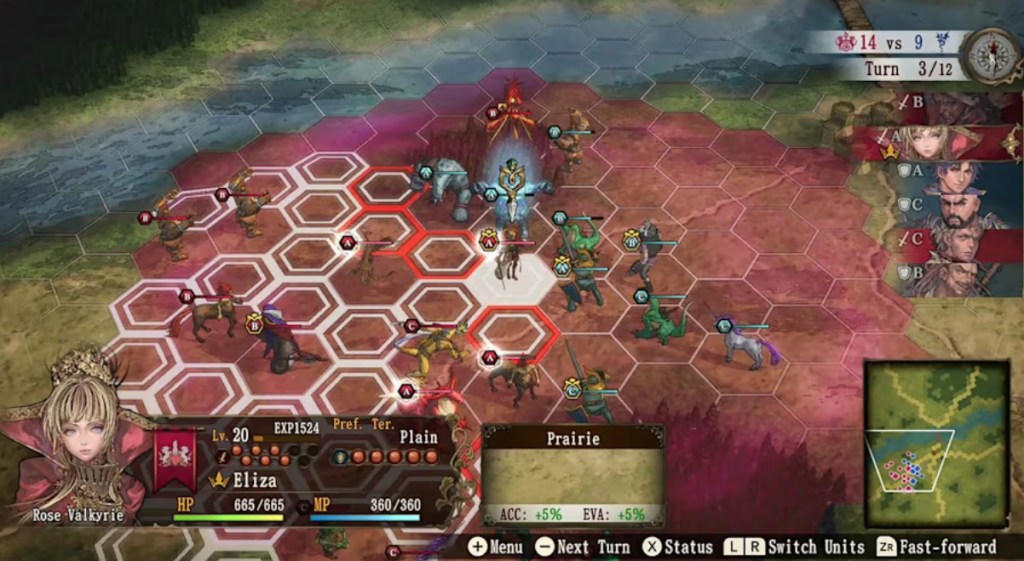
The visuals? Less epic. Characters look fine and have okay animation, but there’s nothing truly visually stunning going on here. What’s more, the visuals have a negative effect on the gameplay, as viewing the action from far enough away to get a good feel for the battlefield also has the effect of making it so you can’t too easily see the differences between different types of monsters (particularly similar types of monsters), and the same goes for terrain, which can be problematic when assessing the battlefield. At the very least, I can commend the game for its absolutely gorgeous hand-drawn art for character portraits.
However, the real question is, how is the gameplay? And to that I’ll say it’s good, but with some heavy caveats. There is a lot of depth to the character progression and combat in this game, with human characters capable of commanding a horde of summoned monsters, all of these requiring mana costs to summon and maintain, and both human and monster characters capable of gaining experience, leveling up, and changing classes. All of these characters have numerous stats, which are affected by terrain, environmental factors, and other elements. If you’re a Strategy gamer who wants to dig into a deep, complex system, you may find a lot to love here.
Unfortunately, for many players, this stuff will all be a bit confusing, even overwhelming. It doesn’t help that the tutorial here is not well-integrated into the game, involves a lot of reading text, and even after having gone through the tutorial content for what feels like hours, I still didn’t feel like I had a firm grasp on the game’s strategic elements. A part of this is due to the way the game displays information, which often isn’t especially helpful, despite providing players with pages of stats to look through.
What’s more, this emphasis on making decisions based on multiple complex factors slows the pace of the game down immensely. One single “season” (turn) in the game can consist of multiple battles, themselves potentially taking 30-60 minutes to complete, and managing both the micro and macro levels of the war can get a bit exhausting. Imagine playing a game of Risk (but more complex than Risk), and every time you have troops invade a country, you have to engage in an hour-long Tactics-Based Strategy-RPG battle, and you can imagine both how jarring that can be, as well as how time-consuming.
There was a brief period of time here where I considered complaining that this game doesn’t have any multiplayer mode, and then I reconsidered this when it occurred to me that making a human opponent wait as long as it takes to complete a turn in this game would be pretty unreasonable, and I can’t fault the game for not even bothering to find a way to make that work. Having said that, I can fault the game for not making good use of the Nintendo Switch’s touchscreen controls, which seems like the sort of thing this game could benefit from. At the very least the game’s visuals work well on the Switch’s small screen in handheld mode.
Despite all of my complaints, I can guarantee that Brigandine: The Legend of Runersia is the sort of game that a certain stripe of gamer will absolutely love. If you like to bury yourself deep in statistics and like the idea of managing a war on multiple levels, this game may be exactly the sort of thing you’re looking for. However, I think many players will be put off by the overwhelming amount of information the game throws at you, and the poor manner in which much of this information is conveyed. Perhaps Brigandine will always only be a game that has a cult appeal, so in the end, whether or not you enjoy it will come down to whether your own personal preferences make you a part of that narrow target audience.
tl;dr – Brigandine is a game that combines Turn-Based Strategy and Strategy-RPG elements, and while the game has deep gameplay and an epic soundtrack, the amount of information players are expected to absorb and manage here feels like something most players will be overwhelmed by. If complex systems of statistics are your jam, you may love this game… but most players, even fans of these genres, will likely want to give it a pass.
Grade: C+
You can support eShopperReviews on Patreon! Please click HERE to become a Sponsor!
 eShopperReviews
Leave a comment