
Atelier Ryza 3: Alchemist of the End & the Secret Key
Genre: JRPG
Players: 1
.
Review:
For those unfamiliar with the Atelier franchise, an atelier (it’s a French word that’s normally pronounced “uh-tell-ee-yay”, but the characters in these games often pronounce the word “at-lee-ur”) is a workshop or studio used by a craftsman or artisan… or in these games, by an alchemist. The Atelier games are a franchise of JRPGs that focuses on young, almost exclusively female adventurers who seek ingredients they can combine and use to enhance their items, with these crafting mechanics forming a central part of the game.
These games have each been released in a subset series that ties them together with a few of the other games in the franchise both in terms of mechanics, but also in terms of the storyline. I know that for many, the Atelier series can seem somewhat intimidating, but BarrelWisdom.com thankfully has a helpful guide to introduce players to the series. However, for the purposes of this review I’ll try to address where this game fits both into the Atelier franchise as a whole, as well as within its individual sub-series.
.
Atelier Primer: Secret Series
Atelier Ryza 3, released on PC, PlayStation 4, and Nintendo Switch in 2023, is the third and presumably final game in the Secret series, the eighth series of games in the Atelier franchise, which also includes Atelier Ryza and Atelier Ryza 2, released on those same platforms in 2019 and 2021, respectfully. Unlike many of the games in the Atelier franchise, these games contain no overarching time limits, and feature an “ATB” battle system that has players selecting commands from menus in real-time.
.
Ryza-ing to New Heights?
Oh yeah, I was doing puns for my reviews of these Atelier games. Have I used that one before? I dunno… anyway….
The Ryza series is somewhat unique within the Atelier franchise as the entire trilogy follows the same main character, and overall has us returning to the stories of the same set of characters through the course of its arc. While there are other examples of Atelier games with direct sequels, such as 2022’s Atelier Sophie 2, Atelier Ryza’s decision to follow the same group of characters through its entire trilogy seems like a direct result of the series’ unexpected popularity.
However, while this game does include a plot refresher for the events of the first two games, I still highly recommend that you play this game only after playing through its two direct predecessors, not only so you get a full understanding of its plot, but because the gameplay mechanics here build on top of what was introduced before. However, even more than this, Ryza 3’s story feels something like a trip through memory lane for its characters, who reminisce on how far they’ve come since the series started, and I expect that much of the impact of this will be lost on those who start this series right at its third installment.
In short, I recommend you play the Ryza games in order. Don’t worry, the prior two games are both excellent and well worth playing through.
The plot this time around brings us back to Ryza, still working as the town alchemist on her home island, when she’s suddenly surprised by the appearance of new monsters, apparently stirred up by the arrival of a new manmade island appearing nearby, upsetting shipping routes and causing distress for the mechanisms within Ryza’s own island. In response to this, Ryza summons her friends to assist her in investigating this new island, mitigating its negative effects, and ideally trying to find a way to move it away from areas where it will still be a hazard and a nuisance.
However, the appearance of this new island is not the only strange occurrence Ryza must contend with. Around the time all of this is happening, Ryza begins to hear mysterious voices, and gets a vision for how to produce a mysterious new key, which enables her to create other magical keys that can augment her and her allies’ abilities in combat, allow her to access caches of supplies strewn around the world, and enhance her alchemy recipes. While helpful, the mysterious nature of this key and its origins are also somewhat alarming, as prior experiences with strange phenomena on Ryza’s adventures have resulted in some situations that were almost cataclysmic.
Overall, this game feels like a mix of the more local, small-scale story elements that were at the start of Ryza’s first game, as well as the world-expanding adventure elements of the second, with Ryza’s research and problem-solving pertaining to the mysterious events around her island will lead her and her friends on a massive exploration of four large areas. At least in terms of scope, Ryza 3 is definitely the largest game in the series by far, and while its areas are not so open to exploration that I would deign to call them “Open-World”, they are nevertheless quite sizable, and sure to delight explorers.
One element that doesn’t seem to have changed much is the game’s Japanese-language voice cast, who is still doing a fine job (as far as my English language-only ears can tell, anyway). Still excellent, though perhaps not as impressive as when we met these characters for the first time. And once again, we have another excellent soundtrack, and while I still think the game doesn’t match the great sounds of the original game, there are still some truly excellent instrumental and orchestral themes here, such as Summer View~From the Secret Hideout~, Fall Crocus, Where Dreams Gather, and probably my favorite new theme for this game, When We Laugh About Forgetting to Buy Something, this game’s new default shop theme.
Atelier Ryza 3’s gameplay once again sees the return of most of the elements of the prior game, such as the somewhat confusing “material loop” crafting system and the real-time combat, though now you have a few additional features added in, such as being able to hot-swap characters mid-combo during battle, and being able to create and use “keys” to enhance various gameplay elements, as noted above. There are other subtle additions here too, such as the ability to dive to find ingredients underwater.
Overall, Ryza 3 doesn’t feel like too great a departure from its predecessors except for its scope – as noted earlier, this game is quite large, and dwarfs the earlier games in the series.
.
Have They Found the Secret Key to Graphical Excellence?
It’s strange to look back on the Ryza series, which started with truly gorgeous environments that highlighted the game’s simple beauty, and then look at Ryza 3, which is bigger, faster, and doesn’t have any desire to “stop and smell the roses”, so to speak. As such, it can be tempted to look at this game and see it lacking the awe and majesty that the first Ryza game began with. However, easing up on the “run” button, you can see that for the most part that beauty is still there, even as you constantly whiz past it as running is far too convenient in Ryza 3 not to do pretty much all the time. However, take a moment and slow down to look at your surroundings, and this game will awe you with its beauty… sometimes…
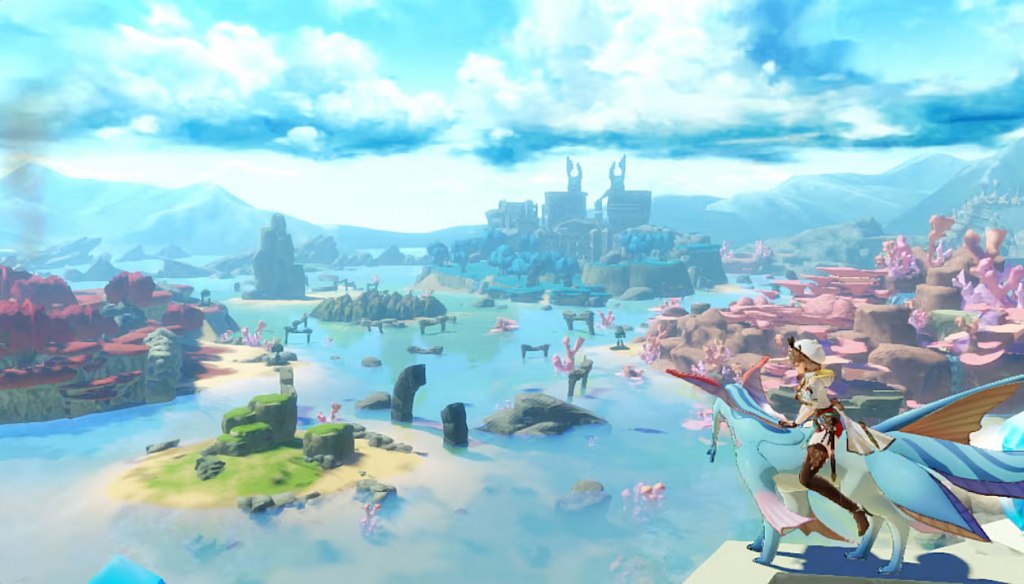
Okay, let me start by saying that the issues the earlier Ryza games had appear to be gone in Ryza 3. There is no dithering to speak of here, and the shadows all look pretty good (though surely not nearly as good as they do on other platforms). Indeed, the lighting and shadow in this game can make for some breathtaking sights, such as shafts of light filtering through the trees at sunset, or a starry night reflected in the puddles left by a prior rainstorm in the mud on a farm, or a world of brightly-colored coral hiding under the surface around a chain of sun-soaked islands. This, in addition to the Atelier series’ usual excellent lightly cel-shaded anime-style 3D characters make for a game that is truly awe-inspiring, though it is unfortunately not consistently so.
This is because Atelier Ryza 3 seems like the least-polished game, visually, in the Ryza series. Tons of pop-in, low-poly elements in the environments, some low-poly textures, aliasing, some ugly animations. While Atelier Ryza 3 is often a gorgeous game, it is also frequently a pretty ugly or mediocre-looking one. And while overall this may ultimately be an improvement, Ryza 3 definitely doesn’t have the same “wow factor” that the first Ryza game did.
And I suppose I should talk about the camera controls, touchscreen, and gyroscopic controls, since I’ve been making a point to do it for every Atelier game, though at this point the franchise seems to have settled into all of this being decent but nothing special – The camera once again works fine here, no complaints. And once again there’s no touchscreen or gyroscopic motion controls.
.
The End That Befits a Great Series, or Simply Ryza-ing On Its Predecessors’ Coattails?
Hey, you try thinking up new puns after… wow, I’ve reviewed 14-15 of these games at this point…
Anyway, Atelier Ryza 3 is indeed a fitting end to the series (assuming it actually is the end), though it doesn’t feel anything like a pinnacle that the series was building to. Rather, the third game in the Ryza series acts as both a look back at the series’ past as well as expanding the scope to be the biggest yet for the Ryza series. Having said that, while this game is in many ways bigger and better, it also seems less-polished, and in part due to this it isn’t as impressive as the first game was upon its release. It’s still well-worth playing for JRPG fans, although I still stress that this is a series you’re better off playing through in order starting with the original Atelier Ryza.
tl;dr – Atelier Ryza 3 is the third game in the eighth series of Atelier games (the Secret series), a franchise of JRPGs with a focus on crafting. The third and (apparently) final installment in the Ryza series is much bigger in scope and adds new gameplay elements on top of what was in the prior games, but at the same time it also seems somewhat less-polished, and doesn’t quite have the “wow factor” that the original Atelier Ryza did. This is still a solid addition to the series, and a must-play for those who enjoyed the prior two games.
Grade: A-
.
This game has been nominated for one or more of eShopperReviews 2023 Game Awards:
Runner-Up: Best Song (When We Laugh About Forgetting to Buy Something by Kazuki Yanagawa)
.
You can support eShopperReviews on Patreon! Please click HERE to become a Sponsor!
This month’s sponsors are Ben, Andy Miller, Exlene, Homer Simpin, Johannes, Francis Obst, Gabriel Coronado-Medina, Ilya Zverev, Jared Wark, Kristoffer Wulff, and Seth Christenfeld. Thank you for helping to keep the reviews coming!
 eShopperReviews
Leave a comment