
Disgaea 7: Vows of the Virtueless
Genre: Turn-Based Strategy-RPG
Players: 1, Online Content Sharing
.
Review:
The Disgaea series of Turn-Based Strategy-RPG games has been around since the first Disgaea‘s original release on PlayStation 2 in 2003, and right from the beginning this franchise made it clear that it wasn’t content to stand in the shadow of the prominent tactics-style RPGs at the time, Tactics Ogre and Final Fantasy Tactics. With absurdly-high caps on levels, stats, and damage, a ridiculous plot set in the bizarro hell-like “netherworld”, the oddball “prinnies” (penguins with peg legs that say “Dood!” a lot and explode when they’re thrown), and silly yet satisfyingly deep mechanics like the Item World and Dark Assembly, this franchise has never been afraid to aim for some ambitiously wild and crazy ways to shake up the genre.
However, probably no game in the franchise was quite as ambitious and experimental as 2021’s Disgaea 6: Defiance of Destiny, which aimed to shake up the series’ status quo in multiple ways. Most noticeably, this was the first game in the franchise with fully-3D gameplay, using cel-shaded 3D characters in addition to the series’ usual 3D levels. The series also upped the ante with its high damage numbers, with even starting characters dealing hundreds of thousands of damage with normal attacks. And perhaps the most unusual change was a game mechanic where players could use “Demonic Intelligence” to have your characters automatically fight for you, making this game play like an Idle Game.
To say these changes were both controversial and a “mixed bag” for series fans would probably be putting things mildly. The fully-3D graphics, while not particularly impressive, suffered from some nasty performance issues on Nintendo Switch. The high damage numbers resulted in those numbers losing all meaning. And while I personally found Demonic Intelligence to be an inspired new direction for the series, many others felt like this was a betrayal of both the strategy and the enjoyable grinding that formed the heart of this franchise’s gameplay.
Many series fans wondered if this franchise had run its course and was now flailing to find relevance. Some even questioned if we’d see a new Disgaea game. However, now in 2023 we have received Disgaea 7: Vows of the Virtueless on PC, PlayStation 4, and Nintendo Switch, leading many fans to wondering, would this game double down on the divisive changes made in the prior game? Would it aim to return the series back to what worked in earlier games? Or would it do something different entirely, and possibly once again frustrate and divide the series’ fanbase?
.
The Dood Abides
So, first things first, this game retains the fully-3D presentation of Disgaea 6, and it isn’t any more visually-impressive this time than it was the last time around. However, having said that, the performance issues aren’t that bad this time… well, depending on how you play it. By default, this game plays in a presentation mode that still has the shuddering visuals while scrolling that the first game suffered in this mode. However, changing over to performance mode in the settings is a marked improvement – there’s still some ugly aliasing issues, but the terrible blurry visuals this mode caused in Disgaea 6 seem to have been alleviated here. Overall, this isn’t a massive improvement, but it’s still an improvement.
This game notably takes the series thematically in a new direction, in that the Hinomoto netherworld regions the game focuses on are based on Feudal Japan. It’s… different, I guess. I don’t think this change drastically affects the series’ wacky, whimsical tone, which was already pretty strongly Japanese-flavored. But I suppose it helps to set this game apart from its predecessors a bit. This is supported by a main cast headlined by a cynical trickster samurai-esque warrior demon named Fuji, and an optimistic otaku fangirl, Pirilika, who is driven to try to return the Hinomoto region to the honorable bushido code of its past, something the land’s demon residents have zero interest in.
I’m not a fan of the writing here – Pirilika has a particularly annoying trait of saying malapropisms that not even the dimmest airhead would think are an actual thing (“Behold! My cult of armchairs!” instead of “Coat of arms”, for example). However, the voice acting here is generally good enough that they can almost get away with it, and you can tell that the voice actors are really doing their best to try to sell the emotion of their words, even when those words are… well, stupid.
Also, while I normally find the soundtrack to be one of the worst parts of a Disgaea game, the soundtrack, this time around I think there are some decent tunes sprinkled throughout the game, like Hinomoto & Rock, Enlightenment Town, The Spring Wind, Still So Distant, Battle-Dance of the Astray, Fairy Blaze, and Snow, Moon, and Flowers. This may be the first time I actually liked a Disgaea soundtrack.
Overall, I think the presentation here is definitely an improvement over what was in Disgaea 6, even if it’s still nothing truly incredible.
.
Hey, Dood, Don’t Make It Bad
While the presentation here is a refinement and evolution of what we saw in Disgaea 6, this game wisely scraps the absurdly-large numbers we had in the prior game, returning the series to more intelligible gameplay. Having said that, I can’t help but feel like the craziness in the core gameplay was reined in a bit too much.
My issue is that early-game progression is a massive slog, and at times it seems to take forever to get your characters to gain levels. In part this is because early into the game some of the series’ signature features have yet to be re-introduced, such as the Item World, the place where all of Disgaea’s enjoyable grinding can take place in randomized levels with the potential for all manner of delightful surprises to be won by defeating enemies or stolen out of their hands. Rather, those wanting to grind to improve their characters will be stuck replaying the game’s campaign maps. And then replaying them again. And then replaying them some more.
Maybe I’m going about this wrong, I don’t know, but I spent roughly 8 hours into the game replaying one of the early levels literally dozens of times (thankfully, the settings menus have fast-forward features and the ability to skip lengthy attack effect animations), and still had difficulty getting past the second-stage boss.
As always, there are ways to speed up this process. There’s once again an unlockable “Cheat shop” where you can have the game increase your experience gain at the expense of gold and other stats, automatically heal after battle for a fee, and so on. The dark assembly is back (this time it’s sumo-themed!), with options to bribe the netherworld’s politicians to expand your store’s stock or improve your characters’ movement and other abilities. The juice bar, the squads, “evilities”, and other features all make a return from prior installments, but the game hands out these options for growth and customization at a much slower pace than I recall prior Disgaea games having, and I strongly felt like I needed to have these options much sooner than the game provided them, leaving me stuck with little option to get my characters in shape for the first few bosses beyond simply replaying one of the earlier levels 70-80 times.
The Demonic Intelligence from Disgaea 6 also returns, but in a much more limited fashion – players can only make use of this in single-player mode in completed stages, and only by using an in-game currency called “Poultergas”. As you might imagine, this means you won’t be using this feature anywhere near as much this time around, at least in single-player. However, Disgaea 7 does also introduce a new PvP mode where you can set a team of your own Demonic Intelligence-programmed characters against an opponent’s. In theory this is a great way to add a multiplayer component to a series that’s really designed solely for single-player play. However, in practice I can’t help but feel like this sort of multiplayer mode is just going to favor the players who did the most grinding for their characters and equipment.
Another thing returning this time around are many of the character classes that were cut from Disgaea 6, and in fact Disgaea 7 adds a huge wealth of new ones as well, with 27 humanoid classes and 18 monster classes, giving players more ways than ever to build their ideal custom party, or perhaps “army” is the right term.
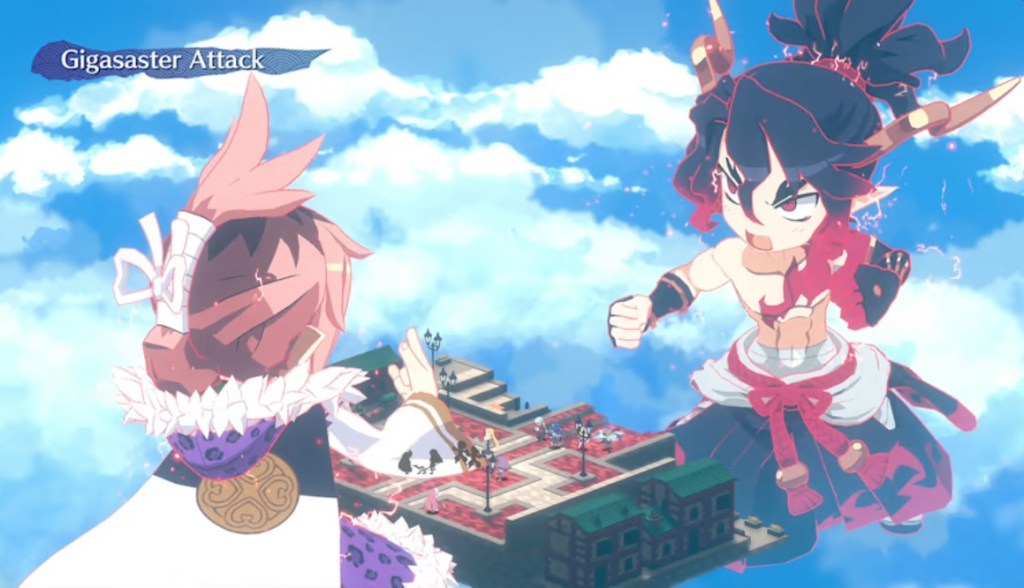
There’s also a new feature this time around, Jumbification, where a gauge gradually fills up until it reaches a point where both you and your opponent can select units to turn kaiju-sized, able to fight each other or slam down on sections of the battlefield to damage multiple enemies at once. Generally, the gauge builds up slowly enough that this mainly acts as a fun finisher for your battle, or possibly as a way to speed things up if the player is being a bit sluggish. Ultimately, I think this is an interesting addition, but I wouldn’t say it’s necessarily better or worse than the way the games played previously.
.
Dood, Where’s My War?
Overall, I think Disgaea 7 is one of the best games in the series… once it gets going. However, “once it gets going” is a pretty major caveat here – it’s difficult for me to give a high recommendation to a game that takes 6-8 hours before it starts getting good, and I was playing Disgaea 7 for over 17 hours before I was able to see all of its main features introduced.
Needless to say, that makes Disgaea 7 a pretty terrible game to introduce new players to the series. For that, I recommend you check out Disgaea 1 or Disgaea 5, with 5 being the game I would still point to as the pinnacle of the series (as long as you can ignore the terrible characters).
Having said that, for players who are already familiar with the franchise, Disgaea 7 is a strong entry in the series, and its early hours will likely surprise you with a higher than usual challenge level. As I mentioned, it does take quite a while to get going, but once it does you’ll find a lot to like here, especially if you were one of the series fans who saw Disgaea 6 as a misstep. Disgaea 7 builds on elements that were introduced in that game to bring things closer to what we had in earlier games, brings back elements that were lost from earlier games, and introduces just enough new stuff to make things interesting. Overall, if you have the patience to work past this game’s early hours, I think you’ll be rewarded with a solid addition to this quirky Strategy-RPG series.
tl;dr – Disgaea 7 is the second game in this oddball Turn-Based Strategy-RPG series to use fully-3D visuals in its gameplay, but unlike the divisive changes made in Disgaea 6, Disgaea 7 aims to bring the series’ gameplay back to what series fans are used to, albeit with a few interesting additions and a feudal Japanese theme. I do think this game suffers from unusually slow progression that makes its early hours a bit of a slog, but once you get past that, the mix of features and gameplay options makes this one of the better games in the series, albeit a poor entry point for newcomers.
Grade: B+
.
This game has been nominated for one or more of eShopperReviews 2023 Game Awards:
Runner-Up: Best RPG, Best Strategy Game
.
You can support eShopperReviews on Patreon! Please click HERE to become a Sponsor!
This month’s sponsors are Ben, Andy Miller, Exlene, Homer Simpin, Johannes, Francis Obst, Gabriel Coronado-Medina, Ilya Zverev, Jared Wark, Kristoffer Wulff, and Seth Christenfeld. Thank you for helping to keep the reviews coming!
 eShopperReviews
Leave a comment