
Hogwarts Legacy
Genre: Open-World Action-RPG
Players: 1
The Nintendo Switch 2 Difference
.
Review:
Hogwarts Legacy is an Open-World Action-RPG released in 2023 on PC, PlayStation 4, Xbox One, and Nintendo Switch. As the name Hogwarts indicates, this game is set in the “Wizarding World” best known for the Harry Potter series, though this game takes place in the late 1800s, well before most of the Harry Potter characters were born.
Before going on, I want to take a moment to recognize that I know there are some players who will balk at buying this game due to the hurtful views of the author of the Harry Potter books. If you’re looking to play this game but trying to avoid any of your money going to said author, I recommend that you track down a used physical copy of the game – no risk of your money going to that author in that situation.
.
Remembrall
In fact, the decision to set this game’s story in the 1800s seems to have been a deliberate decision to set this game apart from the original author’s works without sacrificing the exploration of the world they took place in. The choice of time period doesn’t really affect the setting visually all that much – even in modern-day time period of the books and films, Hogwarts still looked like a medieval fantasy setting.
However, the different time period allows us to explore a completely different dynamic between the students at Hogwarts, different conflicts within the world they live in, and a mostly different cast of characters, with the only characters you’ll recognize being ones that would have been around at that time, such as Peeves the poltergeist.
This game puts players in the role of their own custom character, a teenager in the unusual position of being admitted to Hogwarts in their fifth year without any prior magical schooling. However, it soon becomes clear that the high magical prowess your character seems to naturally have ties into an ability to see and use ancient magic inaccessible to most of the setting’s witches and wizards.
However, this ability is highly coveted by dark forces already moving against you as the game starts. The responsible party seems to be Ranrok, a goblin who seeks to lead an uprising against humans, and has even hired some dark wizards into his employ. The source and history of your unusual power, and why Ranrok desires it so greatly, is one of the core mysteries of this game’s story, something that works incredibly well to fill the plot with intrigue, and loosely parallel Harry Potter’s contentious relationship with his villain, Voldemort, while being different enough that this doesn’t just feel like a repeat of the Harry Potter series.
You can tell the people who made this games were huge Harry Potter fans, as the game contains countless references to the books and movies. Hogwarts castle looks just as it does in the films, as do the depiction of fantastical races and creatures like the goblins, house elves, kestrals, and so on, but the game has far more Peeves than all the films combined (which isn’t saying much), and other references to things only mentioned in the book. Those who never read the Harry Potter books or watched the movies may be left feeling a bit confused right from the intro when Kestrals suddenly become visible or characters refer to a portkey. However, as someone who enjoyed the books and films, this game’s intro sequence had me absolutely smiling ear to ear.
It’s not just about references, though. This game’s story is really well-crafted in its own right, and while Potter fans may be able to see some of the twists and turns coming, many others will be surprised at the directions the story takes.
It also helps that the game’s cast of characters is excellent, particularly your mentor character Eleazar Fig, who gives off a combination of caution and curiosity, as the secrets your character holds may reveal insight into the quest his wife died for. There’s also your friendly and competitive classmates, a Griffindoor named Natasi Onai and Slytherin names Sebastian Sallow. The teachers are also quite interesting, and while some bear the family names of Harry Potter characters like Weasley and Black, these are completely different people with different personalities that may or may not be trustworthy.
.
Wild-fire Whiz-Bangs
One of the reasons the game’s plot works so well is the presentation, although this comes with a huge caveat on Nintendo Switch which I’ll get to momentarily. The above mentioned characters are wonderfully voiced, including your own character. In particular, I felt that Fig and Onai were especially well-voiced in a way that really made those characters memorable.
It also bears mention that Hogwarts Legacy features a soundtrack that is a perfect fit with John Williams’ famous movie soundtracks, with wonderful orchestral themes that mostly only have small hints of the actual Harry Potter melody, but are nevertheless unmistakably of the same setting. For some good examples, check out Overture to the Unwritten, The House Cup, Miriam’s Memory, Coastal Vivarium, and The Greenhouse. In short, this game absolutely brings its A-game when it comes to sounding every bit as epic and cinematic as the Harry Potter films.
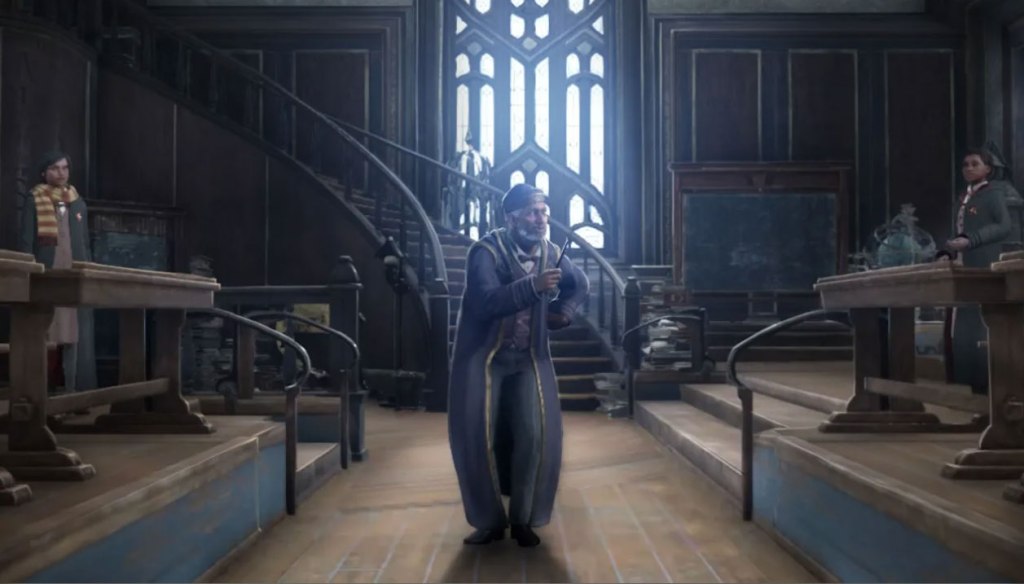
Okay, so how does it look? Well, here just picture that pin I stuck in the “huge Nintendo Switch caveat” starting to shake violently, but I’m going to leave that pin in for just a moment more. Hogwarts Legacy is presented with just as much visual cinematic flair as it sounds, with massive, imaginative environments filled with detail, color, and life, with tons of activity everywhere, including nice little touches, especially within the walls of Hogwarts itself, where every painting, every suit of armor, and even many of the statues are alive and sometimes reacting to the environment, and then there’s all the students going about their lives, gossiping, studying, playing pranks, and so on. The character designs here are all very good, and the attention given to make Hogwarts seem as grandiose as it appears in the films really pays off.
And right about now, that pin I stuck in the big problem is blasting away at high speed, so let’s talk about it. This is a AAA-budget game released on modern platforms the same year this game came out on Nintendo Switch (albeit a half a year later), so as you can imagine, there were going to be some huge cutbacks and compromises, and hoo boy, are there ever.
The framerates in the Nintendo Switch version are around 25-30FPS, with a dynamic resolution of 720p in docked mode and 540p in handheld mode. Needless to say, this is a pretty significant drop from other versions of the game, but still acceptable. However, these are far from the only concessions this version makes.
Terrible pop-in, texture pop-in, horrible aliasing, ugly blurry textures, low-framerate animations at a moderate distance, worse lighting and shadows, worse reflections, lower-density foliage outdoors, worse-looking water, new loading screens when entering places like Hogsmeade, longer load times overall, frequent waits to load while opening doors within Hogwarts itself… Also, I noticed an odd glitch where indoor muffled talking noises continued in places where no people were, such as the Forbidden Forest and empty dungeons.
In short, the cuts made to this version of the game are extremely severe, and players used to how the game looks on any other platform will likely be aghast at how much worse this version looks.
And yet…
And yet, it still works.
Oh, don’t get me wrong. There are absolutely times when this game looks like a blurry, janky mess. Time and again, even those who never saw other versions of the game will be confronted with the overwhelming feeling of a game that surely looked more impressive before it was squeezed onto Nintendo Switch, with some visual flaws that just plain look wrong. However, the game is definitely still playable, and you still get the feel of the grandiose nature of the game, even though you’re seeing it through the worst possible lens in this version. Yet I would say that Hogwarts Legacy fares better than some other “impossible” ports, like The Witcher III.
Although yeah, this is definitely the worst-looking version of the game, by far. But what did you expect? This is a game that struggles to get good performance even on some more powerful hardware. That it can even run on Nintendo Switch is an impressive feat.
.
Exploding Snap
The world of Hogwarts Legacy is large, promising a lot of fun and interesting areas to explore. The school itself is a labyrinthine jumble of hallways, staircases, and various rooms, true to form for the franchise. However, Hogwarts itself is just the centerpiece of the game, which has a large map covering a sizable section of countryside surrounding the wizarding school, including The Forbidden Forest, multiple towns, and plenty of interesting sights to see and people to meet.
As a student, you would naturally think that you’ll have to balance exploration with a class schedule, but although Hogwarts Legacy certainly includes school classes (many needed to progress), you’re not shackled to any sort of schedule – apart from the day-night cycle, events in the game start whenever you activate them, allowing you to explore freely without worrying about being treated as truant (no time-turner required, evidently).
As an RPG, you’ll be gaining experience and levels both through battles and simply by discovering elements within the world. One of the first spells you’re taught, Revelio, not only acts as a brief bust of Batman Arkham-style “reveal enemies and objects of interest through walls”, but also reveals scrolls marking points of interest to be collected. In addition, you have various quests you can opt to take from others in the world, generally taking the form of finding something or fighting some enemies.
Combat, as with the rest of the game, takes place in third-person and in real-time, with players flinging spells at enemies and deflecting, blocking, or dodging incoming attacks. Enemies often cover themselves in a color-coded shield, requiring a specific spell with a cooldown (activated by holding ZR and pressing an assigned face button) to bring down their defenses, while unshielded enemies can be comboed with any number or combination of attack spells, including a generic attack generated by tapping ZR. The use of these special shields helps to ensure that combat isn’t just an endless ordeal of button-mashing.
In addition, players can also use the L and R buttons to use special Ancient Magic attacks that penetrate all defenses and do massive damage. These attacks must be charged by connecting with normal attacks, but they make for a particularly effective way to penetrate any enemy’s defenses, or a satisfying way to quickly put down an enemy of your choice.
As you explore, in addition to gaining experience and levels, you’ll also find new gear to equip, with this acting as one of the main ways to buff up your attack and defense, and also a nice visual customization for your character.
.
Pensive
A lot of the above is genuinely fun and really does a great job of playing into this unique world, and helps to set apart this game from other Open-World games, but there’s a lot of complaints I just sidestepped above, which I’ll now detail here.
Let’s start with the Open-World map. While this is indeed an Open-World game, it’s hard not to feel like the game’s designers missed much of the point of Open-World game design. For starters, Hogwarts is a nightmare to navigate. While this is extremely faithful to the books and films, that doesn’t make it any easier to tolerate when you need to get to a room that’s seemingly right next to you, yet you need to run through a ridiculous series of stairs and corridors to get there, usually with multiple doors that will make you wait next to them while the area behind them loads.
What’s more, while there are fast-travel points (floo flames), it’s not always apparent if the point that’s closest to the place you want to be is actually the one that’ll have the shortest walk to get there. Players will generally end up being forced to use an indicator directing your path to get to your goal, which just feels like the game telling you what to do instead of providing proper tools to enable the player to do it for themselves.
As the very least, the world outside of Hogwarts is more sprawled out and typical of what one would expect from an Open-World game, only the area you can explore is in a fairly narrow valley, meaning that “exploring” feels somewhat limited, and getting from one point to another will almost always involve travelling North or South, usually along the main road. This really cuts down on the joy of finding your own path through the wilderness, and perhaps discovering something cool on the way.
Also, for the early hours of the game, gaining experience and levels will seem largely pointless. Some gear and quests are locked behind a level requirement, but otherwise it doesn’t seem like anything tangible changes when you gain a level. It is only when you’ve progressed through campaign quests for a good while that you unlock the game’s ability tree and can start spending points you’ve been accruing, and why this choice was made has me just scratching my head.
There’s a problem with gear, too – players have a very limited inventory space for these pieces of equipment (what, does this game take place before they invented mokeskin pouches?). It’s never explicitly spelled out to you, but the game expects you to sell off all your old gear whenever you get anything with higher stats, with the game still allowing players to use the cosmetic appearance of clothes you’ve pawned off. This requirement not only seems pointless, but it means that if you’ve neglected to make routine stops at shops to pawn off old gear, you may well find yourself unable to open chests containing new gear as you’re out adventuring. You can expand this inventory by completing a specific type of quest, but this is a very slow process and not any sort of practical solution to this manufactured problem.
Another issue involves the combat controls. The game has players targeting enemies using the right analog stick, locking on by pressing in the right stick with a flick of that stick to swap to a different enemy, and holding ZL for precision aiming. All of this is great in theory, but the problem is that when you lock on to an enemy and want to have more control over the camera, trying to do so will naturally shift your lock elsewhere. This was maddening for me when I needed to run around to avoid incoming attacks, wanted to see where I was going, but not lose my lock just because I didn’t want to fall off a cliff while dodging an attack.
Oh, and don’t get me started on the instant-fail stealth stuff. Ugh…
.
Omnioculars
In the end, I’m really torn in my feelings about Hogwarts Legacy. So much of what this game does, it gets absolutely right. Anything to do with the story, the music, the voice acting, or the artistic vision of the game is truly brilliant, far better than anything the franchise’s author has created since the end of the original Harry Potter saga. The world holds so much promise, mystery, delightful creativity, and wonderful character that it absolutely demands to be seen.
On the flipside, it does so much that is extremely frustrating. The combat is great in theory, but often ends up suffering due to frustrating control issues. The Open-World holds so much potential, but that potential is undermined by some poor design choices. The RPG elements are promising, but the game waits far too long to make all of those elements available to the player. The ability to collect gear to alter your appearance makes for some fun cosmetic possibilities, but the requirement to constantly be selling it off to shops really hurts the gameplay.
And then, of course, there’s all the ugly, nasty, terrible sacrifices this game had to make to its graphics and performance just to be playable on the Nintendo Switch. And again, I can’t fully blame this game’s creators for this last part – after all, it is quite a feat of wizardry that this game even exists on Nintendo Switch, but I also cannot ignore that players with multiple platforms should absolutely be playing this game anywhere else but here.
In the end, I still really enjoyed Hogwarts Legacy, despite itself. The charm and wonder of this game’s world, story, and characters still absolutely shines through, even with layer after layer of nasty sludge covering it in the form of gameplay frustrations and a heavily-butchered port. If you’re a Harry Potter fan whose only gaming platform is a Nintendo Switch, this is still a game you will absolutely want to play. But I don’t think anyone’s fooling themselves into thinking this is at all comparable to what other platforms got earlier this year, nor a perfect Open-World game.
tl;dr – Hogwarts Legacy is an Open-World Action-RPG set in the world of Harry Potter but in the 1800s, and as a result the setting is the same but the characters and conflicts are largely unique. Everything about this game’s approach to telling a story within this franchise is a true delight, but the gameplay features some questionable design choices, and the port to Nintendo Switch has mangled this game’s visuals and performance. This is still a very playable game, and it’s well worth playing to explore this game’s magnificent setting and story. But there’s no question that this is a highly-compromised experience in numerous ways.
Grade: B
.
This game has been nominated for one or more of eShopperReviews 2023 Game Awards:
Runner-Up: Best Action-RPG, Best Music (by Chuck E. Myers, Alexander Horowitz, and J. Scott Rakozy), Best Voice Acting (Nicholas Guy Smith as Eleazar Fig), Best Story
.
The Nintendo Switch 2 Difference
Hogwarts Legacy
Genre: Open-World Action-RPG
Players: 1
.
Review:
Hogwarts Legacy is a bit of an odd case in that it is not a Nintendo Switch 2 Edition game, but there is an upgrade path for players who have a Nintendo Switch version of the game in their list of Nintendo Switch Virtual Game Cards can purchase the Nintendo Switch 2 version for only $10. I can personally vouch that this works for those who have the digital version of the Nintendo Switch game, though I’m not so sure whether this works if you have a physical copy.
Interestingly, those getting the game new will find that the Nintendo Switch 2 version only costs $60, the same price as the Nintendo Switch version. So you’ll definitely want to crunch some numbers to figure out the least expensive way to get this game on Nintendo Switch 2.
There are definitely improvements in this version of the game over the Nintendo Switch version – character models were already excellent in the Nintendo Switch version of the game, but they’re even better here. The resolution and framerate has improved, the pop-in isn’t as bad, there are no longer low-quality animations at a distance, the lighting, shadows, and reflections are better, and you no longer have transition load screens in places like Hogsmeade.
Furthermore, for players who prefer, you can use mouse controls instead of the analog stick in in-game menus, including the cursor in the magic minigame that has you following lines on the screen. Personally I much preferred using the analog stick, but I’m glad this is available for players who would prefer to control the game this way. Furthermore, this game has good support of HD Rumble 2.
Even though there’s a decent number of improvements, what’s here still leaves a lot to be desired. You’ll still find loading times at doors on occasion, hair can still look ugly at times with an odd grainy look to it, and there still aliasing and interlace flicker at times. While most textures are improved, some look really ugly (keep an eye on the tables during your sorting ceremony). There also seem to be a few odd glitches in this version that I hope get fixed in a patch. The main character’s voice can have an odd echoing effect to it that none of the game’s other voices have. Also, in my first playthrough I encountered a glitch that wouldn’t let me speak to other characters until I saved, exited the game, and restarted.
Despite these flaws, I do believe that this is overall an improvement over the Nintendo Switch version of the game, but it’s far from the vast improvement players may hope for. I suppose if you have the Nintendo Switch version this may be worth the $10 to upgrade, but I would warn players to keep expectations low.
tl;dr – Hogwarts Legacy is an Open-World Action-RPG set in the world of Harry Potter but in the 1800s, and as a result the setting is the same but the characters and conflicts are largely unique. Everything about this game’s approach to telling a story within this franchise is a true delight, but the gameplay features some questionable design choices, and while the Nintendo Switch 2 version is overall superior to the Nintendo Switch version, it still has quite a few flaws. This is still a very playable game, and it’s well worth playing to explore this game’s magnificent setting and story. But there’s no question that this is a highly-compromised experience in numerous ways.
Grade: B
.
You can support eShopperReviews on Patreon! Please click HERE to become a Sponsor!
This month’s sponsors are Ben, Andy Miller, Exlene, Homer Simpin, Johannes, Francis Obst, Gabriel Coronado-Medina, Ilya Zverev, Jared Wark, Kristoffer Wulff, and Seth Christenfeld. Thank you for helping to keep the reviews coming!
 eShopperReviews
Leave a comment