
Danganronpa S: Ultimate Summer Camp
Genre: Party Game / Turn-Based JRPG
Players: 1
.
Review:
WARNING: THIS GAME HEAVILY PUSHES MICROTRANSACTIONS
(Note: This game is included in the physical-only bundle Danganronpa Decadence, along with Danganronpa: Trigger Happy Havoc Anniversary Edition, Danganronpa 2: Goodbye Despair Anniversary Edition, and Danganronpa V3: Killing Harmony Anniversary Edition.)
Danganronpa S: Ultimate Summer Camp (from here on for the sake of simplicity simply referred to as Danganronpa S) is a spin-off game released in 2021 on Nintendo Switch and ported to PC, mobile devices, and PlayStation 4 in 2022. This game is an expanded version of minigames included in Danganronpa V3, with this game having all of the characters from the three mainline Danganronpa games (plus series spinoff Ultra Despair Girls) on a lighthearted romp on a VR recreation of Jabberwock Island, the setting of Danganronpa 2.
This game’s tone is certainly completely different compared to the series it is derived from. While the Danganronpa games generally have series antagonist Monokuma (the black and white teddy bear) entrapping a group of sixteen high schoolers and challenging them to kill each other to escape, here Monokuma’s antics only seem to go as far as being mischievous, and the “Monokubs” that acted as his lieutenants in Danganronpa V3 are all united here to keep his destructive nature in check.
This leaves the students from all three games to enjoy their time on the island, mingle amongst each other, and focus on self-improvement. Monokuma’s antics do create a slew of enemies for them to fight, but where in the mainline games this would have brought mortal dread to the students, here they see it as another fun challenge to take on. This all seems very much like a fanfic written by someone who wanted to see how all these characters got along without any of the killing.
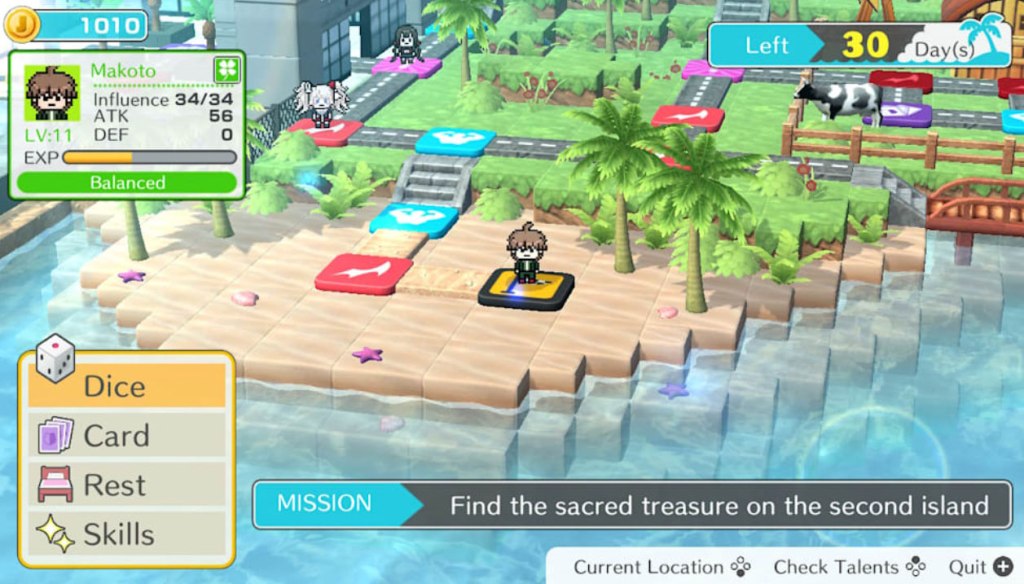
On a technical level, Danganronpa S makes use of the well-designed character art from the earlier games in the series in cutscenes, while the gameplay has very simple 3D representations of the island in the form of a board game, with each of the characters represented by a simplified pixel art version of themselves. It’s pretty underwhelming, especially when you consider that the best part of this presentation, the great artwork, is largely recycled from other games in the series.
The gameplay itself is pretty unusual here too. There are two main modes here: the Development mode, that has you training up your characters’ abilities individually via a Mario Party-style Party Game, and the Vs. Battle mode, that has you fighting a gauntlet of enemies with turn-based JRPG mechanics to earn coins that can be used in gacha machines to unlock new characters.
Let’s start by looking at the Development mode. Unfortunately, despite being clearly inspired by games like Mario Party, there’s no multiplayer support here, and no minigames. You’re just rolling dice and using cards to move to spaces around the island, hoping to take advantage of those spaces to improve your character’s stats. There are goals to achieve, but it’s unclear how you’re meant to achieve them. And there are bosses to fight, but it’s unclear exactly how to find where all of them are, and you’re not given a clear indication when you’ve leveled up your character enough to be able to fight them.
In other words, you’ll just be rolling dice and upgrading your character until you think you’re ready, then trying to figure out where the heck the boss is, at which time you’ll likely either steamroll over them because you’ve leveled up more than enough, or you’ll be absolutely trounced because you still need to level up more… and just how much more is not anything you’ll find out by getting stomped, either.
Both the Development mode and Vs. Battle mode will make use of the game’s turn-based JRPG battle system, but there is absolutely nothing especially interesting or clever about this system. In fact, it’s so yawn-inducingly basic that by default battles will just go automatically… and even then you’ll be wishing for a way to speed things up.
At the very least series fans will surely get some enjoyment from seeing all of their favorite characters interacting with each other, including numerous characters that never even meet in the mainline series. Unfortunately, if you’re really eager to play as a specific character to see how they interact with others, you need to unlock them first, and the game’s gacha system ensures that even after you’ve put the hard work into getting the coins you need to unlock them, it’s down to pure luck whether your purchase will actually get you the character you want.
But of course, you could always spend real-world money in the eShop to unlock your character of choice…
Yeah, ew, gross.
In the end, Danganronpa S is an interesting experiment that lets players enjoy this series’ characters in a completely different context. Unfortunately, virtually everything about this game feels like a sleazy cash grab, from the reused visuals, the poorly-designed Board Game and JRPG elements (also more or less reused from Danganronpa V3), and the one element with the most potential to attract series fans is also the one directly tied to ugly microtransactions. Even if you’re a series fan, this is absolutely not a game you should be wasting your money on.
tl;dr – Danganronpa S is a spin-off game within the Danganronpa franchise that has the characters from throughout the series in a lighthearted romp that mixes Party Game and Turn-Based JRPG elements based on minigames from Danganronpa V3. Unfortunately, all of the gameplay elements here are poorly-designed and boring, the visuals are largely recycled, and the appeal of seeing your favorite character interact with others is ruined by a gross gacha system that’s clearly trying to push you to spend money to unlock them in the eShop. Do not waste your money on this rip-off of a game.
Grade: D
You can support eShopperReviews on Patreon! Please click HERE to become a Sponsor!
This month’s sponsors are Ben, Ilya Zverev, Andy Miller, Exlene, Homer Simpin, Johannes, Francis Obst, Gabriel Coronado-Medina, Jared Wark, Kristoffer Wulff, and Seth Christenfeld. Thank you for helping to keep the reviews coming!
 eShopperReviews
Leave a comment