
Final Fantasy VI
Genre: Turn-Based JRPG
Players: 1
.
Review:
(Note: This game is included in the Final Fantasy I-VI Pixel Remaster Collection, along with Final Fantasy, Final Fantasy II, Final Fantasy III, Final Fantasy IV, and Final Fantasy V)
Final Fantasy VI, originally released in Japan in 1994 on the Super Nintendo, was the final game in the mainline Final Fantasy series to release exclusively on a Nintendo platform, with subsequent games being released to Sony platforms. It is the final 2D game in the mainline series, and to many it is the pinnacle of “old-school” Final Fantasy games,
Due to the decision by Square (later Square Enix) not to publish Final Fantasy II, Final Fantasy III, and Final Fantasy V outside of Japan, and wanting to avoid confusion when bringing this game to Western audiences, Final Fantasy IV was retitled Final Fantasy II in its Western release, and Final Fantasy VI was retitled to Final Fantasy III, though in more recent releases, Square Enix has since reverted back to referring to these games using their original Japanese numbering. Even so, whenever you talk about Final Fantasy III, particularly with those who played the series back in the Super Nintendo era, you often still need to specify whether you’re talking about the American Final Fantasy III or the Japanese Final Fantasy III, which some called Final Fantasy IIIj.
In the time since Final Fantasy VI’s original release, it received a port to the original PlayStation in the Final Fantasy Anthology bundle re-translated the game’s localization and added new pre-rendered cutscenes, a Game Boy Advance release further enhanced the graphics and improved the localization and added new bonus content as well as adding new dungeons and new espers.
This release, the “Pixel Remaster” version of the game, originally released on PC and mobile platforms in 2021, with a port to PlayStation 4 and Nintendo Switch with a few extra features in 2023. I’m not about to compare this release to each and every other version of the game, but I will note some of the features and comparisons this release has to other versions. Having said that, there’s good news here and bad news.
I’ll get the bad news out of the way right now – this game doesn’t give us the additional dungeon and espers that were added to the Game Boy Advance version of the game. It also doesn’t have the 3D cutscenes the PlayStation version of the game received (though it thankfully also lacks the horrible loading times of that release). Anyone hoping that this would be anything remotely like a comprehensive package of Final Fantasy VI content is likely to be disappointed.
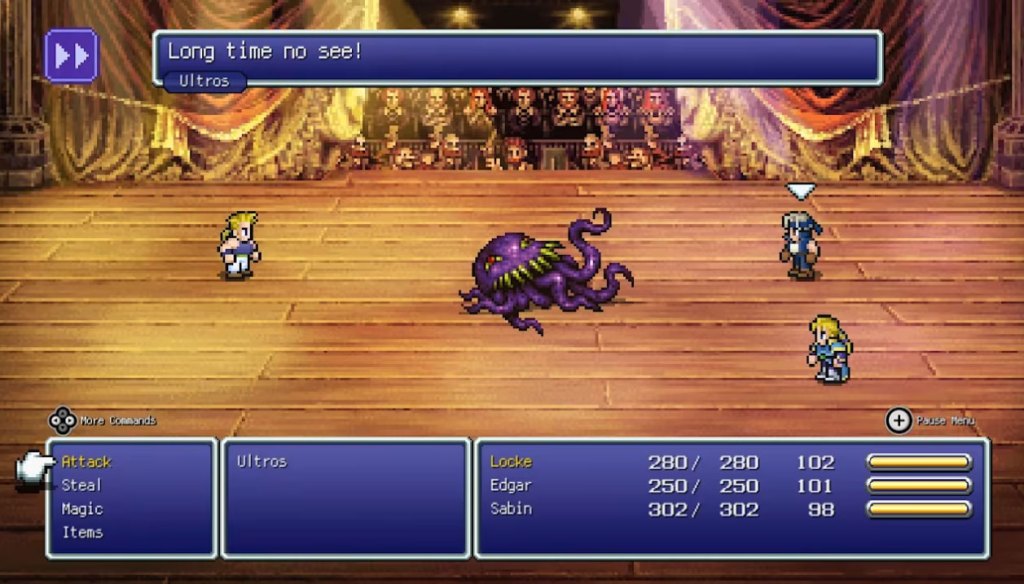
The good news is that the remade presentation here is still quite nice, though this isn’t the great leap over the original games like Final Fantasy, Final Fantasy II, and Final Fantasy III received. The Pixel Remaster version of the game adds in some nice added effects like lighting highlights on the ocean, and a really nice flowing water effect in streams, and there are other subtle changes here and there, but overall this doesn’t look dramatically improved over the original release, save for one exception – the game’s famous opera scene has now been rendered in full 3D in a style vaguely like HD-2D games like Octopath Traveler and Triangle Strategy. It’s a nice touch that adds something a little extra to this release of the game.
Also, for players who complained about the modernized text in PC and mobile release of the Pixel Remasters, this version has added options to return the text to the pixelated original look.
The more significant change here has to be this version’s newly-remade soundtrack using a combination of orchestrated, instrumental, and synthesized themes, as well as full English voicework for the aforementioned opera scene (though personally I’m not a huge fan of this version of that theme). Personally, I think that Final Fantasy VI’s soundtrack is not just one of the greatest soundtracks in the series, but one of the greatest videogame soundtracks of all time, so hearing this new version of the soundtrack is a real treat.
I don’t have any tracks I can link to directly, but check out this page for samples. In particular, I recommend 3. Omen -3-, 5. Awakening, 6. Locke’s Theme, 10. Kefka, 13. Shadow’s Theme, 15. Cyan’s Theme, 17. Phantom Forest, 18. Phantom Train, 19. The Veldt, 20. Gau’s Theme, 22. Kids Run Through the City, 25. Protect the Espers!, 26. The Decisive Battle, 28. Terra’s Theme, 31. Forever Rachel, 42. Overture -3-, 59. Wedding Waltz – Duel -4-, 61. Setzer’s Theme, 65. The Airship Blackjack, 68. Relm’s Theme, 73. Battle to the Death, 77. Searching for Friends, and 89. The Prelude (this song is in every Final Fantasy game, but I feel this version is particularly moving, though sadly the demo in the linked page doesn’t really show this).
So… yeah, that’s a lot of good songs. I did just say this was one of the greatest videogame soundtracks of all-time, did you really think I was just going to cite 3-4 examples? And as remakes go, this remake of the soundtrack is all-around pretty excellent, even if there are a few places where I prefer the original. And as with the other games in the Pixel Remaster series, those who prefer the original soundtrack can opt to play with the original chiptune music instead.
Beyond the presentation, there are also content and gameplay improvements here too. One of the most noteworthy improvements has to be the new Auto-Battle system, which can really cut down on the grinding this game puts players through. Want to cut down it even more? The PlayStation 4 and Nintendo Switch release include menu options to boost the amount of gold and experience you get from battles, allowing you to severely cut down on the grinding. If you prefer, you can even eliminate random encounters completely, though of course this could lead to being severely under-leveled when encountering scripted battles like bosses.
This release also adds a quick save feature you can use in a town or dungeon, as well as a new map system. You can also change the button layout to suit your preferences. Finally, the game’s main menu includes a gallery where you can listen to the entire soundtrack and look at concept and publicity art for the game.
Okay, so now that we’ve talked about all the changes made to this release of the game, what about the game itself? How well has it aged?
In my reviews of the previous games in the series, I mentioned the series struggling to find a balance between unique and distinct characters and character customizability, and I believe Final Fantasy VI finally finds a good balance between the two. Every playable character has their own distinct class-based abilities, with some of these being traditional (Locke is a series-standard thief, and Terra starts the game as a series-standard Red Mage) and others being wildly-creative (Sabin uses Street Fighter-style controller inputs for devastating special moves, and Setzer’s special move brings up a slot machine with a random result). This gives these characters a huge amount of individuality.
However, customizability here is excellent too. From early on, players can augment a character’s stats and abilities using “relic” items that can change how any character plays somewhat. Some merely protect against status ailments, some reflect magic attacks back on the enemy, some boost a specific stat like strength or evasion, and some change the nature of the wielder’s attack to be more like a series-traditional dragoon, or shield allies like a series-traditional knight.
Later in the game, players also get access to “magicite”, which increases the wielder’s stats, gives them a summon ability, and can permanently teach them one of that magicite’s abilities. For players who desire, you could potentially have a full party of characters each equipped with a full menu of magic spells by the game’s end (save for a few specialty characters).
It bears mention that even if you’re not especially fond of one or two characters, you’ll likely find someone to replace them with in your party – the game includes as many as fourteen permanent party members from which players can use four at any given time, and at some points in the story they’ll even be instructed to split their group into three separate parties acting in different places at the same time. Suffice it to say, even by today’s standards, Final Fantasy VI is a highly-ambitious JRPG.
That ambition isn’t merely limited to the gameplay, either. Final Fantasy VI features an epic, sprawling story, and nearly all of those characters will play a huge role in the game’s plot (the exceptions mostly just being a pair of optional bonus characters you can pick up late in the game). It’s not just the heroes who are highly charismatic and memorable, either – Final Fantasy VI also has one of the most iconic, sinister villains in the entire series, Kefka, whose infamous laugh is still as memorable all these years later.
Right from the game’s dramatic opening as soldiers piloting mechs with their mind-controlled slave trudging through the snow toward a mountain town late at night, this game establishes a solemn tone that I feel sets this game apart from all its predecessors. That’s not to say it’s without a sense of humor, and limitations of the sprite-based hardware and censorship of the time mean that the game’s designers had to get a bit… creative with the way these characters communicate their emotions (“Son of a submariner!”), but this game touches on some serious topic matter in a manner that’s relatively sensitive given this game’s age, including abuse, war crimes, murder, genocide, suicide, hopelessness, and the loss of loved ones.
This game is highly creative in where it takes its story, too. I alluded to it before, but perhaps this game’s most famous scene is the opera scene, where your diverse band of characters stages an ambitious heist that sees one of their number posing as an opera singer, with different kinds of action taking place both on-stage and in the rafters. In another scene, you get to the typical battle with the final boss on a floating island, only for that battle to go… very differently than you might expect.
Okay, okay, I need to stop talking about how great this game is. I need to move on…
So… then we have to look at this game’s price. I do appreciate the improvements and enhancements that this version of the game received, but even so, $18 seems like an absurdly high price for a game that is now 30 years old, especially when this isn’t even a comprehensive release. Seriously, if they were gonna’ charge an arm and a leg for this game, they could have at least tossed in the added Game Boy Advance dungeon and espers to sweeten the deal.
Look, I won’t mince words – Final Fantasy VI is still to this day one of the greatest RPGs of all-time, and despite being three decades old, it has aged impeccably well. What’s more, this release of the game is superb, adding some much-appreciated enhancements that will make it even more enjoyable for modern audiences. However, I cannot ignore the steep $18 price tag on this game, especially when this version lacks features from prior releases. I still think this is an absolute must-play game, but that price makes it harder to recommend. But if you enjoy retro-style JRPGs and see this game in a decent sale, I definitely suggest you pick it up.
tl;dr – Final Fantasy VI is a Turn-Based JRPG that is still to this day arguably one of the best games this genre has ever seen. However, while the remade music in this release is wonderful and some of the new added features are nice, they do not justify the bloated $18 price tag this game has, especially when this release is missing some content that was included in other versions of the game. If you’re a fan of classic JRPGs and don’t mind taking a hit to your wallet, you should consider this a must-have game… but at this price, I can’t give it the full recommendation I feel it deserves.
Grade: B+
You can support eShopperReviews on Patreon! Please click HERE to become a Sponsor!
This month’s sponsors are Ben, Ilya Zverev, Andy Miller, Exlene, Homer Simpin, Johannes, Francis Obst, Gabriel Coronado-Medina, Jared Wark, Kristoffer Wulff, and Seth Christenfeld. Thank you for helping to keep the reviews coming!
 eShopperReviews
Leave a comment