
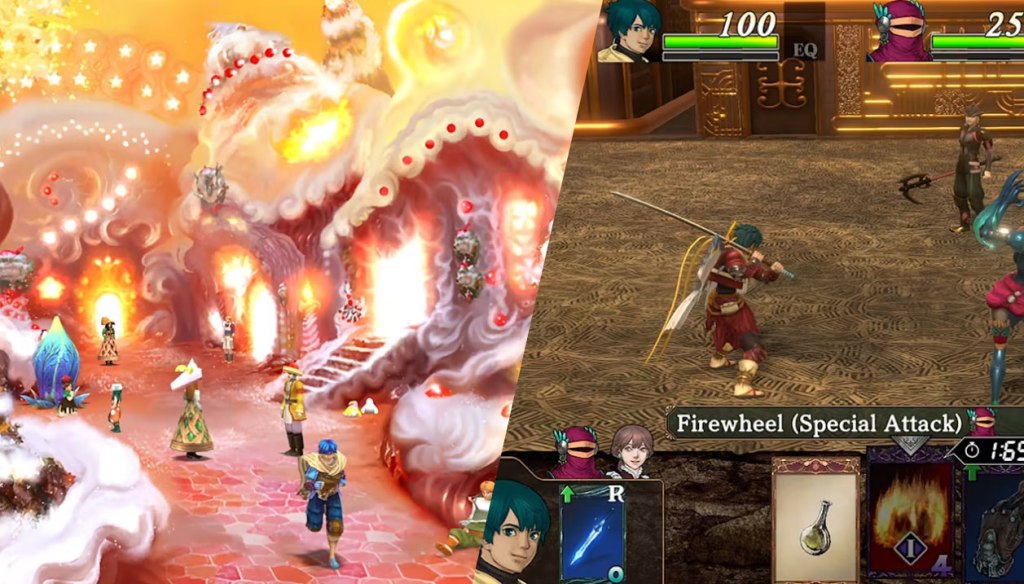
Baten Kaitos I & II HD Remaster
Genre: Compilation / Turn-Based Card JRPG
Players: 1
.
Review:
Baten Kaitos I & II HD Remaster, released on Nintendo Switch in 2023, is a pair of remastered remakes of GameCube Turn-Based Card JRPGs developed by Monolith Soft, the developer who would go on to create the Xenoblade franchise. The games included here are Baten Kaitos: Eternal Wings and the Lost Ocean (AKA Baten Kaitos I), originally released on the GameCube in 2004, and Baten Kaitos Origins (AKA Baten Kaitos II), originally released on the GameCube in 2006.
Here is what I thought of all of the games in this collection:
| Game | Genre | # of Players | Score |
|---|---|---|---|
| Baten Kaitos I | Turn-Based Card JRPG | 1 | B- |
tl;drBaten Kaitos is a Turn-Based Card JRPG about winged people living on an island in the sky in a race to stop an ancient evil from re-awakening. This game has a gorgeous presentation and an abundance of original ideas, but not all of those ideas work, and sometimes the gameplay here seems too convoluted for its own good. This game is still well worth playing, but it’s definitely not going to be a game everyone will like. | |||
| Baten Kaitos II | Turn-Based Card JRPG | 1 | C |
tl;drBaten Kaitos II, as with its predecessor, is a Turn-Based Card JRPG. This game’s story is a prequel to the original game, and while some gameplay elements have been simplified from the original game, others have been made much more complicated, in ways the game has no interest in properly explaining to you. This includes a story where you’re not properly introduced to any of the characters, the world they’re in, or the various factions. And don’t get me started on this game’s completely remade battle system. Suffice it to say, this game is a mess, and while it still has its strong points, I think only the biggest fans of the original game will likely enjoy it, and only if they don’t mind something very different from the original game. | |||
In short, while I think these games have their strong points, these are messy, overly-complicated JRPGs that are difficult to get into, even if you’re totally down with the Card RPG mechanics. The way the combat rushes you to make decisions, the odd way the games handle leveling up, the Graphic Adventure-style “Quest Magna” system that limits how many of these important quest items you can carry at any given time, and then there’s the plot of these games, each of which has their own problems.
In the first Baten Kaitos, I’d argue the biggest problem is that the main character, Kalas, is an unlikeable jerk. One of the first things the guy does to establish just what sort of person he is happens when Xelha, another party member, is taking a moment to mourn her recently-fallen comrades… and without even giving her a moment to grieve, he immediately starts looting their bodies offering to share a little of their loot with her to shut her up. Ugh.
Baten Kaitos II’s main character, Sagi, fares a bit better here. But we’re not given any sort of introduction to him or his partner Guillo, the military organization they’re members of, or the world they’re in. As such, it’s hard to get invested in these characters or any of their struggles.
Between the two games, I think the original Baten Kaitos fares better, largely thanks to its more straightforward and enjoyable combat, and more visually appealing world (at least in the early areas). The second game also makes it a point to gate progress early on through multiple irritating required uses of the aforementioned “Quest Magna” that slows the game’s pacing down while you run back and forth to figure out what the game needs you to do.
This release of these games improves the visuals of the original games by increasing the resolution and smoothing out the framerates, with the result being a pair of games that look excellent, making use of pre-rendered backgrounds and 3D characters, paired with the original games’ solid soundtrack. There are only two real problems on the presentation side of things – first, these releases don’t include the original games’ English voice acting – you’re stuck with the Japanese voice actors (with the odd exception of the first game’s intro cinematic). And second, the video quality of the first game’s opening cinematic is pretty terrible.
When it comes to options and added features, both games now allow you to skip encounters with enemies, turn on “instant KO” to make enemies all die in one hit, change the game speed or battle speed, or turn on an “auto-battle” to have the game do the fighting for you. I suppose, for players who hate these games’ battle system and just want to play through the story, this is a good way to do that.
In the end, I really wanted to like both games in this Compilation more than I did. There’s a great old-school JRPG charm here, and the promise of a card-based battle system holds a lot of potential. But I can’t help but feel like both of these games seemed like they were actively trying to make me dislike them, in their frustrating story elements, or their overly-complicated gameplay. Die-hard fans of JRPGs may still want to give this a try, but know that both of these games are not going to appeal to everyone.
tl;dr – Baten Kaitos I & II HD Remaster is a pair of remastered remakes of GameCube Turn-Based Card JRPGs. I commend these games for trying something unique within the genre, and these remasters do a mostly good job of bringing the presentation up to more modern standards, but at their core these two games are very difficult to love, with overly-complex gameplay and stories that either feature an unlikeable protagonist or are just poorly-told. JRPG fans may still want to try these games out, but they are absolutely not something everyone will appreciate.
Grade: C+
You can support eShopperReviews on Patreon! Please click HERE to become a Sponsor!
This month’s sponsors are Ben, Andy Miller, Exlene, Homer Simpin, Johannes, Francis Obst, Gabriel Coronado-Medina, Ilya Zverev, Jared Wark, Kristoffer Wulff, and Seth Christenfeld. Thank you for helping to keep the reviews coming!
 eShopperReviews
Leave a comment