
Paper Mario: The Thousand-Year Door
Genre: Turn-Based JRPG
Players: 1
.
Review:
The Paper Mario series of family-friendly Turn-Based RPGs has had a rough few years decades. Going back to the Wii’s divisive Platforming-focused Super Paper Mario in 2007, the series has increasingly abandoned its more straightforward RPG roots with each subsequent game. 2012’s Paper Mario: Sticker Star on Nintendo 3DS forced players to grind for stickers needed for even the most basic of attacks, 2016’s Paper Mario: Color Splash on Wii U doubled down on mechanics that players hated in the previous game, making players not only grind for these stickers cards, but forcing them to use the Wii U gamepad’s touchscreen to use them in every single battle, and while 2020’s Paper Mario: The Oragami King on Nintendo Switch featured a large, beautiful world and a delightful story, its spinning puzzle-like battle system was the most convoluted yet in the series, making each battle drag out to interminable lengths.
Paper Mario fans yearned for the elegant simplicity of the series’ early days, but those seemed long-gone now. Even more disheartening, Nintendo’s other long-running Mario RPG franchise, Mario & Luigi, seemed to be dead and gone, with creator AlphaDream going out of business. Anyone hoping for a simple RPG featuring Mario in a funny story with likeable characters, and without having to labor through tedious gameplay mechanics to enjoy it… well, they were out of luck.
Then, everything suddenly changed, all at once.
It started with 2023’s Super Mario RPG on Nintendo Switch, a faithful top-to-bottom remake of Mario’s first RPG title, breathing new life into a true classic that spawned everything that was to follow. More recently, we’ve seen the announcement of Mario & Luigi: Brothership on Nintendo Switch, joyously seeing the return of that series thanks to a still-undisclosed developer, with the game due to release later in 2024. And between the two, we received yet another remake of a classic Mario RPG in the form of 2024’s Paper Mario: The Thousand-Year Door on Nintendo Switch.
When Mario RPG fans talk about their favorite games in these franchises, Paper Mario: The Thousand-Year Door usually tops these lists. The original game came out on GameCube in 2004, and greatly expanded on what we saw in the first Paper Mario game on Nintendo 64. It took what was great about that game and expanded on it, blowing it up into an absurd quest filled with wacky characters, unusual plot twists, and creative game mechanics that made the series seem absolutely filled with potential… at least until we saw that potential largely squandered in subsequent sequels.
Paper Mario: The Thousand-Year Door doesn’t really have any unifying gimmick or game mechanic like later games in the series would have, although there are certainly plenty of interesting and unique game mechanics here. There’s also no grinding for stickers/cards/paint/confetti like later games would have you do, though that’s not to say that there aren’t interesting and useful things for you to collect during your quest. Rather than building the game on top of gimmicks like these, Paper Mario: The Thousand-Year Door simply relies on fun gameplay, a good story, and lots of variety to keep things interesting.
For those who never played the original, the story (which doesn’t rely on you knowing anything about any other game’s story, save for who Mario, Peach, Bowser, etc. are) starts out straightforward enough: While on vacation in the seedy town of Rogueport, Peach has come into possession of an ancient map said to lead to a mysterious treasure, and has sent the map to Mario, inviting him to join her on the search for this treasure. Upon arriving at Rogueport, Mario discovers Peach is nowhere to be found, and multiple other parties are also trying to track down the treasure. Trying to track down the whereabouts of Peach just as much as the treasure, Mario joins the hunt, soon being joined by other friendly faces along the way whose own goals and motivations are leading them on the same path.
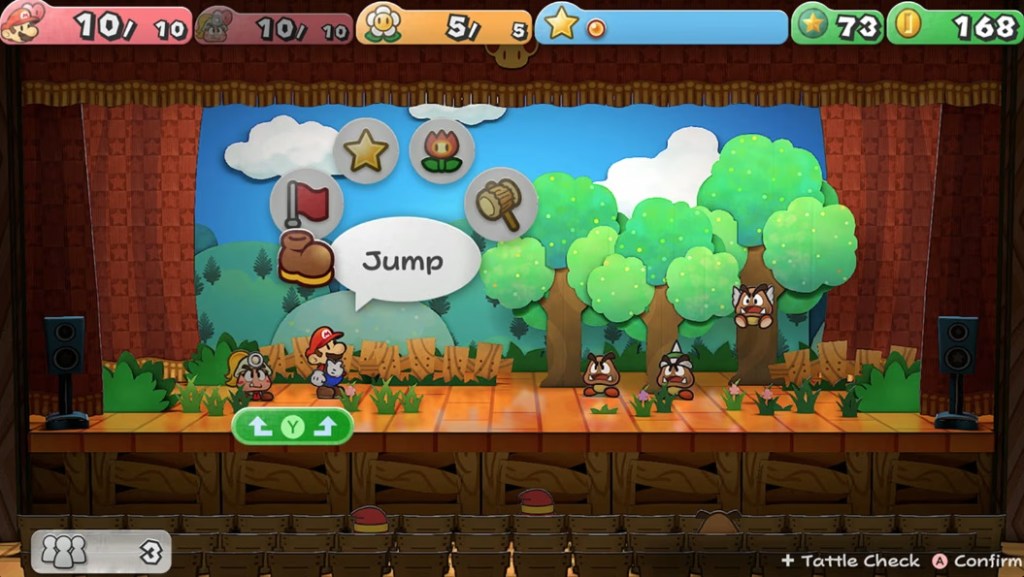
As with most Mario RPGs, Thousand-Year Door takes a standard RPG formula and adds real-time elements to the combat to give players an opportunity to add extra damage to attacks by timing a button press or flicking an analog stick at the right time, as well as reducing damage from incoming attacks in the same way. Thousand-Year Door adds another element to the mix: the audience. Every battle is viewed by an audience full of Toads, Koopas, and other Mario characters, and when you perform a timed hit well or exploit an enemy’s weakness that audience grows and you fill up a special move meter. Do poorly, and the audience shrinks. While straightforward to start, soon you’ll need to keep an eye out for troublemakers in the audience looking to toss things at you, or you may fight a boss who decides to head into the audience on their turn to shake things up. The way this game keeps finding creative new ways to recontextualize this gameplay element is one of the real joys of Thousand-Year Door.
Speaking of shaking things up, that’s another thing Thousand-Year Door does really well. Rather than just sticking with the same standard RPG formula throughout, you’ll find that sometimes you’re suddenly in a TV-style quiz show, sometimes you need to participate in a pro wrestling tournament, and sometimes your point of view swaps to Peach and Bowser, who are dealing with their own problems elsewhere in the world. Again, the way this game mixes things up is one of its greatest strengths, adding to the humor in this game and keeping things fresh throughout.
When we turn our attention to what’s new in this release, we must of course start with the graphics. They are, in a word, gorgeous. Thousand-Year Door on Nintendo Switch still makes use of 3D visuals designed to look like papercraft, but everything has lovely detail and texture that gives it a real feeling of existing within a real-life space, and that level of detail has been greatly heightened in this version. It isn’t as visually-impressive as Origami King was four years ago, with that game’s larger open spaces giving players a lot more to take in, but it’s still a huge leap over the GameCube original.
This increased visual quality is despite the drop from 60FPS framerates to 30FPS, something which has little effect on the gameplay. While some players are irritated about this change, I believe there is a far more important number to look at, and that is resolution – the GameCube original was only 480p (854×480), compared to 1600×900 on Nintendo Switch while docked and 1138×640 in handheld mode. In other words, the framerates here are being halved, while the resolution is increasing as much as four times what was in the original. It’s a tradeoff that is absolutely well worth it here, in my opinion.
The remade visuals are joined by a completely remade soundtrack that sounds much-improved over the original. For some good examples, check out An Awfully Long Time Ago…, Rogueport: Podley’s Place, Goombella, Frankly, It’s a Mystery, Grifty the Traveling Minstrel, Battle: Hooktail, and Madame Flurrie, just to name a few.
In addition, there are a few more other subtle improvements throughout the game, such as a new pipe room area that makes backtracking far less of a pain, a few changes to level design to make traversal less tedious, a new radial ring you can bring up with the press of a shoulder button to quickly swap out your helper party member, and some other smaller additions here and there. These changes don’t drastically affect the game, but generally act as QoL improvements that make the game easier to enjoy and cut down on irritations.
Okay, so I think at this point it’s plain that I think Paper Mario: The Thousand Year Door is good, and the Nintendo Switch version is much-improved over the original. Are there any complaints I have? Well, a few, actually. I think the pacing can be a bit slow at times, particularly in the beginning. I think that when the game calls for platforming that platforming can be sloppy and not particularly enjoyable. And I think that until combat starts to get more complex it can be too repetitive. Basically, I think the earliest parts of the game are its worst, and you need to give it time to grow on you.
However, while it may still have some issues keeping it from perfection, Paper Mario: The Thousand-Year Door is still to this day an absolutely impeccable turn-based JRPG, one that absolutely is at its best on Nintendo Switch, and which stands to show how this old-fashioned approach to the Paper Mario series isn’t just something that is fondly remembered by those who hate change, but something truly wonderful that the franchise has sadly gotten too far away from over the last two decades. Hopefully this game marks the beginning of a new era when we can see a true return to form for the franchise.
tl;dr – Paper Mario: The Thousand-Year Door is a full remake of the classic family-friendly GameCube Turn-Based JRPG, one that series fans swear is still the best in the series, and they have a point – despite a slow start, this game is excellent, with some compelling but straightforward gameplay mechanics, likable characters, and a great story. What’s more, this release features a gorgeous graphical upgrade, a remade soundtrack, and some excellent minor quality-of-life gameplay additions. Overall, that makes this a must-play for RPG fans, and especially for fans of Mario RPGs.
Grade: A-
You can support eShopperReviews on Patreon! Please click HERE to become a Sponsor!
This month’s sponsors are Ben, Ilya Zverev, Andy Miller, Homer Simpin, Johannes, Francis Obst, Gabriel Coronado-Medina, Jared Wark, Kristoffer Wulff, and Seth Christenfeld. Thank you for helping to keep the reviews coming!
 eShopperReviews
Leave a comment