
Neckbreak
Genre: First-Person Shooter
Players: 1
.
Review:
Before going on, I should clear up a bit of this game’s history. Neckbreak started its life in 2022 on PC and Xbox One under the title Project Downfall, with a port of this game coming to Nintendo Switch in 2024. However, for reasons the developer claims are “due to “due to some technical as well as marketing reasons”, this release of the game was pulled from digital storefronts, with the seemingly-identical game Neckbreak released not long after that same year, in 2024. I’m unclear on what changes were made to the game in its re-release under a different name (apart from a protagonist who now looks far less like Keanu Reeves), so I’ll just be going into this review fresh.
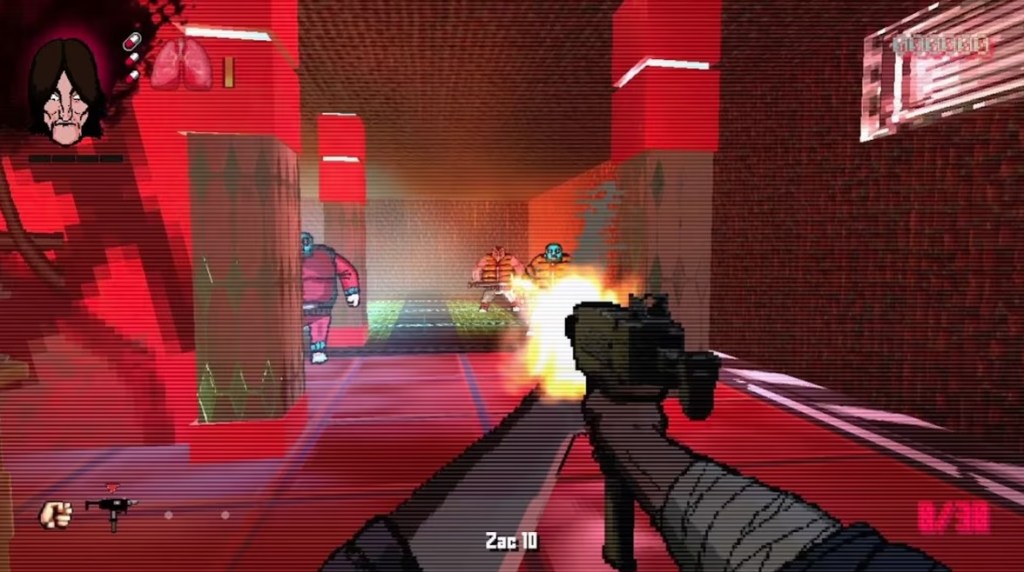
Neckbreak is a First-Person Shooter that many have dubbed as a First-Person Hotline Miami, and for good reason. Not only does the game use a trippy aesthetic that’s highly reminiscent of Hotline Miami, as well as a gritty tone and high levels of violence, but it also features gameplay where players can only get a few shots from a weapon before they need to toss it and procure a new one, and death comes extremely quick for both you and your enemies.
Let’s talk about that aesthetic first. Neckbreak takes place in a dystopic cyberpunk-style future where the government, gangs, and corporations all seem to have under-the-table deals with each other, where trash is piled up on streets lined with graffiti of homophobic slurs, and where all of this is viewed from a perspective of an office worker zonked out on corporate-mandated drugs (at one point you pass an arcade game flashing a screen declaring “Winners don’t use drugs! Except government approved”). Just to be clear, this world is loud and violent, where seemingly everyone is out to make an easy buck, and death is cheap.
In more tangible terms, Neckbreak uses 3D visuals with characters and weapons represented by 2D visuals that animate poorly but react to environmental lighting in a way that makes this game look like an odd combination of high-detail and low fidelity. Further expanding on this, the game’s lighting effects are at times overbeating, with neon lights creating harsh and at times blinding glows. All of this is seen through film grain and TV scan lines (the latter of which you can thankfully remove in the settings if you prefer). This all makes for a pretty striking visual presentation that really drives home the game’s oppressive atmosphere and highlights the lack of humanity to be found in the setting – blow away a one of the people you encounter, and they almost literally crumple away like paper.
This presentation is heightened even further with some truly excellent sound design, where every shot and punch has an excellent visceral element to it that you hear even more than you see it when it lands. And this is all backed by a soundtrack that not only gives you a distinct “cyberpunk”-style vibe with lots of synth/techno themes, but also seems to mirror the sorts of soundtracks of cyberpunk anime like Ghost in the Shell with vocal elements, creating a soundscape that’s harsh, oppressive, and cold, but also tinged with sadness and hints of beauty. For examples, check out Apartment, E.C. 2, Call of Duty, and Exchange.
When it comes to the gameplay, the concept of “Hotline Miami in first-person” largely works. This game has the same frenetic pace, snappy action, and satisfying combat. It is immensely satisfying to unload your gun into one goon before tossing it into another and then snapping his own weapon out of mid-air to finish him off, and the game makes things even more satisfying with the ability to pop a pill for a brief “bullet-time” moment of slow-mo, along with the ability to slide along floors to close the distance to an enemy or behind cover.
Having said that, I do have a few issues here. First, the standard walking speed is a bit on the slow side, and although you can press in the left analog stick to run, this gets tiresome. You can change the settings to toggle running, but this is awkward too, as the standard run speed is too fast for precision. There’s also a default auto-aim that’s extremely annoying, although this too can be turned off.
The real problem here, I think, is that enemies are extremely stupid – they all stand still in one spot until you get within a range of them, and then their either rush you or stand in place and fire at you. At one point, I encountered a row of enemies that let me plow through them one at a time as I would come into range of one, take him out, then come into range of the next one who was only a foot or two behind the one that I just slaughtered but who did not react in any way. Since we’re comparing this game to Hotline Miami, it bears mentioning that while Hotline’s enemies weren’t the brightest, they did at least occasionally have patrol routes, investigate nearby sounds, and react to their buddy next to them getting killed.
So is Neckbreak as much of a success in first-person as Hotline Miami was in a top-down view? Unfortunately no – a few irritating control issues and brain-dead AI add up to hold this game back. However, the excellent presentation and satisfying combat still make this game well worth playing, at least if you have a stomach for its violent, oppressive world.
tl;dr – Neckbreak is a First-Person Shooter that copies much of the style and gameplay of the Hotline Miami franchise, bringing it to a first-person perspective in a dystopian cyberpunk world. While the presentation and core gameplay are excellent here, dumb AI and a few control issues keep this game from reaching the same heights as its inspiration. However, even with this being the case, it’s still well worth playing if you don’t mind the extreme violence and dark topic matter.
Grade: B
.
This game has been nominated for one or more of eShopperReviews 2024 Game Awards:
Runner-Up: Best Sound Design
.
You can support eShopperReviews on Patreon! Please click HERE to become a Sponsor!
This month’s sponsors are Ben, Ilya Zverev, Andy Miller, Homer Simpin, Johannes, Francis Obst, Gabriel Coronado-Medina, Jared Wark, Kristoffer Wulff, and Seth Christenfeld. Thank you for helping to keep the reviews coming!
 eShopperReviews
Leave a comment