
Deltarune
Genre: Turn-Based RPG
Players: 1
The Nintendo Switch 2 Difference
.
Review:
Deltarune, like its predecessor Undertale, is sorta‘ a Turn-Based RPG, albeit one that plays with the conventions of the genre in surprising and at times post-modernist ways. This game is not really a sequel to Undertale, and although it reuses some characters and elements from that game, it seems sorta’ like an alternate-world take on Undertale, with returning characters largely divorced from the events of that game. That said, it is recommended that before playing this game, players complete Undertale first.
Anyway, Deltarune was and continues to be released in episodic format, with chapter 1 releasing on PC in 2018 then ported to PlayStation 4 and Nintendo Switch in 2019, and chapter 2 releasing on PC, PlayStation 4, and Nintendo Switch in 2021 – both released for free as a “demo” for the full game, though these two chapters alone clock in at roughly 3-4 hours total. The 3rd and 4th chapters, subsequently, are packaged together with the first two as a paid release in 2025 on PC, PlayStation 4, Nintendo Switch, and Nintendo Switch 2. Further chapters are planned with releases TBA, and will be made available for free to those who purchased this bundle whenever they are released.
As an aside, if you wonder whether it’s fair to review a game when it is still technically incomplete, I’ll remind you that eShopperReviews routinely doesn’t play games to completion before reviewing them, so that’s hardly an issue here.
Deltarune mainly follows three new characters – silent protagonist Kris, his classmate the school bully Susie, and Ralsei, the self-proclaimed prince of a strange land that Kris and Susie find themselves in. However, it’s a bit of an oversimplification to say these three are the leads of Deltarune, as they frequently split apart, find themselves at odds, and even when together frequently don’t cooperate with each other.
Early on, the reason for this is Susie, who is aggressive and violent, refuses to follow your direction, and cuts a swathe of chaos around and ahead of you until she doesn’t have any choice other than to play nice, though even then she only just barely does so. If I were Kris, I’d find her an absolute nightmare to be around, but as someone playing the game, she’s a highlight of the game that helps to set Deltarune apart from other games, and even from Undertale, and that’s not to say the other characters are any less interesting, Susie’s just the one who right from the start absolutely demands attention.
All of this is still just talking about her role very early in episode 1, but suffice it to say there are some dramatic twists and turns in this story as it progresses that I won’t get into.
Where Undertale’s story emphasizes the role of player choice arguably more than any other videogame ever has, Deltarune seems to be an oppressive counter to that, right from the start making it a point that your choices don’t matter, and the game’s creator Toby Fox has underlined the fact that, unlike Undertale, this game will only have one ending… though Fox also says this experience is about more than just the ending. It’s a compelling way to follow up the profound experience that many found Undertale to be, though I think most players will find this doesn’t quite have the same impact.
Still, it’s funny, engaging, and thoroughly creative and surprising, and the way Deltarune takes on genre conventions had me laughing numerous times while playing the game, and its dialogue is pretty funny as well. Players who were charmed by Undertale will find a lot to like here too.
The visuals once again make use of a 2D pixel art style with a decidedly retro look that brings back memories of games like Earthbound, with some really creative and distinct character designs. Backing this is a soundtrack that mixes chiptune, synthesized, instrumental, and vocal pieces and has some excellent tunes, including multiple versions of the game’s main theme, such as Beginning, Field of Hopes and Dreams, Friendship, You Can Always Come Home, and Don’t Forget. There are some other nice themes here too, such as Before the Story, Girl Next Door, and My Castle Town. There’s a really eclectic mix here, but it all works well for this decidedly quirky game. That said, it’s anyone’s guess if any of these songs becomes as massively iconic as Megalovania…
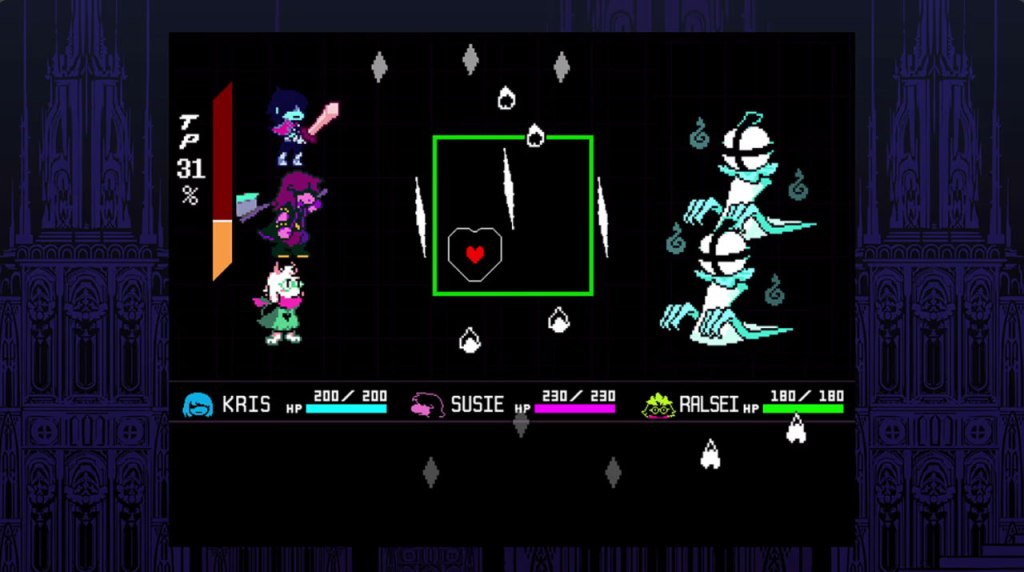
The gameplay once again takes a unique approach to Turn-Based RPGs, as enemy attacks have the player (represented by a heart) dodging enemy attacks like a Bullet Hell Shmup. And just like in Undertale, this game does some really creative things with that unique formula that I wouldn’t dare spoil for you here.
Look, I’m going to tell you what you probably already know. If you loved Undertale, you’ll probably love Deltarune, albeit probably not quite as much. If you didn’t like Undertale, I don’t think you’ll like Deltarune. And if you never played Undertale… well, you should probably play Undertale before playing this game. However, that aside, Deltarune is an outstanding quirky weird funny thoughtful clever and at times mind-bending game that is absolutely deserving of your attention.
tl;dr – Deltarune is a Turn-Based RPG (sorta’) that follows in the footsteps of Undertale but does a few things quite differently, yet is in many ways much the same wildly creative, bizarre, funny, thoughtful and original experience that Undertale was. If you enjoyed Undertale, this is a no-brainer, if you didn’t like it then this probably won’t be any different for you, and if you haven’t played Undertale, then play Undertale before playing this.
Grade: A-
.
The Nintendo Switch 2 Difference
Deltarune
Genre: Turn-Based RPG
Players: 1
.
Review:
The Nintendo Switch 2 version of Deltarune is available for free to those who purchased the Nintendo Switch version of the game, and likewise the Nintendo Switch version is free for those who purchased the Nintendo Switch 2 version. This is pretty much the best-case scenario for those unsure which version of the game to get – get either one, and you get both. Plus, the Nintendo Switch 2 version of the game can import save data from the Nintendo Switch version.
That said, don’t expect too much in the way of differences. For the most part, both versions of the game are identical. This is not much of a surprise, given that Deltarune is a graphically-unimpressive 2D pixel art game that’s not the sort of game that will benefit from the improved hardware of Nintendo Switch 2.
Having said that, there is one distinct difference in this version of the game, and an exclusive feature not available in any other version of the game – the Nintendo Switch 2 version features one bonus room that makes use of both Joy-Con 2 controllers in mouse mode for a unique, if brief experience. All other versions of the game will have a different version of this room that plays differently.
Does that make this version of the game better? That’s debatable. But since buying either Nintendo Switch version of the game gets you both versions, and both versions will play on Nintendo Switch, and you can transfer over your save data, it will only cost you a little time to try both to compare the two.
With this being the case, my final judgment on the Nintendo Switch 2 version of the game is the same as my judgment on the Nintendo Switch version.
tl;dr – Deltarune is a Turn-Based RPG (sorta’) that follows in the footsteps of Undertale but does a few things quite differently, yet is in many ways much the same wildly creative, bizarre, funny, thoughtful and original experience that Undertale was. If you enjoyed Undertale, this is a no-brainer, if you didn’t like it then this probably won’t be any different for you, and if you haven’t played Undertale, then play Undertale before playing this.
Grade: A-
You can support eShopperReviews on Patreon! Please click HERE to become a Sponsor!
This month’s sponsors are Jamie and His Cats, Ben, Ilya Zverev, Andy Miller, Homer Simpin, Johannes, Francis Obst, Gabriel Coronado-Medina, Jared Wark, Kristoffer Wulff, and Seth Christenfeld. Thank you for helping to keep the reviews coming!


 eShopperReviews
Leave a comment