
Rune Factory: Guardians of Azuma
Genre: Action-RPG / Management Simulation
Players: 1
The Nintendo Switch 2 Difference
.
Review:
The Rune Factory series has been around since its first 2006 release on Nintendo DS, where the first game bore the subtitle “A fantasy Harvest Moon”, and that’s pretty much been the premise from the start – these games combine combat-focused Action-RPG gameplay with Management Simulation elements you’d expect to find in games like Stardew Valley, Story of Seasons, and Harvest Moon.
For a while, these games were primarily 2D, which worked well for the franchise, with Rune Factory 4 Special‘s release on Nintendo Switch in 2020 getting a glowing review from me. However, when the series went fully 3D in 2022’s Rune Factory 5, I feel like it stumbled. While the core gameplay was still good, the performance on Nintendo Switch was pretty bad given how underwhelming the game was, and the game overall felt bland and generic compared to its predecessors. The series tried to go back to what worked with another remake of a handheld game, Rune Factory 3 Special, but I felt it aged poorly compared to Rune Factory 4.
I go through this bit of history because going into the next Rune Factory game, I feel like it was clear that things needed to change, and it seems that the folks in charge of making us a new Rune Factory game agreed. Rune Factory: Guardians of Azuma, released in 2025 on PC, Nintendo Switch, and Nintendo Switch 2, still bears the same core formula as the other games in the series, mixing combat-focused Action-RPG gameplay with “Farming RPG” Management Simulation, but this time the game has a distinctly Japanese aesthetic, with a story that starts with a clash between two dragons and their riders and then turns to the struggle against a growing corruption plaguing the titular land of Azuma. So clearly this time around they’re striving to avoid the generic presentation of Rune Factory 5.
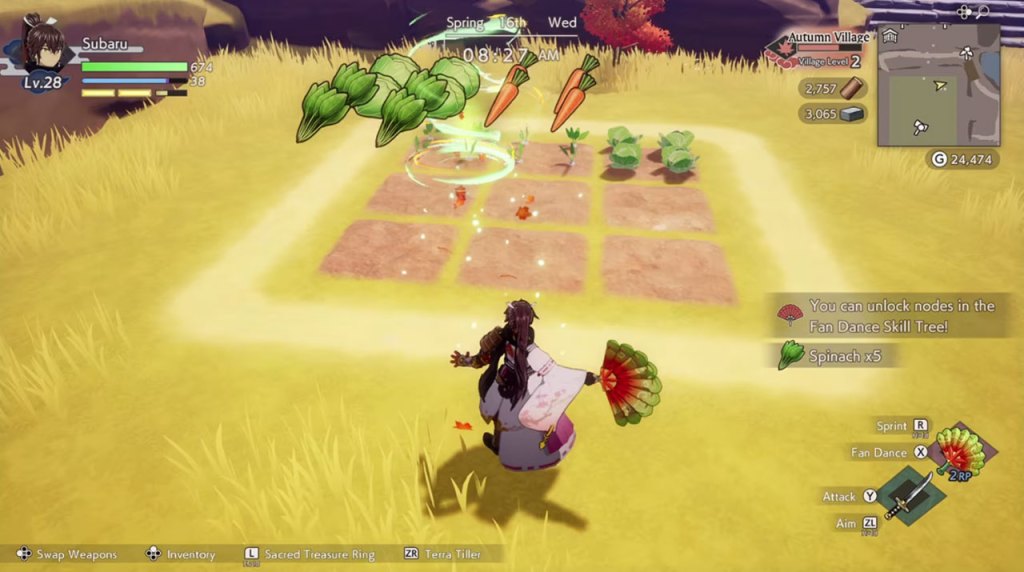
When we look at performance… well, this is better than Rune Factory 5, at least. Some elements of this game work quite well. The game’s anime-style 3D cel-shaded characters have a great character design to them, with some nice combat animations. However, the performance on Nintendo Switch is all over the place. Sometimes the framerates are smooth, and sometimes they’re really rough. Plus there are bland textures, rough-looking shadow textures, and tons of pop-in. In the end, it still works, but it’s messy, and it’s disappointing considering what we know the Nintendo Switch is capable of.
This is joined by voiced performances that are mostly good. However, one character – a dragon transformed into a flying “wooly” nicknamed Woolby, feels very out of place here, and while that’s initially charming, his voice started to grate on me before too long. And this is all backed by a soundtrack clearly inspired by traditional Japanese music, fitting the game’s themes well enough.
When it comes to the gameplay, there’s some good and some bad here. For the good, let’s start with combat. Combat in Rune Factory: Guardians of Azuma has evolved quite a bit from earlier games, with a nice skill tree involving numerous weapon types and sub-weapons, a pretty good combat flow, and a dodge-counter system that’s a bit reminiscent of what’s in The Legend of Zelda: Breath of the Wild and Tears of the Kingdom.
What’s more, when we turn to the Management Simulation side of things, this game expands that element of the game to include the building and placement of structures, giving the game a bit of a town-building mechanic that’s kinda’ nice. Plus, as your town grows, you can put its new residents to work gathering wood, mining, or tending to the farm, a wonderful idea I feel more “farming sims” would incorporate, as it lets you delegate these tasks to focus more on adventuring and working on building the town.
On the negative side of things, actually getting things done in town feels like it requires extra busywork, as you often can’t craft things yourself, but need to track down a specific villager who can do the work for you, such as a carpenter or blacksmith. And then, rather than taking the raw materials and working them into what you need, you’re forced to go through the multi-step process of processing the materials and then combining them into the end product. It’s not the worst thing in the world, but it makes for more busywork for the player.
In the end, I think that Rune Factory: Guardians of Azuma has its ups and downs on Nintendo Switch. The middling performance and the extra busywork the game throws at you are both less than ideal. However, it’s nice to see this series find a personality again, and the core gameplay is mostly better than ever. If you’re a fan of Action-RPGs, this is definitely worth a look, though Nintendo Switch might not be the ideal platform for it.
tl;dr – Rune Factory: Guardians of Azuma is an Action-RPG and “Farming RPG” Management Simulation that brings the long-running series in a new direction with a traditional Japanese-inspired aesthetic, and evolves both the combat and the farming gameplay in mostly-excellent new ways. There are some minor gameplay frustrations, and the Nintendo Switch version has performance issues, but overall this is a solid new entry in this series and well worth a look for fans of its respective genres.
Grade: B
.
The Nintendo Switch 2 Difference
Rune Factory: Guardians of Azuma Nintendo Switch 2 Edition
Genre: Action-RPG / Management Simulation
Players: 1
.
Review:
While I believe that there’s no reason that Rune Factory: Guardians of Azuma should struggle to run well on Nintendo Switch, the sad truth is that it does. So even though a Nintendo Switch 2 Edition seems like it shouldn’t be necessary, well… here we are.
Right away, the improvements to framerate and resolution are noticeable in this version, and some of the other issues are improved, though not resolved completely. The pop-in isn’t as bad… but it’s still there. The shadows no longer look quite so rough… but they’re still not great. It’s still enough of a performance boost that this is definitely an improved version over the Nintendo Switch release, but it’s not a massive, profound difference.
The Nintendo Switch 2 version of the game does make one other change – when you’re engaged in the Management Simulation elements in building mode, you can make use of mouse controls to place objects from a top-down perspective. This is a nice addition, though I think which one you prefer will really be a matter of preference.
So with all of that, is the Nintendo Switch 2 version worth the $10 extra this version costs? Sure, I think it is, though it’s not such a massive difference that it’s likely to change your mind about the game if you got the Nintendo Switch version and are weighing whether to upgrade. However, I do think this is a step in the right direction for the Rune Factory series overall.
tl;dr – Rune Factory: Guardians of Azuma is an Action-RPG and “Farming RPG” Management Simulation that brings the long-running series in a new direction with a traditional Japanese-inspired aesthetic, and evolves both the combat and the farming gameplay in mostly-excellent new ways. The Nintendo Switch 2 Edition of the game improves the performance and adds mouse mode support to the town building parts of the game, making for a decent but not massive improvement to the game. Overall this is a solid new entry in this series and well worth a look for fans of its respective genres.
Grade: B
.
This game has been nominated for one or more of eShopperReviews 2025 Game Awards:
Runner-Up: Best Action-RPG, Best Simulation, Best Sequel
.
You can support eShopperReviews on Patreon! Please click HERE to become a Sponsor!
This month’s sponsors are Jamie and His Cats, Ben, Ilya Zverev, Andy Miller, Homer Simpin, Johannes, Francis Obst, Gabriel Coronado-Medina, Jared Wark, Kristoffer Wulff, and Seth Christenfeld. Thank you for helping to keep the reviews coming!
 eShopperReviews
Leave a comment