
Faeria
Genre: Collectable Card Game / Turn-Based Strategy
Players: 1-2 Competitive (Online)
.
Review:
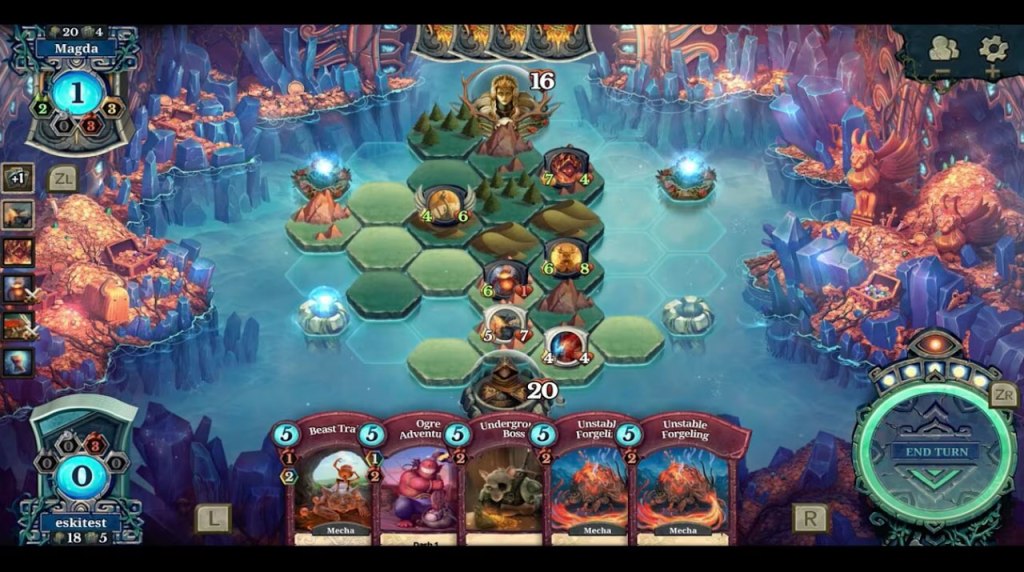
Faeria, released on PC in 2017 and ported in 2020 to PlayStation 4, Xbox One, and Nintendo Switch, is a game that combines elements of a Collectable Card Game with a hex-based Turn-Based Strategy game. In a manner similar to Magic: The Gathering, players take turns placing down lands and using resources to summon creatures to fight on their behalf, but here the lands are placed on a hex board, and they determine not only what type of creatures you can summon but where they can be summoned.
It’s a clever twist on the classic formula, and it’s not the only one present here. The resources you gather can be hoarded from one turn to the next, and you can gain more of them by placing units near four spots on the board that grant extra energy to players who do so.
What’s more, unlike Magic: The Gathering, which has players trying to find a good balance of land cards to mix into a deck, Faeria allows players to place two generic lands every turn, or one specific-type land… or they can skip land placement entirely to draw an extra card or gain extra energy. However, land types aren’t just for claiming prime spots, they’re also terrain you need to even traverse areas, and you can only place next to land you’ve already placed, or next to a unit you have out in the field.
All of the above makes for a pretty wide variety of strategies and counter-strategies. Do you focus on building out to energy sources by focusing on double-land placements, possibly blocking them off from the opponent? Do you try to balance out land types, possibly placing them in strategic spots to give you the best options for summoning those creature types? Perhaps you’ll find it’s better to build a defensive barrier around your character’s avatar, attempting to make an impenetrable defense before going after the opponent. Or perhaps you try to get a land placed right next to the opponent’s avatar so you can start summoning creatures right next to them and take them out without getting through their armies. Do you hoard resources until they’re needed, or get troops out on the board so they’re ready to attack as soon as possible? Are you more worried about running out of cards or running out of energy?
Of course, there are some creative card types that complicate these strategies. Some units are immovable structures that provide passive bonuses to the player who summoned it, possibly requiring the opponent to switch up their strategy to target it if it becomes too bothersome. Some creatures can fly, allowing them to pass through tiles that have no terrain placed. Some creatures can jump, more easily getting past blockades. Some creatures can dash, covering greater distances in a single turn. And then of course there are things like direct-damage spells and abilities that can cut a hole in what was previously a solid defense.
If you’re the sort of player who enjoys Collectable Card Games, I suspect you’ll be able to see the interesting opportunities that the Turn-Based Strategy elements open up for players. And for Strategy fans, you have the tantalizing opportunity to customize a deck to look for synergies that can be killer on the battlefield once implemented with the right tactics, something you’re not likely to find in most strategy games with stock unit types and pre-determined armies and races.
I think this game also does an excellent job catering both to solo and multiplayer enthusiasts. The multiplayer appeal is pretty obvious, and to the game’s credit it still seems to have a decent online community to play against. As for single-player, the game touts over 100 hours of content, ranging from battles against AI opponents to strategic puzzles requiring players to accomplish specific goals.
The presentation here is decent, with some nice card art and decent-looking 3D arenas to fight in, backed by cinematic music that’s honestly not too memorable but works well enough for this game’s themes. There’s nothing terribly exciting going on here, but it all works well enough for the gameplay.
Finally, when it comes to complaints, I do think that adding the Turn-Based Strategy elements to a Collectable card Game results in turns that seem to take longer than you’d likely see in either genre on their own. it’s not horrible, but the pacing can seem to be a tad slow at times. Also, I felt like sometimes when I was trying to look between cards and creatures already placed on the board, my cursor would become inexplicably stuck at times, and though this was always only a brief irritation, it was an irritation nonetheless. Also, I will note that while this game does support the use of the touchscreen in handheld mode, much of the text in the game is so tiny it may prove hard to read on the screen in handheld mode.
While Faeria isn’t without its flaws, this is overall an absolutely inspired mix of the Collectable Card Game and Turn-Based Strategy genres, a blend that makes for some wonderful strategic opportunities. If you’re a fan of either genre I definitely think this is a game that’s worth getting.
tl;dr – Faeria combines the Collectable Card Game and Turn-Based Strategy genres in a truly delightful way that makes for a wide variety of wonderful strategic possibilities. The pacing can be a tad slow and tiny text doesn’t work well in handheld mode, but overall this is a fantastic combination of the two genres with plenty of content to explore. Definitely worth a look for anyone who enjoys both genres.
Grade: A-
You can support eShopperReviews on Patreon! Please click HERE to become a Sponsor!
This month’s sponsors are Jamie and His Cats, Ben, Ilya Zverev, Andy Miller, Johannes, Francis Obst, Gabriel Coronado-Medina, Jared Wark, Kristoffer Wulff, and Seth Christenfeld. Thank you for helping to keep the reviews coming!
 eShopperReviews
Leave a comment