
Mystic Vale
Genre: Turn-Based Card Game
Players: 1-4 Competitive (Local Alternating, Online)
.
Review:
Mystic Vale is a Card Game released as a physical game in 2016, taking the concept of the deck-building Card Game subgenre a step further by presenting players with a game that was a card-building game as well, where players had a deck of card sleeves that they would gradually fill with translucent cards, piecing together within them the cards that your deck already consists of, which begin the game as either a relatively weak and ineffective card, or outright blank.
A videogame version of this game was released on PC and mobile devices in 2019, with a Nintendo Switch version releasing in 2020, replacing the need for card sleeves with a digital equivalent that would piece together different parts of the cards for you.
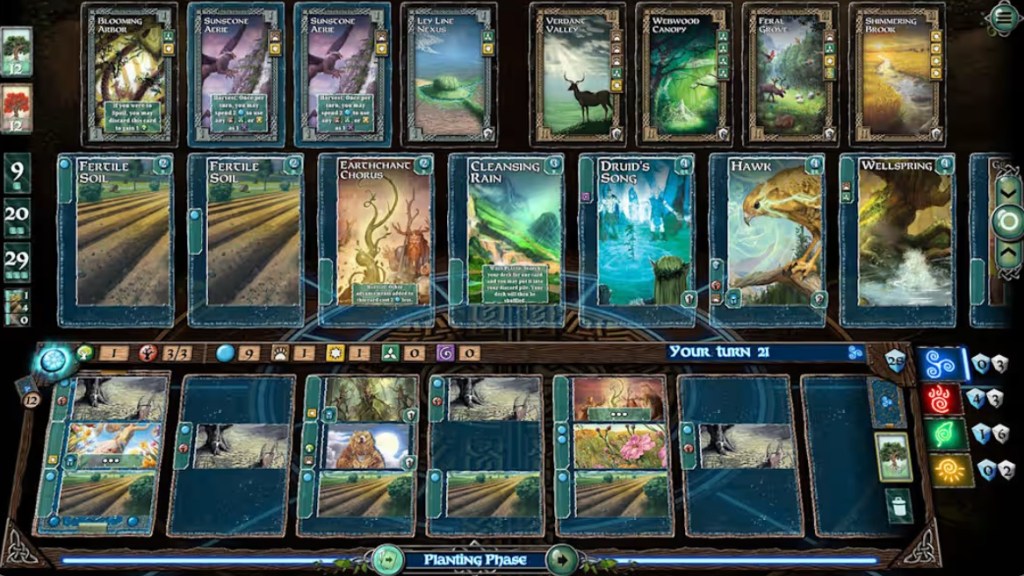
Mystic Vale thankfully contains an interactive tutorial to take you through the basics of how to play. Players deal out cards into their tableau from their deck, with the next card in the deck showing but not counting as played just yet. At the start of each turn, their cards are automatically dealt until the card on the deck is the third one to show a decay symbol. At this point, the game becomes a “push your luck”-style risk/reward system. Players can opt to keep dealing themselves cards, but the moment they reveal a fourth decay symbol, their turn ends automatically and they don’t get to do anything or gain anything.
If players call it quits before this happens, they can move on to the second phase of their turn, where the effects of the cards in their tableau play out and they can use the resources these cards produce to purchase upgrades for cards in the tableau out of a pool of purchasable cards that all players share, and also use specialty resources to purchase “vale” cards that are either always available or have a constant effect. Players do this until they either can’t afford to buy anything or don’t wish to and then end their turn, discarding their tableau and losing all resources.
Upgrading cards gives players a lot of flexibility to combine whichever card elements they want, save for one limitation – each card element is located either on the top, middle, or bottom of the card, and you can’t attach an upgrade to a slot that’s already filled. Beyond this, you’ll be looking for synergies to make the most of what you have, such as combining helmet symbols on cards that increase that card’s bonuses, or using bonuses that negate a card’s decay symbol, making it so that players can draw more cards before they reach their limit. There are clearly multiple strategies players can aim for here, giving the game some good depth.
As players upgrade their cards, some cards will display grey or blue victory point symbols, with blue symbols taking their points from a finite pool. Once this pool is emptied, players have one last turn to collect as many points as possible before the game ends, upon which the player with the most points wins the game.
it might seem like a lot, but once you get a feel for how it all works, it’s mostly pretty straightforward, leaving players to just think out their strategy. I will say that the gamepad controls here are pretty clunky – they work, but they’re awkward and the screen layout can make it harder to compare things at times. Thankfully, this game does support touchscreen in handheld mode, which works quite well.
The presentation here retains the nice card artwork of the physical game, with little added special effects flourishes here and there. It’s nothing fancy, but it’s all legible, easy to parse, and not at all boring to look at, which are the most important things. This is all backed by a really lovely fantasy-esque instrumental soundtrack that’s surprisingly relaxing, really making for a chill vibe when playing the game.
When it comes to complaints, my main issue is the clunky interface, but I will also note that this is a case of a Card Game where player interaction is at a minimum – you don’t attack other players, nor do you trade with or buy from each other. Really, the only way you interact here is by claiming card upgrades from the shop before other players can get them, or by nabbing the last blue point to start the endgame. Apart from this, you might as well be playing solitaire and comparing scores after the fact.
On that note, I should mention that this game does technically feature online, but at this point there don’t appear to be any players to match with. However, given the earlier issue I mentioned, I don’t think you’ll find that playing with AI opponents is going to make for a much different experience here.
Still, despite the interface issues and lack of player interactions with each other, Mystic Vale is a solid Card Game with a fun premise of building up their deck not by gaining cards but by building them, and the “push your luck” risk/reward mechanic is excellent. Plus, at $10, I’m pretty sure this is cheaper than buying the actual physical game. If you’re a fan of Card Games, this is well worth adding to your game collection.
tl;dr – Mystic Vale is a Turn-Based Card Game where players buy upgrades to their cards to improve their deck. It’s a fun mechanic that’s well-implemented here, and there’s a great risk/reward mechanic as well. The menus are a bit clunky and there’s a lack of players being able to interact with each other, but overall this is a solid addition to this genre.
Grade: B
You can support eShopperReviews on Patreon! Please click HERE to become a Sponsor!
This month’s sponsors are Jamie and His Cats, Ben, Ilya Zverev, Andy Miller, Johannes, Francis Obst, Gabriel Coronado-Medina, Jared Wark, Kristoffer Wulff, and Seth Christenfeld. Thank you for helping to keep the reviews coming!
 eShopperReviews
Leave a comment