
Once Upon a Katamari
Genre: Arcade
Players: 1-4 Competitive (Online)
.
Review:
The Katamari series of family-friendly Arcade-style games where players aim to roll up objects using a sticky ball (the titular katamari) to create a bigger ball to roll up bigger objects has been beloved since its first installment in 2004, praised for its compelling gameplay, catchy soundtrack, and bizarre and kooky eccentricity. However, after the original game and its 2005 sequel We Love Katamari, it’s generally agreed that later games in the series never quite recaptured the magic of these initial two entries in the series.
Over the course of this last hardware generation, the response to this issue was pretty straightforward – remasters. As such, we have now received two very good remasters of those first two games on Nintendo Switch in the form of 2018’s Katamari Damacy Reroll and 2023’s We Love Katamari Reroll + Royal Reverie. But with this done, where to go from there? A remaster of one of the next games in the series like Me & My Katamari or Beautiful Katamari? Both of those were still warmly-received, but many felt they retreat old ground. Perhaps a port of the mobile game, Katamari Damacy Rolling Live? Same problem (along with complaints about the game’s touchscreen controls).
Instead of looking backwards, the Katamari series sees a new step forward in 2025’s Once Upon a Katamari, released on PC, PlayStation 5, Xbox Series X|S, and Nintendo Switch. Testing out some new gameplay mechanics and a time-traveling theme, the big question here is whether any of this truly feels like it’s taking the series in a bold new direction, or whether it’s just a bunch of gimmicks and nothing more.
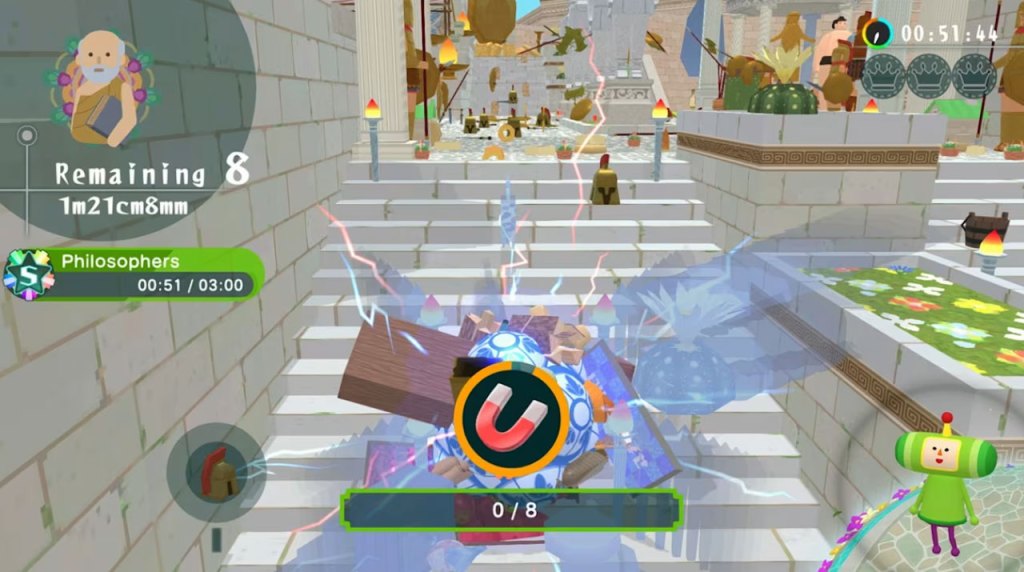
The presentation at least will seem very familiar to series fans, with simple 3D visuals that aren’t impressive on their own, but rather due to just how much stuff there is in each level, with all of this game’s levels absolutely filled with an absurd variety of random objects to collect with your katamari. Plus, while human characters and animals often appear blocky with very simple textures, it’s an endearing and colorful style that’s still visually appealing. And of course that’s on top of the delightfully ridiculous King of All Cosmos, who still speaks with record scratch noises and is every bit the center of the absurd glamorous lunacy this series has always made a huge part of its charm.
I should make it a point to note that this game does have its fair share of loading times, and I noticed occasional slowdown too, though largely this doesn’t affect gameplay.
Another part of the series charm is its soundtracks, and in that regard, Once Upon a Katamari is… okay. There’s once again an eclectic mix of J-Pop-style songs, with some standouts that include Katamari on the Doun and Katamariism, but overall I don’t feel like this soundtrack is anywhere near as memorable as the soundtrack for the first two games. However, for players who feel the way I do, you may be relieved to know that many of the songs of the earlier games are available as paid DLC or a pricier “King of All Sounds” version of the game. It’s not great that we’re being made to pay for this when these aren’t licensed songs and Bandai Namco could have easily just included them with the game, but I suppose it’s better than not getting them at all.
When it comes to the gameplay, the core gameplay remains the same as other titles in the Katamari series – you roll a ball, to pick up objects like rolling a ball of snow to make a snowman, capable of picking up bigger objects as your ball gets bigger. While this hasn’t changed, there are other things going on here that take the gameplay in different directions.
The first of these is focus – many of this game’s levels have players aiming not to get the biggest ball within the time limit, but aiming to accomplish other goals, like rolling up only the most expensive items, getting a set number of a specific type of item, or reaching a specific size as fast as possible. I feel like these sort of goals are going to be divisive and not everyone will like them.
For another major change, levels now have power-ups that you can grab and use to help you. Some are actually pretty useful, like a magnet that temporarily grabs up any nearby items you’re big enough to roll into your ball and a rocket that temporarily increases your speed. There’s also a power-up that points you to the level’s hidden secret, which will certainly help completionists. But then you have power-ups like a stopwatch that stops moving elements in the environment, and I found this to be pretty pointless. Plus, there’s an argument to be made that these power-ups muck up the elegant simplicity that makes the gameplay so compelling.
There’s also the new Katamari Ball mode, playable both against computer-controlled opponents and other players online. This game mode cleverly makes players gather up objects and bring them back to a moving collection point, with larger balls able to grab up other players, but also move more slowly. It’s a fun game mode, though the changes to the standard gameplay mean it doesn’t feel quite right, and make it take some getting used to.
Speaking of changes to the gameplay, the core gameplay mechanics and physics have been tweaked somewhat here. Your katamari is far less prone to lose objects when it collides with something, and the shape of objects you collect seems to have far less of an affect on how your ball rolls – picking up something long pointing out from your ball often won’t result in it tumbling in an uneven manner, one of the charming elements of the earlier games. Also, maybe it’s just me, but it feels harder to control your katamari this time around, with the controls being slower to respond in a way I found frustrating.
Finally, I need to mention the way this game requires players to collect crowns throughout its levels to access later levels, meaning players may occasionally need to go back and replay older levels to access newer ones, something that’s especially frustrating when the game already reuses levels repeatedly with different goals or item placement.
Overall, I do think there are some good additions to the Katamari franchise here – the time-travel theme makes for some good variety in different settings, and Katamari Ball is an enjoyable way to play Katamari competitively. However, stacking up against this are a lot of negatives and questionable choices that I don’t think make for a better, more enjoyable game. I appreciate that they’re trying to shake up the formula here, but I think they need to keep looking for better ways to do that. Still, while this may not come even close to the greatness of the first two Katamari games, it’s still a solid and enjoyable game that fans of the franchise will surely find worth getting.
tl;dr – Once Upon a Katamari brings to the arcade-style ball-rolling series a new time-traveling theme and new gameplay mechanics, but a lot of these new mechanics are poorly-conceived or a mixed bag. This is still an enjoyable game in a consistently enjoyable series, but it’s far from the greatness of the first two Katamari games.
Grade: B
.
This game has been nominated for one or more of eShopperReviews 2025 Game Awards:
Runner-Up: Best Misc. Game, Funniest Game
.
You can support eShopperReviews on Patreon! Please click HERE to become a Sponsor!
This month’s sponsors are Jamie and His Cats, Ben, Ilya Zverev, Andy Miller, Johannes, Francis Obst, Gabriel Coronado-Medina, Jared Wark, Kristoffer Wulff, and Seth Christenfeld. Thank you for helping to keep the reviews coming!
 eShopperReviews
Leave a comment