

Metroid Prime 4: Beyond
Genre: Open-World First-Person Shooter / Metroidvania
Players: 1
The Nintendo Switch 2 Difference
.
Review:
Metroid Prime 4 is a game that has been so long in the making that it’s probably a requirement for reviews to mention how long it’s been in the making, so I suppose I’d better do that.
While the original 2D Metroid series received a new entry four years ago in the form of Metroid Dread on Nintendo Switch, for a new original Metroid Prime game we have to go all the way back to 2016’s underrated but nevertheless disappointing 3DS game Metroid Prime: Federation Force. However, if we look to the mainline Metroid Prime series, there hasn’t been a new game in that franchise since the Wii received Metroid Prime 3: Corruption in 2007, 15 years ago. Ironically, when Metroid Prime 4 was first announced in 2017, we would still need to wait another 8 years before it finally saw release, with the game at one point being scrapped entirely and started over from the beginning.
However, the wait is finally over, and now in 2025 Metroid Prime 4: Beyond has released on Nintendo Switch and Nintendo Switch 2, so of course everyone is wondering whether it’s worth the wait after all this time.
For those unfamiliar with the series (it has been a while, as I just noted), the Metroid Prime games take the Metroidvania formula that the Metroid series pioneered (it does form half of the genre’s name, after all) and bring it into full 3D from a first-person perspective. These games have players battling enemies in first-person with “lock-on” controls that help you keep track of them as they scurry around quickly, but while there’s plenty of combat, the core of this game series is about exploration, discovery, and solving puzzles.
Metroid Prime 4 adds to this formula a large central Open-World area, a new motorbike vehicle called Vi-O-La, and new psychic powers. You’ll also have new allies joining you in this journey, and an entirely new planet, Viewros, to explore. Don’t worry, I’ll get to all of these soon enough.
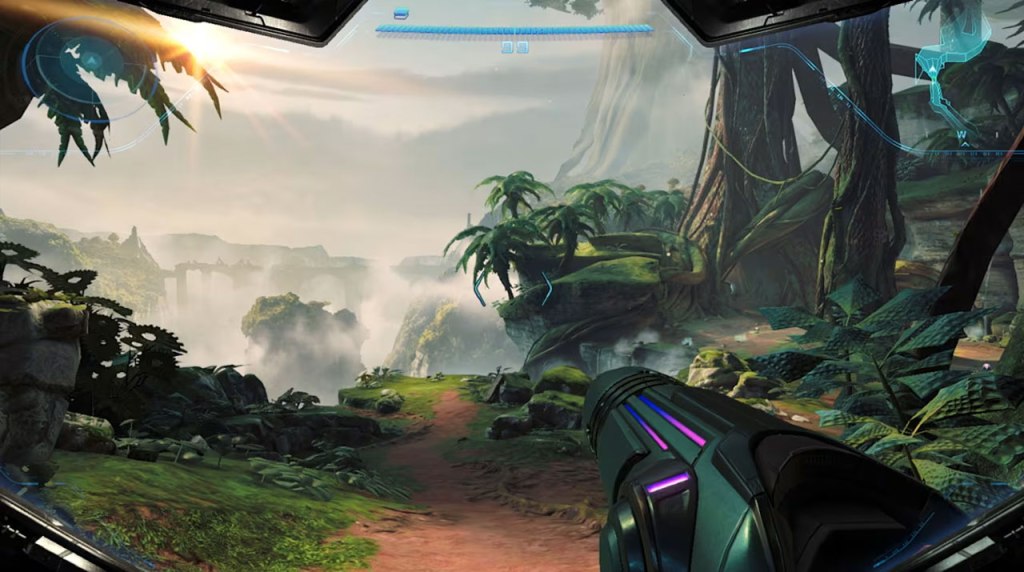
But first, I want to start with the presentation, and particularly the graphics, because on Nintendo Switch, Metroid Prime 4 is one of the most jaw-droppingly beautiful games the platform has ever seen (and don’t worry, I’ll get to the Nintendo Switch 2 Edition farther down). Massive environments with tons of detail, beautiful textures, jaw-dropping lighting effects, and all running at a silky-smooth 60FPS framerate on Nintendo Switch with a good resolution (I’ve seen some online saying it’s 900p dynamic resolution docked/720p dynamic resolution handheld, but I can’t track these numbers down to anyone I trust). Yes, this game looks much better on Nintendo Switch 2, but trust me – if all you have to play with is the original Nintendo Switch, you’re still in for an amazing treat for the eyes.
It’s not just on a technical level that Metroid Prime 4 impresses, either. The visual design here is amazing, with some really imaginative architecture, fun enemy designs, some absolutely gorgeous locations, and some surreal visual effects that truly make this game’s visuals feel otherworldly. Taking this a step farther is the phenomenal soundtrack, which accentuates Viewros’ strange beauty perfectly. Sadly, there aren’t many tracks I can point you to at this time, but I can highlight what is possibly the most impactful one, the theme for the game’s first post-tutorial area, Fury Green. Having this piano and choir piece playing as you explore the ruins at the base of a massive magical tree on the edge of a cliff overlooking an incredible view… my jaw dropped. It was so stunningly beautiful.
Of course, since I’m talking about sound, we have to get to the other part of that… the voice acting. It has already been widely reported that Samus is joined in this game by other friendly characters, and in particular one especially wordy engineer, Myles MacKenzie. After I just spoke about the quiet beauty this game offers players, I now have to report that it is indeed true, Myles ruins that contemplative solitude with his wisecracks and “helpful” suggestions for things for you to do next. Look, I can at least reassure you that after the opening area, he’ll bug you somewhat less throughout the rest of the game, but he is in many ways this game’s version of The Legend of Zelda: Ocarina of Time’s Navi, and I don’t mean that as a compliment.
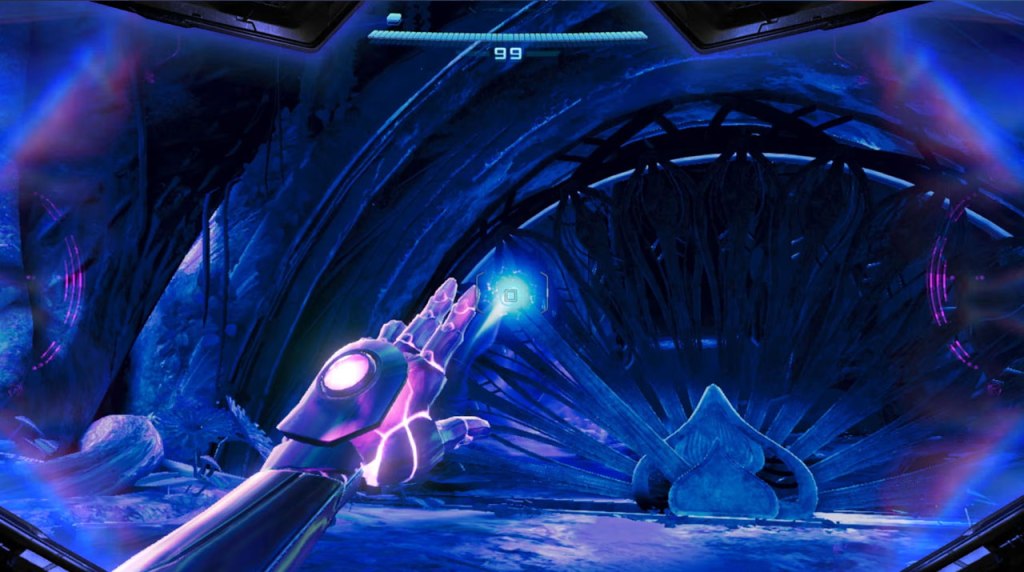
At the very least, the moment-to-moment gameplay is still strong, and in fact the new psychic powers add quite a lot to this game and really push it to be more than a simple rehash of its predecessors. While on the surface some of these abilities mirror old abilities, they often have added uses. For example, the psychic version of the scan visor also lets you manipulate certain objects for puzzles and fire off a slow-mo guided shot to take out three enemies at once, and the morph ball bomb can also be suspended in mid-air and flung using psychic powers to charge up far-away bomb slots in walls and statues.
The controls here are also quite good, with Nintendo Switch players offered multiple control options, with as much or as little gyroscopic motion-control as you like. I find it all works very well, though I do have one complaint here, and that’s the way that the game’s lock-on alters the right analog stick to move the cursor, something that’s disorienting and takes a lot of getting used to.
This combines with another issue – this game has plenty of enemies who frequently dodge your attacks with absurd speed, making it so that only a fraction of them actually connect. Even for enemies who don’t, you’ll find they’re often bullet sponges, meaning in both cases you’ll find yourself frustrated at times with how much you need to tap the attack button before finally downing a standard non-boss enemy.
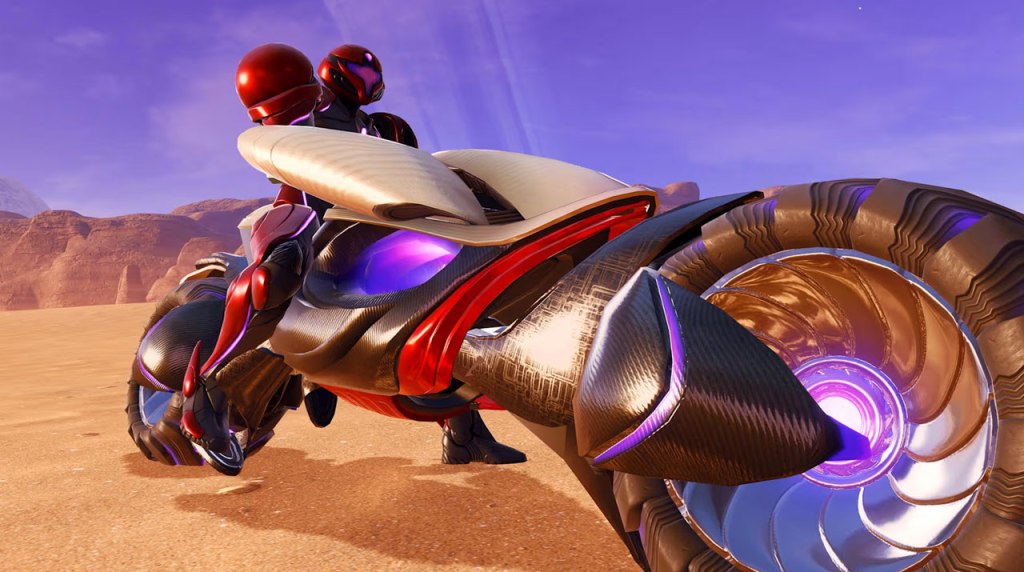
There’s another issue here, and it’s this game’s new “Open-World” game design. This game’s areas are separated by a vast stretch of desert that is sadly quite one-note and empty. The game makes it a bit more bearable to traverse this boring stretch by letting you do so with the aforementioned Vi-O-La bike, but that doesn’t change that it seems like a waste of an Open World to make such a large space and then make it largely joyless to traverse. The game even cuts all the music in this area (unless you pay $30 for an Amiibo to unlock the ability to play music in this section, a cynical cash-grab that’s pretty gross).
Unfortunately, not only do the Open World elements not really work well here, but by breaking up the Metroidvania sections into smaller separate areas that are often fairly linear and lack much exploration, it wrecks the world continuity that you find in the best Metroidvanias, and now the individual smaller areas feel more contained and less wondrous to explore. At the very least you get new abilities at a frequent rate, but that doesn’t save this from being pretty mediocre as a Metroidvania.
As for the Vi-O-La itself, it’s enjoyable enough to drive, but it feels like it’s in the wrong game. Nothing about riding around on the bike and Akira-sliding into enemies feels like it has any connection to the standard first-person Metroid Prime gameplay, and when the game stops everything to take you through a lengthy tutorial to show you how to use it, it felt like Batman: Arkham Knight‘s Riddler sections where all the Batman gameplay falls by the wayside for a bit so you can race through obstacle courses on the Batmobile. Well, okay, it’s not quite that bad, as Vi-O-La is actually enjoyable to drive. But it still feels just as out-of-place.
The lackluster Metroidvania sections, the confusing focus on motorcycle driving, and the chatty sidekick character all lead me to wonder if the creators of Metroid Prime 4 forgot what makes Metroid so great in the first place, and the tedious bullet sponge enemies and disappointing Open World elements make me wonder if this team had any sort of unified vision driving this game’s overarching design.
It’s a shame too, because there are times where Metroid Prime 4 is phenomenal, one of the best games I’ve played in years. Some of the puzzles are truly clever, some of the boss encounters are delightfully well-designed, and when Myles shuts the heck up, you can easily find yourself in awe of this game’s pure majesty and surreal creativity.
However, you have to take the bad with the good here, and the bad really muddies things up and make it harder to applaud the things that Metroid Prime 4 gets so very, very right. In the end, Metroid Prime 4 is still a phenomenal game, and one absolutely worth playing. But was it worth the wait? Honestly, no. Not 18 years. 18 years for a game that still manages to botch some of the basic fundamentals of the Metroid Prime formula? Even as good as this game still is, maybe we needed to wait yet another eight years so they could get everything right.
tl;dr – Metroid Prime 4 is a First-Person Shooter and Metroidvania with Open-World sections, and it is an audiovisual tour de force on Nintendo Switch, with a gorgeous world, incredible puzzle design, and some clever gameplay elements. It also disappoints with its underwhelming Metroidvania elements, its half-baked Open World elements, and some truly baffling design choices. The result is a game that, while still outstanding, is a bit underwhelming given the 18 years it took for us to finally see this game release.
Grade: A-
.
The Nintendo Switch 2 Difference
Metroid Prime 4: Beyond – Nintendo Switch 2 Edition
Genre: Open-World First-Person Shooter / Metroidvania
Players: 1
.
Review:
Despite launching a full hardware generation after it was first announced, Metroid Prime 4 did end up meeting its promise of releasing on the original Nintendo Switch. However, for many players, they will be approaching this as a Nintendo Switch 2 game. This version of the game is priced $10 more than the Nintendo Switch version, or you can upgrade from the Nintendo Switch version via a $10 Upgrade Pack. So, what exactly do you get with that upgrade?
In terms of content, the two versions of the game are identical, but the Nintendo Switch 2 Edition does have one feature that goes beyond mere performance upgrades – dynamic mouse mode support. Players who choose to do so can instantly go from using a Joy-Con with standard gamepad controls or gyroscopic motion control, to using it as a mouse, simply by placing it down on a surface. This was seamless, requires zero setup, and you can instantly go back and forth just by putting down and picking up the right Joy-Con 2 controller. This is how mouse mode should work in every game that makes use of it!
There’s also a less-advertised feature that isn’t getting much mention, an improvement in loading times. Loading up the game to the title screen goes down from 20 seconds in the Nintendo Switch version to 9 seconds on Nintendo Switch 2. And while loading up a save file took the same 11 seconds for me in both versions, that doesn’t tell the whole story. Throughout the game, Metroid Prime 4 uses transition animation sequences using in-game footage to hide loading times, with Samus generally running or driving Vi-O-La down a hallway while the game loads. On Nintendo Switch 2, these non-interactive hallway sequences are far shorter. I guess hallways are shorter on Nintendo Switch 2.
However, the big difference everyone is looking at are the big graphics and performance improvements, with the Nintendo Switch 2 Edition boasting a 4K docked (1080p in portable)/60FPS Quality Mode, and a 1080p docked (720p in portable)/120FPS Performance Mode, which you are prompted to choose right when you start, and can change in the settings menus at any time. As Digital Foundry has noted, Quality Mode’s “4K” boast is a bit misleading – Quality Mode does indeed render Samus’ visor, your in-game HUD, at 4K resolution, but the rest of the game is at only 1440p resolution, which is a pretty slimy way to cheat the numbers here.
However, even if Quality Mode still only really gets up to 1440p resolution, that’s still plenty, and a huge jump over the Nintendo Switch version of the game. Again, this isn’t to knock the Nintendo Switch version, which I still think looks amazing, but seeing the game in 1440p with a nearly unflinching 60FPS framerate is a sight to behold.
Meanwhile, in Performance Mode, the bump up to 120FPS is definitely noticeable, with movement being silky-smooth. If you’re looking for a showpiece of how 120FPS can make a game look great in motion, Metroid Prime 4 is exactly the game you want to reach for.
Which mode is better? I’ve heard different people preferring both, and I don’t think there are any wrong answers here – both modes look amazing, have buttery smooth framerates, and nice smooth resolutions, it’s just one favors resolution and one favors framerates
I should also note that on Nintendo Switch 2, this game’s lighting looks particularly pretty thanks not only to these graphical improvements, but to the inclusion of HDR lighting, though of course this will depend on whether you have a TV that supports this feature.
The result of all of this? Metroid Prime 4 looks amazing on Nintendo Switch 2. It is quite possibly the best-looking game Nintendo has ever published on a technical level, and is an outstanding year-one showcase of what Nintendo’s second hybrid console is capable of. Plus, the mouse mode inclusion is wonderful, and implemented perfectly. While I do have gripes about the game itself, I have zero complaints about the improvements made to the Nintendo Switch 2 Edition of the game. If you don’t have a Nintendo Switch 2 but still want Metroid Prime 4, I think you’ll still be playing a jaw-dropping gorgeous game on the original Nintendo Switch. But if you do have a Nintendo Switch 2, you absolutely want to spend the extra $10 to get one of the best-looking games that any Nintendo platform has ever had.
tl;dr – Metroid Prime 4 is a First-Person Shooter and Metroidvania with Open-World sections, and it is an audiovisual tour de force on Nintendo Switch 2 that is a showcase for the platform’s capabilities, with a gorgeous world, incredible puzzle design, and some clever gameplay elements. It also disappoints with its underwhelming Metroidvania elements, its half-baked Open World elements, and some truly baffling design choices. The result is a game that, while still outstanding, is a bit underwhelming given the 18 years it took for us to finally see this game release.
Grade: A-
.
This game has been nominated for one or more of eShopperReviews 2025 Game Awards:
Winner:
Best Song (Fury Green) by Kenji Yamamoto and Minako Hamano – For a brief moment, Metroid Prime 4: Beyond was perfect. You exit the tutorial area, step onto a strange new world, and are overcome with awe and beauty, accentuated by this theme that not only captures the feeling of this moment, but does so with subtle nods to the soundscape of earlier Metroid Prime games. Sadly, this moment does not last, and soon the game would go on to disappoint by abandoning the amazing atmosphere of this moment. But at least for this moment, the Fury Green theme brough this game to perfection.
Best Graphics – If it was possible, Metroid Prime 4 would win this award twice this year – once for Nintendo Switch, and again for Nintendo Switch 2. That’s because it is the best-looking game on both platforms this year, with silky-smooth performance, detailed environments, and great atmospheric touches throughout. Metroid Prime 4 continues the series tradition of being a graphical showpiece for its respective platforms, and it’s incredible that it does that on the Nintendo Switch 2 despite being created with the original Nintendo Switch in mind. Whichever version you get, be prepared for an absolute feast for the eyes.
Runner-Up: Best Metroidvania, Best Paid Nintendo Switch 2 Game Upgrade, Most Disappointing
.
You can support eShopperReviews on Patreon! Please click HERE to become a Sponsor!
This month’s sponsors are Jamie and His Cats, Ben, Ilya Zverev, Andy Miller, Johannes, Jaka, Jared Wark, Gabriel Coronad-Medina, Francis Obst, Kristoffer Wulff, and Seth Christenfeld. Thank you for helping to keep the reviews coming!
 eShopperReviews
Leave a comment