
Atelier Yumia: The Alchemist of Memories & the Envisioned Land
Genre: Open-World Action-RPG
Players: 1
.
Review:
For those unfamiliar with the Atelier franchise, an atelier (it’s a French word that’s normally pronounced “uh-tell-ee-yay”, but the characters in these games often pronounce the word “at-lee-ur”) is a workshop or studio used by a craftsman or artisan… or in these games, by an alchemist. The Atelier games are a franchise of JRPGs that focuses on young, almost exclusively female adventurers who seek ingredients they can combine and use to enhance their items, with these crafting mechanics forming a central part of the game.
These games have each been released in a subset series that ties them together with a few of the other games in the franchise both in terms of mechanics, but also in terms of the storyline. I know that for many, the Atelier series can seem somewhat intimidating, but BarrelWisdom.com thankfully has a helpful guide to introduce players to the series. However, for the purposes of this review I’ll try to address where this game fits both into the Atelier franchise as a whole, as well as within its individual sub-series.
.
Atelier Primer: Yumia Series
Atelier Yumia, released on PC, PlayStation 4, Xbox One, and Nintendo Switch in 2023, is the first game in the Yumia series, the tenth series of games in the Atelier franchise (running concurrently with the ninth, the Resleriana series). Being the first game in a new series, it’s hard to conclusively say what elements tie together this new series, and in fact I can only assume it will be a series and not a one-off based on how the Atelier games tend to release. However, if the first game is to be any indication, it seems like the Yumia games have a more serious and less lighthearted tone than most games in the Atelier franchise, have a strong focus on Open World elements, seem to lack the time limits that earlier games in the franchise were known for, and add an interesting real-time dodging mechanic to the “ATB” battle system that has players selecting commands from menus in real-time.
.
How This Differs From Atelier Games of Your Memories
Yeah, the Atelier review puns are back.
This is my first Atelier franchise review of a game in a new series in a long time – since decades before eShopperReviews existed, in fact. And while each new Atelier series brings its own unique elements to the franchise, I don’t think that any of them have changed quite so dramatically as Atelier Yumia.
While Atelier games tend to be relaxed, cozy affairs, Atelier Yumia starts in medias res in an action scene, which acts as a tutorial for the game’s combat system. And far from the early adolescent protagonists of most Atelier games, Yumia herself is somewhere in her late teens or early twenties. Also, unlike most Atelier protagonists who are cheerful, bubbly, and beloved by those around them, Yumia is pensive and isolated in a community of people who fear and distrust her.
In Yumia’s world, alchemy was the cause for a horrible calamity that wreaked havoc across the land and blighted it with magical fallout. This led to alchemy being something of a forbidden art, and Yumia herself is an alchemist who has only just been given provisional approval to use her skills for an expedition dedicated to exploring the land and trying to fix the problems threatening people. Ironically, Yumia’s magic seems to be the only way to stop the magical damage that others like her caused in the past.
However, this fact and Yumia’s genuine desire to help and prove herself don’t stop nearly everyone she meets from treating her with scorn and distrust, something that clearly affects her deeply, but that she tries to move past as she endeavors to show herself and her skills as something of value to the same people who want nothing to do with her.
As I’ve said, it’s a very different sort of story from a typical Atelier game, and I really appreciate that. While I did like past protagonists in the franchise, like Ryza, Yumia’s story is one I find genuinely compelling, and it’s surprisingly nuanced to see her shifting mid-conversation from being genuinely excited to show off her skills, briefly taken aback when someone responds with derision, swallowing her disappointment and calming herself with the sort of practiced detachment of someone who has had to do this countless times before, and then either being apologetic and deferential or taking a measured tone to explain how the skills she’s talking about can be useful for the person she’s speaking with.
As with most modern Atelier games, Atelier Yumia’s dialogue is voiced in Japanese in story cutscenes and in asides between characters as they’re wandering about the world, and to my ear the voicework here sounds very good, though of course my ear is foreign to the language being spoken so take that for what it’s worth.
.
Envisioning This Game’s Land
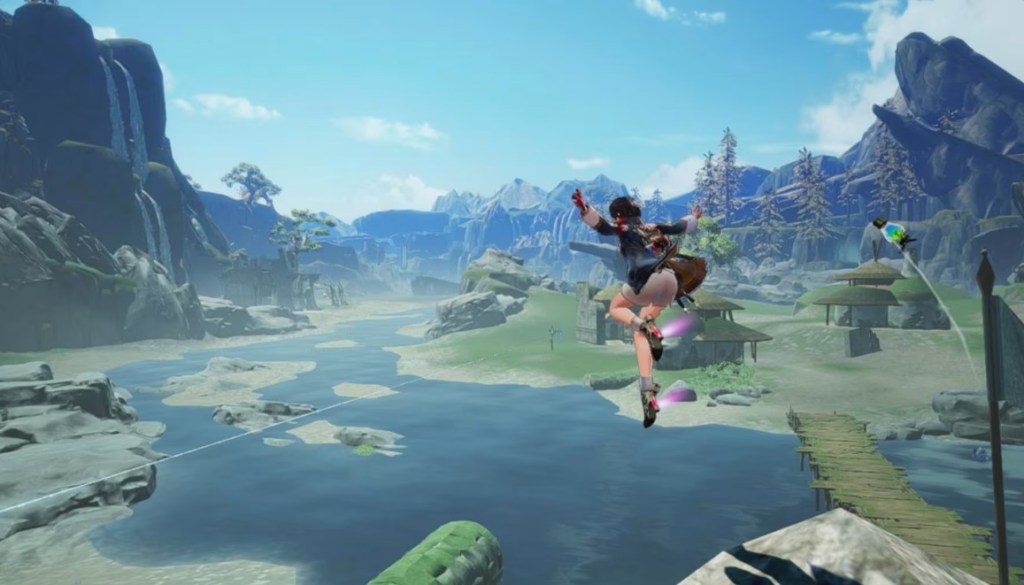
While multiple earlier Atelier games have incorporated Open-World elements, I would argue that Atelier Yumia is the first game in the franchise I’ve played that fully embraces it, with a massive world to explore where you can truly go anywhere, and where there are plenty of secrets to be found as you look around.
Of course, you’ll be gathering up hundreds of crafting ingredients as you travel around, but you’ll also find puzzles to solve to progress your character’s skill trees, “mana wells” to tap into give you crafting recipes and further enable skill progression, and “manabound” areas that will sap away your energy until you can find a spot within them where Yumia can do a little magic dance to clear the area and make it safe for travel, opening up more of the world. Overall I don’t think this game reaches the same height of top-tier Open-World games, but it uses this facet of the gameplay well.
Another surprising addition to the Atelier franchise is base-building, something that I’m honestly stunned hasn’t been a major component of the Atelier games prior to now, given how focused the Atelier franchise is on crafting. Basically, in some spots, Yumia can erect whole buildings, and decorate them with furniture and alchemy implements. There are preset buildings for players who don’t want to get into the nitty-gritty details of designing and decorating structures, but players who choose can opt to become a full-on architect planning out these structures.
The automation and streamlining of elements extends to other parts of the game, such as the crafting system. Atelier Yumia’s crafting is poorly-explained, unfortunately, but players can skip the more detailed elements and just automatically craft from recipes, either making an ideal version of the recipe or the bare minimum, depending on their needs. This is just as well, as I don’t see an option to craft in bulk, and anything to cut down the time it takes to craft things here is much appreciated.
As for the battle system, as I mentioned before, this game evolves previous games’ real-time menu-based combat system to include new real-time dodging, with players circling around enemies and dodging attacks with the press of a button, or using the D-Pad to swap from close-range attacks to long-range attacks. I think this combat is mostly great, but it’s also frustratingly inconsistent – some enemy attacks are forecast to the player while others aren’t. Also, sometimes combat can seem pretty chaotic to the point where it devolves into just button-mashing.
.
A Presentation That’s Everyone We Envisioned?
When it comes to the presentation, I’ll start with the one unqualified success – the soundtrack. This game is an absolute feast for the ears with wonderful vocal themes like Labyrinth Synapse, Memory’s First Cry, Unknown, Deep Breath, and Remember, plus gorgeous orchestral themes like Reminiscing in Solitude, Arcane Ascendance, My Third Favorite Word, Wish-Weaving Workshop, Grassland Settlement, The First Hill, The First Night, Tree Root Valley, and Sea Sparkle, quieter themes like Surrender, and faster-paced action themes like Spring Rain, Dramatic Encounter, Fretfulness, Early Summer Rain, and Alchemy’s Blessing. Atelier game soundtracks rarely disappoint, and this is no exception.
The same holds true for the wonderful anime-style character designs, and conceptually the world of Atelier Yumia is a beautiful place with a colorful world with some creative-looking monsters.
However, on Nintendo Switch, this game is really suffering, with resolution and framerate issues, ugly shadows, absolutely terrible aliasing, sometimes blurry textures. The game is still playable on Nintendo Switch, but you can absolutely see how this game was mangled in trying to get it to fit on Nintendo’s underpowered hardware. This really needed to be a Nintendo Switch 2 game.
I also need to point out how sloppy this game feels at times, with a lot of clipping and poor collision detection at times. This really feels like one of the most unpolished games the Atelier franchise has ever had.
.
Does All of This Result in a Yummy-a Game?
Yeah, the puns are getting worse, but at this point it’s too late to stop…
In some ways, Atelier Yumia is my favorite game yet in the Atelier franchise. I’m glad the series has finally fully embraced Open World design in a way that works well for the Atelier formula, a more mature and somber story is a huge change for the franchise that nevertheless makes for something truly compelling, the soundtrack is phenomenal, and the visual design is still wonderful. However, the game is still held back by clunky and confusing design choices, combat that’s fun but overly frenetic, and on Nintendo Switch the game has graphics and performance issues that make it difficult to give this the whole-hearted recommendation I would like to. This is still a great Open-World Action-RPG, even on Nintendo Switch, but if you can I would recommend getting this on any other platform.
tl;dr – Atelier Yumia makes some major changes to the Atelier franchise, and mostly these are all excellent, bringing the Atelier games fully into Open-World territory, with a gorgeous soundtrack, wonderful story and characters, and largely enjoyable gameplay, albeit with a few issues that still need tweaking. However, on Nintendo Switch the biggest problem by far is the lacking graphical performance that results in a game that, while still playable, definitely suffers due to the limitations of the hardware it is on. If you’re a fan of RPGs and especially this series, this is still absolutely worth playing, but there’s no question the Nintendo Switch release is a compromised version of the game.
Grade: B
.
This game has been nominated for one or more of eShopperReviews 2025 Game Awards:
Runner-Up: Best Music, Worst Port / Remake
.
You can support eShopperReviews on Patreon! Please click HERE to become a Sponsor!
This month’s sponsors are Jamie and His Cats, Ben, Ilya Zverev, Andy Miller, Johannes, Jaka, Jared Wark, Gabriel Coronad-Medina, Francis Obst, Kristoffer Wulff, and Seth Christenfeld. Thank you for helping to keep the reviews coming!
 eShopperReviews
Leave a comment