
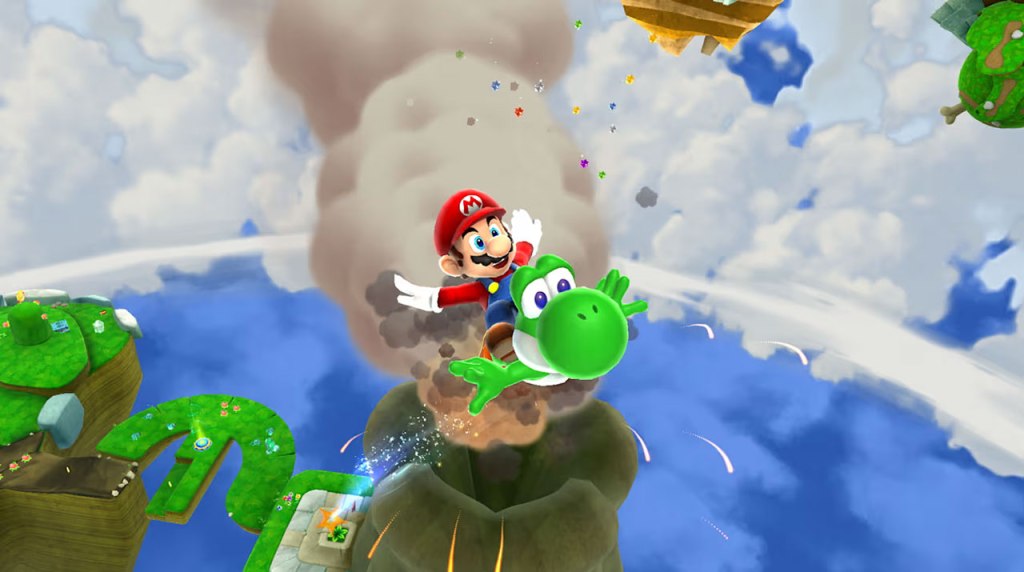
Super Mario Galaxy 2
Genre: 3D Platformer
Players: 1-2 Co-Op (Local)
The Nintendo Switch 2 Difference
.
Review:
(Note: This game is included in the Super Mario Galaxy + Super Mario Galaxy 2 bundle, along with Super Mario Galaxy.)
More than any other game company, Nintendo has a way of doing the “monkey’s paw wish” thing time and time again. They’ll deliver something wonderful, only to saddle it with flaws that are horrible, all in one package. And then, I need to figure out how the heck to review something I dearly love and also kinda’ hate, all at the same time.
This was the case when Nintendo released Super Mario 3D All-Stars in 2020, which packaged together three legendary 3D Mario games on Nintendo Switch, and then priced them at $60, didn’t include any extras beyond a music player, and made the decision to prey on FOMO by making it a limited time only release. How do you review a package that contains some of the greatest games of all time, but stuffs them into such a nasty package?
Well, that’s a question I’ll have to answer a second time, because in 2025 they did it again with the release of Super Mario Galaxy + Super Mario Galaxy 2, which once again presents players with a bundle of a few of the greatest games of all time, but with some pretty nasty caveats. And with each of these games also releasing individually on the Nintendo Switch eShop, I’ll also look at how well both individual components of this package hold up.
.
Binary Star
Conspicuously absent from the Super Mario 3D All-Stars collection, despite its predecessor being included, Super Mario Galaxy 2 was always something of an afterthought, though don’t take that as a knock on its quality. But the game did begin development as an alternate or expanded version of the original Super Mario Galaxy, originally titled Super Mario Galaxy More or alternately Super Mario Galaxy 1.5, and it wasn’t originally intended as a fully-fledged sequel. It started with levels and gameplay ideas abandoned during the development of the original game, but increasingly expanded to include new ideas, including level ideas submitted by staff other than Nintendo’s typical level designers.
The resulting game, released on Wii in 2010, felt like a continuation of the original Super Mario Galaxy, not dwelling quite as long on the early introductory parts of the game and getting right to some of the game’s new features and content. One of the biggest additions to this game are multiple new power-ups, including the spin drill, rock Mario, and cloud Mario, as well as the inclusion of Yoshi, who had been absent in the original Super Mario Galaxy but now held a prominent role in the sequel.
On the other hand, less prominent this time around was fan-favorite Rosalina, delegated to a cameo role toward the end and as a “Cosmic Spirit” that less-experienced players can opt to assist them during difficult parts of the game. In turn, Super Mario Galaxy 2 features far less focus on story than the prior game, and what little story that is here seems to conflict with the events of Super Mario Galaxy, making this something of an alternate version of events.
Much of what made the original Super Mario Galaxy great is still here though. This game once again features the Mario series’ cartoony art style in 3D, and brings a fair amount of spectacle with its spacey theme, with some really nice effects, nice-looking water, good textures, wonderfully-creative character designs, and some truly imaginative level concepts. In addition, this game boasts an excellent orchestral soundtrack that I would argue is almost but not quite on par with the prior game.
Super Mario Galaxy’s gravity-warping level design is back again too, once again having players exploring the game’s 3D spaces in ways unlike any 3D Platformer had ever done before (apart from the first game, of course). However, perhaps due to the development team’s reuse of the same game engine, this game feels a lot more comfortable with itself than the first game, and more willing to stretch out and try interesting ideas. As a result, many players believe that Super Mario Galaxy 2’s levels are even better than the first game.
Speaking of those levels, Super Mario Galaxy 2 once again ditches the “sandbox”-style design of Super Mario 64 and Super Mario Sunshine, instead presenting players with levels that are mostly linear in nature, albeit with exceptions here and there that gave players diverging paths or a bit of exploration. This also included sections with more unique self-contained gameplay styles, like levels where you turn the Wii remote on its edge and move it like a joystick, or levels where you point the cursor at the screen to “grab” points for Mario to be pulled toward in a zero-G vacuum, providing another showcase for the Wii’s unique motion controls.
Also returning is the asymmetrical co-op multiplayer, something Nintendo has sometimes called “Co-Star Mode”, and that many players have taken to calling “girlfriend mode” (as problematic as that term is), where players can hand a second controller to a friend who assists them by aiming a cursor to fire star bits to help (or possibly hinder) Mario.
The “which is better, Super Mario Galaxy or Super Mario Galaxy 2?” question seems to be one that will never be truly settled, and will really come down to personal preference. I think most would agree that the first game was more impactful and impressive, while the second game has stronger gameplay and level design. For the record, Metacritic lists Super Mario Galaxy 2 as the fifth-highest-rated videogame of all-time, ranking just behind the original Super Mario Galaxy. However, even if you take the opinion that the first game is better, I think it’s fair to say that both games are truly incredible must-have experiences, and you can’t go wrong with either.
.
Switching Up
This 2025 release of Super Mario Galaxy 2 on Nintendo Switch copies many of the changes that were made to the 2025 release of Super Mario Galaxy, which in turn took many of its changes from the game’s release for the Super Mario 3D All-Stars Collection, including its one added bonus – As an option accessible from the main menu, you’re given the option to listen to the game’s soundtrack.
Like that game, this release of Super Mario Galaxy 2 lets players use Joy-Cons, a Pro controller, or even the Nintendo Switch in handheld mode while still making use of the game’s gyroscopic motion-controlled pointer, but since none of these forms of motion-control have the same accuracy and sensitivity as the Wii remote, players also have the ability to re-center the pointer with a button press, and the spin move can now be activated with a button press as well, if you prefer.
For players in handheld mode who don’t want to wave around their Nintendo Switch, touchscreen controls have also been added to let you directly tap on the screen to send star bits shooting where you want – perhaps not an ideal solution, but a sensible one given the needs of the controls when playing in handheld mode. Additionally, some of the aforementioned motion-controlled minigames have been altered so players can still control them regardless of what input method they’re using. There’s an argument to be made that by doing this, the game loses much of the charm it had on the Wii, but again this is clearly a necessary evil – in order to get the game to work on Nintendo Switch, the controls had to be adapted for a game platform where players won’t have access to a Wii remote, and depending on how they’re playing they may not even have the ability to wave around a Joy-Con controller.
The visuals are also greatly improved, jumping up from a 420p resolution in the original Wii release to a dynamic 1080p resolution on Nintendo Switch (720p in portable mode), while retaining the original game’s 60FPS framerates.
.
A Few Extra Star Bits
In addition to the improved resolution on Nintendo Switch, the 2025 release of Super Mario Galaxy 2 also features improved textures throughout the game, making it look even better. It’s a more subtle change than the boost to resolution, but it’s an improvement all the same.
This release includes a new “Assist mode” that’s basically an easy mode that gives players more health and keeps them from plummeting to their deaths in areas with bottomless pits or black holes.
There’s also new Amiibo support, though the effect here is minimal – depending on which Amiibo you scan, you’ll get a life mushroom, a 1-Up mushroom, or star bits. That’s it.
There are also additional improvements if you’re playing this release on Nintendo Switch 2, but… well, I’ll get to those farther down…
So now, let’s talk about price. I suppose the $40 price tag on this game isn’t quite as egregious as the original Super Mario Galaxy’s $40 price, since Super Mario Galaxy 2 wasn’t previously available on Nintendo Switch. However, it’s still an absurd price for a game that’s 15 years old. And while this release has polished the original game’s visuals to look great in the modern day, this isn’t a remake, it’s largely an upscaled port, and one where apart from the changes needed to make it work on Nintendo Switch, every other change here is extremely minimal.
.
A Galaxy of Fun, or Just Taking Up Space?
So pulling everything together… how do I even rate this? On the one hand, this is one of the greatest games of all-time, one that has aged extremely well and is still magnificent to this day, and one that is at its absolute best in this release. But on the other hand, it’s also an overpriced upscaled port. How do I rate this?
Well, I cannot give it the glowing review I would like to, because its bloated price and lacking features need to be accounted for. However, if you have not played Super Mario Galaxy before, you need to ignore all of that and treat this game like I gave it an A+ grade after this (I personally rate it just slightly behind the original), because this is absolutely not to be missed. As I’ve said repeatedly through this review, this is the best version of one of the greatest videogames of all time. The fact that this is a cynical, overpriced, and lazy release makes it less significant for a jaded old gamer like me who’s already played this before (multiple times now), but if you’ve never played it before you can just treat it like it’s a brand-new game and you should still be absolutely ecstatic with it. And if you haven’t played it before, you need to remedy that oversight immediately.
tl;dr – Super Mario Galaxy 2 is a 3D Platformer that is one of the greatest videogames of all time, with delightful gravity-defying physics, great gameplay, outstanding imaginative level design, an incredible soundtrack, and creative use of gyroscopic motion control. This release is also the best version of this game ever made (save for the even better version you get when you play it on Nintendo Switch 2), with smart changes made to get the game working on Nintendo Switch. Having said all of that, the $40 price tag is absurdly pricey for an upscaled port of a game from 2010. If you’ve never played this before, consider this an absolute must-buy. But the questionable price and value hold this release back from getting my highest recommendation.
Grade: A-
.
The Nintendo Switch 2 Difference
Super Mario Galaxy 2
Genre: 3D Platformer
Players: 1-2 Co-Op (Local)
.
Review:
(Note: This game is included in the Super Mario Galaxy + Super Mario Galaxy 2 bundle, along with Super Mario Galaxy.)
When the Super Mario Galaxy + Super Mario Galaxy 2 bundle was announced, it came with the announcement that it would be receiving a free update on Nintendo Switch 2 that brings the game’s resolution up from the docked 1080p resolution of the Nintendo Switch release to 4K resolution, while bringing the resolution in handheld mode up from 720p to 1080p. So, how much does the Nintendo Switch 2 improve this game? Let’s take a look…
I’ll get right to it – yes, this game looks magnificent in 4K, and the difference is noticeable. The framerates and textures aren’t upgraded here, but even just a resolution boost makes this game look much cleaner and nicer on Nintendo Switch 2.
However, that’s not all! In addition to the resolution boost, playing the game on Nintendo Switch 2 allows access to a feature that hasn’t been nearly as advertised, though many players might not even know about it – when using the 2-player co-op “Co-Star Mode”, the second player can opt to use gyroscopic motion controls to move the cursor, or they can use Mouse Mode. Testing this out, it makes things far more accurate, and I can definitely see some players choosing to play this way. Unfortunately, there’s no way to use Mouse Mode in single player, though at the very least gyroscopic motion control on Nintendo Switch 2 suffers less from cursor drift.
Unlike the original Super Mario Galaxy, the loading times aren’t really improved here – the game takes 13 seconds to load to the title screen on Nintendo Switch, and another 7 seconds to load a game save, while it takes 12 seconds and 8 seconds on Nintendo Switch 2. In other words, a total wash. Oh well.
So, do these improvements help to justify that $40 price tag? Well, they certainly help, but that’s still pretty pricey for a mostly straightforward upscale of a 15 year-old game. However, if you’ve never played Super Mario Galaxy 2, you should absolutely consider this a must-have – it’s the best version of one of the greatest videogames ever made.
tl;dr – Super Mario Galaxy 2 is a 3D Platformer that is one of the greatest videogames of all time, with delightful gravity-defying physics, great gameplay, outstanding imaginative level design, an incredible soundtrack, and creative use of gyroscopic motion control. This release is also the best version of this game ever made, with smart changes made to get the game working on Nintendo Switch (and further improved on Nintendo Switch 2). Having said all of that, the $40 price tag is absurdly pricey for an upscaled port of a game from 2010. If you’ve never played this before, consider this an absolute must-buy. But the questionable price and value hold this release back from getting my highest recommendation.
Grade: A-
.
You can support eShopperReviews on Patreon! Please click HERE to become a Sponsor!
This month’s sponsors are Jamie and His Cats, Ben, Ilya Zverev, Andy Miller, Johannes, Jaka, Jared Wark, Gabriel Coronad-Medina, Francis Obst, Kristoffer Wulff, and Seth Christenfeld. Thank you for helping to keep the reviews coming!
 eShopperReviews
Leave a comment