
Pokemon Pokopia
Genre: Action-RPG / Simulation
Players: 1-4 Co-Op (Local Wireless / Online), GameShare Support
.
Review:
Pokemon Pokopia is an Action-RPG and Simulation released on Nintendo Switch 2 in 2026. Developed by Omega Force, who previously worked on the phenomenal Dragon Quest Builders 2, it might be tempting to think that this game is a take on that game’s formula with Pokemon characters, but the gameplay is a bit different here, blending elements from games ranging from Animal Crossing to Viva Pinata and, yes, Dragon Quest Builders and Pokemon too.
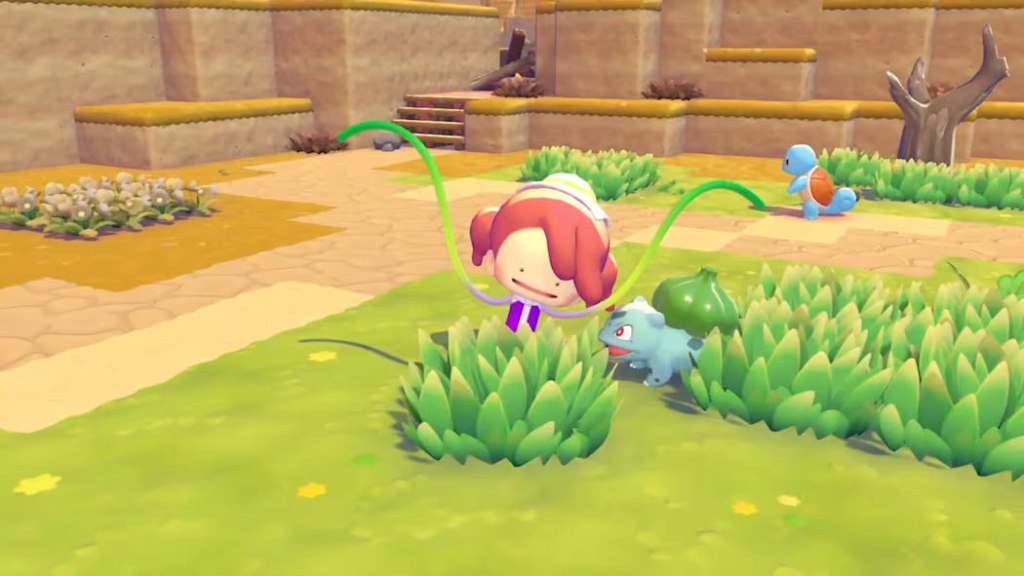
The plot has players controlling the shape-shifting pokemon, Ditto, who has decided to disguise itself (poorly) as a human that was presumably its previous owner. You are met by a Tangrowth (referred to by the pokemon in the game as Professor Tangrowth) who informs you that all of the humans in the region are gone, as are most of the pokemon, leaving behind only ruins and unanswered questions about what caused this to happen. Players who are familiar with the franchise will recognize this area as the ruins of the Kanto region, the setting of Pokemon Red and Blue. Over the course of the game, Ditto will try to restore the region, bringing back the missing Pokemon and hopefully the missing humans, while also trying to discover what caused everything to fall apart.
The presentation here makes use of the sort of 3D voxel-based graphics popularized by Minecraft, which means terrain constructed largely from cube-shaped blocks, with some environmental objects and the Pokemon themselves being rendered in more detail. It’s nothing impressive or novel at this point, but the game does have an appealing soft look, the Pokemon animations are adorable, and the game mostly runs at a smooth framerate (with a few brief drops at points), so the game is at least visually-appealing.
The sound design here is a mix of surprisingly good and predictably nostalgic – Pokemon all still use synthesized sounds based on their original appearances dating back to the original Game Boy, and other in-game sound effects follow this pattern too. However, at the same time, you have subtle sound design like echoes in enclosed areas, or the quiet rush of moving water on the other side of a wall. Definitely a mixed bag.
The soundtrack, meanwhile, is mostly soft, relaxed themes that highlight this game’s “cozy game” atmosphere quite well, with a blend of original themes and classic Pokemon themes. This all works well for the game, though I can’t say I found any of the music to be truly memorable in its own right.
For the gameplay, it’s worth noting that unlike both Minecraft and the Dragon Quest Builders games, there’s no combat here, no damage – as a Ditto, even a fall from great heights just causes you to revert to your squishy form for a moment before reforming. The focus here is entirely on building, exploration, and trying to accomplish the goals the Pokemon in the game give you. Also unlike Minecraft, this game’s open-ended nature is somewhat limited – all of the game’s areas are self-contained in large zones that give you a message and turn you back around whenever you stray to the edge of the map. As such, I wouldn’t quite call this “Open-World”.
So, having said all of that, what do you do in Pokemon Pokopia, exactly? Well, as you explore the game’s environments, you’ll come across glowing patches of ground that will pop up an indication of the conditions needed to create a habitat that will “attract” (spawn) a Pokemon. This tends to be a certain number of adjacent pieces of terrain like four pieces of grass, four spaces of wildflowers adjacent to a tree, a fishing pole and a chair adjacent to the ocean, and so on. After moving things around to create this habitat, a Pokemon will appear there – sometimes immediately, but at other times it may take a while.
Once the Pokemon spawns, they will have requests to make their environment nicer for them, ranging from putting decorations nearby to changing how humid the area is to improving the lighting. You can fulfill these requests to complete challenges that earn you coins that you can spend on resources and crafting recipes for the in-game crafting.
Pokemon aren’t just there to demand things from you, though. Some pokemon will grant you new abilities such as being able to spray water to hydrate dry areas, instantly cause grass to grow, or dig through earth. Some pokemon will occasionally gift you various items as thanks for your efforts. And any pokemon can be asked to follow you around and assist you with their unique abilities, such as Bulbasaur making plants grow faster or Charmander lighting fires. As you progress, you’ll need the help of specific pokemon to construct structures, so finding these pokemon is important for progression for more than just ticking to-do items off of checklists and gaining coins.
There are two areas where Pokemon Pokopia really excels. Firstly, this game does a great job giving players multiple tasks to pursue at any given time, and there are no wrong answers. You can go exploring, collecting resources and looking for new habitat suggestions. You can work on building habitats and improving them for your Pokemon. You can investigate some of the game’s fun hidden secrets and uncover relics to hint at the history of this world. You can focus on improving the overall state of the game’s areas by watering plants and repairing damage to paths and buildings.
Some tasks make use of the game’s real-time clock and require the passage of real-world time for completion, but this is rarely a hindrance since there’s plenty of stuff to do. And if you get stuck on any given task, it’s easy enough to stick a pin in it and do something else until you get a necessary resource, or think up a new approach to solve a difficult problem.
The other thing this game does really well is the way it sells the Pokemon as truly living in this world. Once you spawn one of them, they don’t just stay tethered to their spot running through idle animations. They’ll explore the area, interact with the other Pokemon, have little nonverbal conversations, and even have “photo moments” where they interact in fun and unique ways, like a Scyther acting as a boxing coach for a Hitmonchan working out with a punching bag.
One area Pokopia does poorly is its multiplayer. You’re not granted access to multiplayer at the start, but a short way into the game the option unlocks. However, this is Animal Crossing: New Horizons-style multiplayer, which means that once you have visitors, both you and your visitors are locked out of doing a lot of the sorts of stuff you’re probably looking forward to working on together. The game’s GameShare multiplayer is even worse, as not only does this limit what you can do, but GameShare is restricted to one late-game area.
There are also some other smaller frustrations, like the lack of any easy way to transfer items between different areas, or even know what resources are where if you left something you need in a chest somewhere. And the simple act of targeting spaces you’re working on is somewhat unwieldy, though players can opt to use Mouse Mode for aiming, which can help some.
Overall, Pokemon Pokopia is a wonderful game that does more than just blend Pokemon and Dragon Quest Builders, and in fact it blends multiple inspirations together into something that, while not at all original, is nevertheless wonderfully enjoyable. It’s just a shame that some frustrating design choices and poorly-implemented multiplayer mar what is otherwise a phenomenal game. However, even with these flaws, I still strongly recommend this one – if you’re looking for a great Pokemon “Cozy Game”, this is going to be just the sort of thing you’re looking for.
tl;dr – Pokemon Pokopia blends Action-RPG and Simulation genres in a game that combines elements from Dragon Quest Builders, Animal Crossing, Viva Pinata, and of course Pokemon, with players taking the role of a Ditto tasked with fixing and building up the environment to entice Pokemon to return. This is a wonderfully engaging and relaxing “Cozy Game” that gives players plenty of fun things to do, and is only let down by some frustrating design choices and woefully disappointing multiplayer. But despite these flaws, this is still a superb game that every Pokemon fan should consider picking up.
Grade: A-
You can support eShopperReviews on Patreon! Please click HERE to become a Sponsor!
This month’s sponsors are Jamie and His Cats, Ben, Ilya Zverev, Andy Miller, Johannes, Jaka, Jared Wark, Gabriel Coronad-Medina, Francis Obst, Kristoffer Wulff, and Seth Christenfeld. Thank you for helping to keep the reviews coming!
 eShopperReviews
Leave a comment