
Hololive Holo’s Hanafuda
Genre: Card Game
Players: 1-4 Competitive (Local Wireless / Online)
.
Review:
Note: This review has been directly sponsored by a kind donation from Jamie and His Cats. Thanks again for your generous contribution!
Hololive is a franchise focused on Japanese anime-style VTubers that dates back to 2018. Hanafuda is a classic Japanese playing card that has its roots in the 16th century of Japan, with variants evolving over time and gradually becoming more standardized. Hanafuda’s history is tied to Nintendo’s roots too, as Nintendo was founded in 1889 as a Japanese playing card manufacturer specifically printing hanafuda cards, and it still continues to release hanafuda cards in Japan to this day, including sets with popular Nintendo characters like Mario, Kirby, and Pokemon. So it is perhaps appropriate that in 2025 we would see a game combining all of these elements releasing on Nintendo Switch… as well as PC and PlayStation 4.
Given how old Hanafuda is, it’s hard to judge the game based on its core design, since that’s already well-established, with Holo’s Hanafuda being based on the popular Koi-Koi game variant. However, there are other elements here that it can be judged on, such as the presentation, and the features, including the quality of the tutorial – this last part being especially important to me since going into this game I had no idea how to play Hanafuda.
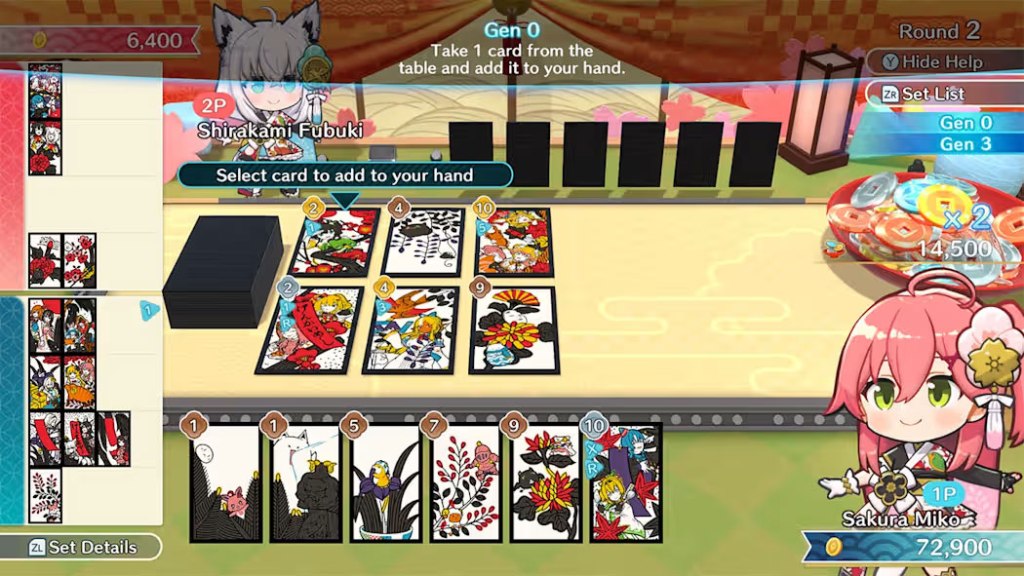
I’ll get right to it then: I still don’t know how to play Hanafuda. Or at least, I don’t understand the game beyond its surface level, which involves a pool of face-up cards on the table that you match numerically with cards in your hand to claim them, with “sets” being formed that will let you either bank your points and end the round or “Koi-Koi” to push your luck and continue with a point multiplier at the risk of losing all of the points you’ve gained thus far in the round.
While I understand all of this in theory, in practice there’s a lot that the game doesn’t make very clear. What exactly is a set and how is it made? How does the game determine when you gain access to a special move (unique to this particular version of the game) that allows you to do things like force your opponent to discard a card or negate the value of one of their cards. And most importantly, just what exactly is the strategy here beyond simply looking for cards that match your number?
It’s a shame I felt so lost when it came to the gameplay, because the presentation here is quite adorable. The game opens with a stop-motion cinematic featuring the game’s characters rendered as felt dolls that is absolutely precious, and throughout the game these characters are further depicted as “paper doll”-style 2D animated characters with a semi-chibi-esque design, with the gameplay itself using simple but clean-looking 3D for the cards, table, and other details such as coins indicating the gradually-growing bonuses of the game as it progresses.
All of this is joined by brief cutesy Japanese-language utterances of the characters, backed by an upbeat soundtrack featuring traditional Japanese instruments with modern synthesized rhythms, and joined by a lighthearted story where the Hololive characters get “isekai-ed” into a videogame and must defeat dark versions of their videogame alter-egos in Hanafuda matches to escape the game’s world.
However, as cute as Holo’s Hanafuda is, I can’t really recommend it to players who don’t already play Hanafuda since it doesn’t do a good job of explaining the game to newcomers. If I wanted a Hanafuda game with a tutorial that didn’t help me understand the game, I’d just as soon get Clubhouse Games: 51 Worldwide Classics, because at least then I’d still have 50 other games I could enjoy while being just as perplexed about the gameplay of Hanafuda.
tl;dr – Holo’s Hanafuda is a Card Game that combines the classic Japanese Card Game Koi-Koi with the Hololive VTuber characters. The presentation in this game is adorable, but newcomers to Hanafuda will find that this game does a poor job of explaining the game to them. As a result, I can’t really give this game a recommendation.
Grade: C-
You can support eShopperReviews on Patreon! Please click HERE to become a Sponsor!
This month’s sponsors are Jamie and His Cats, Ben, Ilya Zverev, Andy Miller, Johannes, Jaka, Jared Wark, Gabriel Coronad-Medina, Francis Obst, Kristoffer Wulff, and Seth Christenfeld. Thank you for helping to keep the reviews coming!
 eShopperReviews
Leave a comment