
Opus Magnum: Complete Edition
Genre: Puzzle / Simulation
Players: 1, Online Leaderboards
.
Review:
Opus Magnum is a Puzzle game with Simulation elements released in 2017 on PC, with a Complete Edition releasing on Nintendo Switch in 2026 containing the original game along with the brand new De Re Metallica expansion, released separately on PC alongside this game’s Nintendo Switch release. The plot of Opus Magnum follows an alchemy expert using his skills to craft alchemical formulas, but the gameplay is wholly concerned with creating assembly lines.
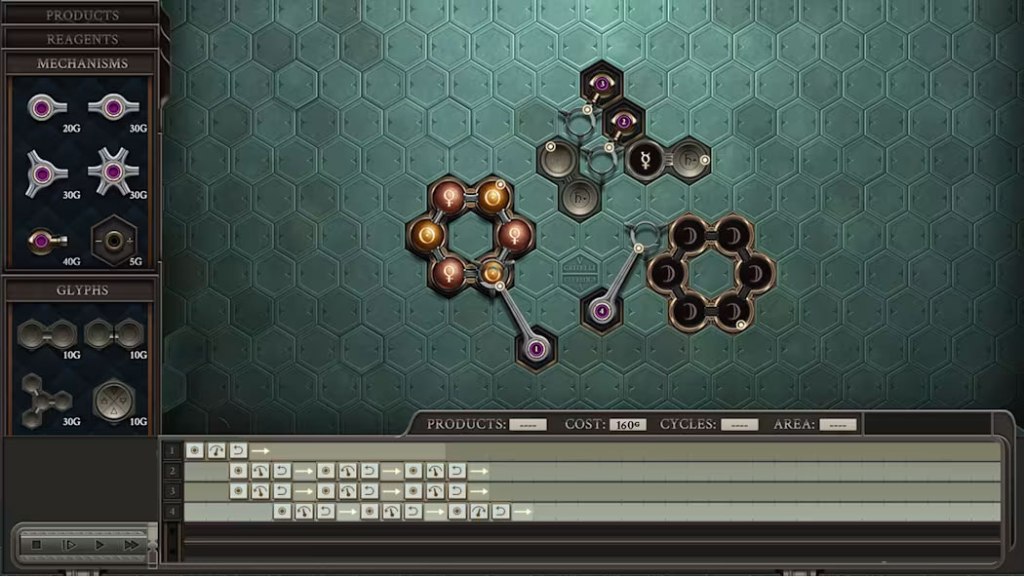
The presentation in Opus Magnum is simple, depicting alchemical elements as orbs on a hexagonal grid, with your mechanisms looking like mechanical arms, tracks, and other various mechanisms. This is joined by hand-painted 2D portrait art for characters and backgrounds in menus and in-game cutscenes, with a subdued soundtrack befitting this game’s contemplative nature. All of this is fine, though quite frankly I couldn’t care less about this game’s story, which focuses on an arrogant alchemy graduate seeking a challenge suited to his skills while taking on various jobs.
No, the star here is clearly the gameplay, and for good reason. Opus Magnum takes a bit of time to figure out and get used to how it works, but once you do, it presents a truly engaging challenge just begging you to find creative solutions. Generally, the game’s stages present you with basic elements, as well as a target compound you’re seeking to create, and then it sets you loose – you can go about completing the task however you want.
Largely, this involves using different types of machines to move around elements, transform or combine them, and then deliver them to the location of the target compound. To do so, you’re given a variety of tools – arms that spin around, can rotate what they hold, or in some cases stretch out or collapse; tracks that can move arms to different locations; glyphs that combine, separate, or transform elements, and so on. Then, you instruct each moving part how to act on a timeline, with an eye towards ensuring that each part works in concert with the others.
Virtually every puzzle in the game can be completed in numerous ways, while still presenting a challenge in actually doing it. And one of the clever things this game does is offer players leaderboards of sorts, showing how the player’s solutions compare to others when measured by three criteria: cost (how many components your machine is made from), time (how long it takes for you to create the appropriate amount of the target compound), and space (how much room your machine takes up). You’re not penalized for making big, costly, expensive machines, but seeing your results compared to others’ is a great motivator to improve upon your creations, and perhaps make multiple versions to exemplify each of the three criteria, or combinations of them.
There are a few glaring problems here, and it largely comes down to the interface. On Nintendo Switch, the gamepad controls for Opus Magnum are clunky and unwieldy, and it can take a while before you get used to how the game works and figure out how to get your cursor to go where you want it. Sadly, the Nintendo Switch version of the game doesn’t support the touchscreen in handheld mode, so you’re forced to engage with these less-than-ideal controls, and even worse, the text in handheld mode is so tiny that it’s not really conducive to handheld play.
It also doesn’t help that some of the symbols you need to be using are similar in shape and color. And making things more frustrating, on levels where you need to transform one element into another, the game isn’t clear about what needs to transform into what, or how many times. This can lead to a lot of frustrating trial-and-error as you try to figure out exactly what the game wants from you in these levels.
It’s a real shame that Opus Magnum has these control, interface, and information issues too, because otherwise this is one of the more brilliant, compelling Puzzle games I’ve encountered in quite a long while. And even with the above problems, I would still highly recommend this game, particularly if you’re mechanically-minded and delight at the idea of creating your own custom machines piece by piece to accomplish a task. If that even sounds remotely interesting to you, Opus Magnum is an absolute must-have.
tl;dr – Opus Magnum is a Puzzle game with Simulation elements that has players constructing machines to piece together alchemical formulas. This game gives players some really compelling challenges and then lets them have the freedom to solve those challenges however they like, in a way that is extremely satisfying and compelling. Unfortunately, the interface and controls are clunky and awkward, and the game doesn’t always make it easy to get the information you need. However, despite these issues, Opus Magnum is an absolutely brilliant Puzzle game, and fans of the genre should consider it a must-have.
Grade: A-
You can support eShopperReviews on Patreon! Please click HERE to become a Sponsor!
This month’s sponsors are Jamie and His Cats, Ben, Ilya Zverev, Andy Miller, Johannes, Jaka, Jared Wark, Gabriel Coronad-Medina, Francis Obst, Kristoffer Wulff, and Seth Christenfeld. Thank you for helping to keep the reviews coming!
 eShopperReviews
Leave a comment