
Mega Man Star Force Legacy Collection
Genre: Compilation / Action-RPG / Card RPG
Players: 1-2 Competitive (Local Wireless / Online)
.
Review:
Mega Man Star Force Legacy Collection is a Compilation released in 2026 on PC, PlayStation 4, Xbox One, and Nintendo Switch containing seven games… well, technically seven games, but due to four of those games just being variant versions with slight differences (like Pokemon Red and Blue versions), in practical terms this is just three games: Mega Man Star Force 1, 2, and 3, all games that combine Action-RPG and Card RPG elements with gameplay and story that makes this act as a successor series to the Mega Man Battle Network games.
If you want specifics, this collection contains versions of Mega Man Star Force: Dragon, Mega Man Star Force: Leo, Mega Man Star Force: Pegasus, Mega Man Star Force 2: Zerker × Ninja, Mega Man Star Force 2: Zerker × Sauria, Mega Man Star Force 3: Black Ace, and Mega Man Star Force 3: Red Joke, all originally released in 2007, 2008, and 2009 on Nintendo DS.
Before getting to what’s new, let’s talk about the games included here. I won’t review them individually – they’re all fairly similar (I prefer Star Force 2, as it has more cohesive level design than the other two games), and focus on schoolkid Geo Stelar, who meets the energy-based space alien Omega-Xis, who joins forces with him to transform the pair into the digital hero Mega Man, entering a cyberspace world overlapping with the human world and taking on the threat of viruses, malicious aliens, and humans scheming to sabotage the electronic devices of the game’s futuristic version of Earth.
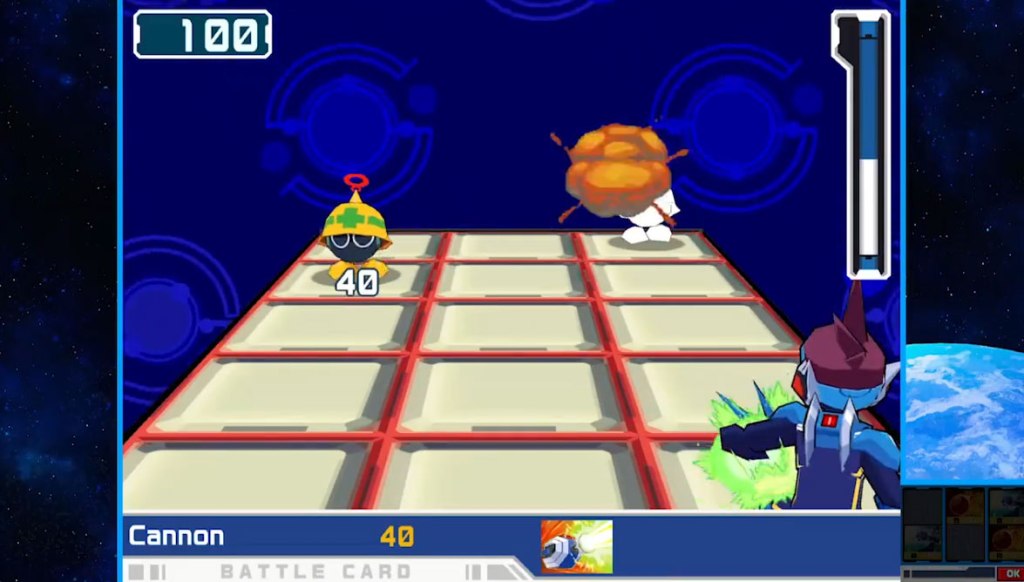
Apart from the space aliens, it’s a plot that isn’t too far divorced from the Mega Man Battle Network games, and likewise the gameplay is very similar, with battles taking a new behind-the-character perspective, and with the battle cadence going back and forth between selecting cards and then using them against enemies in live action in the series’ three-lane confrontations, but otherwise this is not very different from the Battle Network games.
I do think that this trio of games (and let’s be clear, this really is just three games with slight variations stretching it into seven) is simultaneously both a little too complicated for its own good while also being a little too close to the Battle Network series that was already starting to get repetitive by this point. These games also have some pacing issues like unskippable transformation sequences and mazelike level structure with a fair amount of backtracking. However, these issues don’t change that the underlying games here are still solid.
When it comes to this modern release, given the unique two-screen hardware of the Nintendo DS, you may wonder how that affects the gameplay on modern platforms, and the answer to that question is that Capcom has put a lot of work into these games to ensure that they’re streamlined to work on platforms with a single screen and no touchscreen (in fact, the Nintendo Switch version does not have touchscreen support even in handheld mode). Players can choose in the settings how the two screens of the original game are displayed, but by default the game has the main gameplay taking up most of the screen with the second screen minimized until called for by the gameplay or swapped-in with the ZL button.
This context-sensitive screen-swapping works quite well, to the point where players needn’t even worry about the second screen while playing – when it’s needed, it will swap with the main screen automatically, and during battle, card selection freezes the action while you make choices on this second screen. This dynamic screen-swapping is effortless for the player, but I suspect it took a lot of effort from the developers to make it all work, and I salute them for their dedication here.
Beyond the changes needed to make the game even work on modern platforms, there’s also plenty of additional changes to the game to modernize them and make them more accessible. While the default layout of the two screens works perfectly fine in my opinion, players can change the layout and size of the two of them, can change other display options and controls, adjust the game speed (by default you can speed up the game by holding down ZR), adjust enemy encounter rates, and individually adjust difficulty settings (battle rewards, your attack power, the effectiveness of healing, etc.).
In addition to this, I have to address the presentation overhaul here, because it is massive. Battles, which are depicted in cel-shaded 3D, have greatly-improved resolution with smooth visuals that give no hint that they originated on Nintendo DS. Meanwhile, the remaining visuals still appear as 2D pixel art, but with a new procedurally improved resolution, remade text and interfaces, and new voiceover clips performed by the voice actors from the Mega Man Star Force anime series. Players who prefer the classic look can still revert back to the original visuals in the settings options too, if they like.
In addition to all of this, we have a gallery with artwork and “design documents” from the included games, a music player, and a new “Network Battle” mode that lets players duke it out with others online using their own custom character.
When it comes to omissions, I have to note that this package lacks the crossover game Rockman.EXE: Operate Shooting Star, never released in America and not included in the Mega Man Battle Network series. There’s also no trace of anything from the announced but cancelled fourth installment of the Star Force series. Perhaps we might see these games in a future collection along with games omitted from other collections like Mega Man Battle Network Transmission and Mega Man Battle Chip Challenge, but I doubt it.
So with those omissions in mind, let’s take a look at value. Capcom thankfully didn’t slap us with a full $60 price tag for what amounts to three games that are nearly 20 years old. This collection is priced at $40, which honestly seems fair given the amount of work that must have gone into this.
Is this a comprehensive or perfect collection of Mega Man Star Force games? Not quite, no. Are the underlying games absolute must-have titles? Not really, no. But Mega Man Star Force Legacy Collection is a Compilation containing three solid games brought into the modern day with an amount of effort that truly seems like a labor of love. Fans of the Mega Man Battle Network games should consider this bundle an absolute must-have, and Action-RPG and Card RPG fans without much Mega Man experience may also want to give this a look. It’s a great example of taking some great games from a tricky platform to port from and doing an exemplary job making them accessible for modern players.
tl;dr – Mega Man Star Force Legacy Collection is a Compilation of three Nintendo DS Action-RPG and Card RPG games (expanded to seven games via alternate versions). The games themselves are solid, if a bit samey and tedious at times, and these ports show a great deal of effort to make these games work well on modern platforms. The result is a package that’s well worth checking out for fans of unique RPGs and Mega Man fans alike.
Grade: B
You can support eShopperReviews on Patreon! Please click HERE to become a Sponsor!
This month’s sponsors are Jamie and His Cats, Ben, Ilya Zverev, Andy Miller, Johannes, Jaka, Jared Wark, Gabriel Coronad-Medina, Francis Obst, Kristoffer Wulff, and Seth Christenfeld. Thank you for helping to keep the reviews coming!
 eShopperReviews
Leave a comment