
I have now reached my 500th review on eShopperReviews. I’ve been reviewing games on this subreddit for a half a year now, and with the 500th review, I’m going back to the game that I believe to be still to this day the best game on the Switch. However, this game has been out for a few years now, and it’s already been reviewed by just about everyone who does Switch reviews, so in addition to my normal sort of review, I’m going to approach it from a different angle, with a focus on not just what makes it so good, but also touching on its place in the console’s library, its place in the Open-World genre, its place in its own series, and its place as one of the best games ever made.
The Legend of Zelda: Breath of the Wild was originally designed for the Wii U but ultimately released simultaneously for the Wii U and Nintendo Switch after it became apparent that the Wii U did not have long to live, and now it is best remembered as a Switch launch title. This game marked Nintendo’s first steps into the Open-World genre, a genre previously best known for the Elder Scrolls games, the Grand Theft Auto series, and multiple game series produced by UbiSoft, such as the Watch Dogs, FarCry and Assassin’s Creed games. Still, even compared to those, Breath of the Wild does something special, and it’s hard to quite put your finger on.
In many ways, Breath of the Wild follows the formula other games in the genre have made standard. One of its core gameplay elements, climbing towers to fill out your map, is something we’ve seen in the FarCry games, in The Lord of the Rings: Shadow of Mordor, and others. Filling the map with numerous somewhat interchangeable tasks to give players a reason to explore is old hat for the genre. And yet, Breath of the Wild takes these concepts and gives them new purpose.
The brilliant thing Breath of the Wild does that goes above and beyond other games in the genre is that it places as its focus exploration and traversal, and everything in the game ties into these elements. With the rare exception of ancient Hyrulian technology, every wall, every structure, every object is scalable, and players will be encouraged to do so to better explore the world. As you explore, you find shrines which, upon completion, grant the player spirit orbs which can be used to increase the player’s health and stamina. These upgrades, in turn, allow for better traversal, where players don’t have to be quite as fearful of enemies and can climb to greater heights.
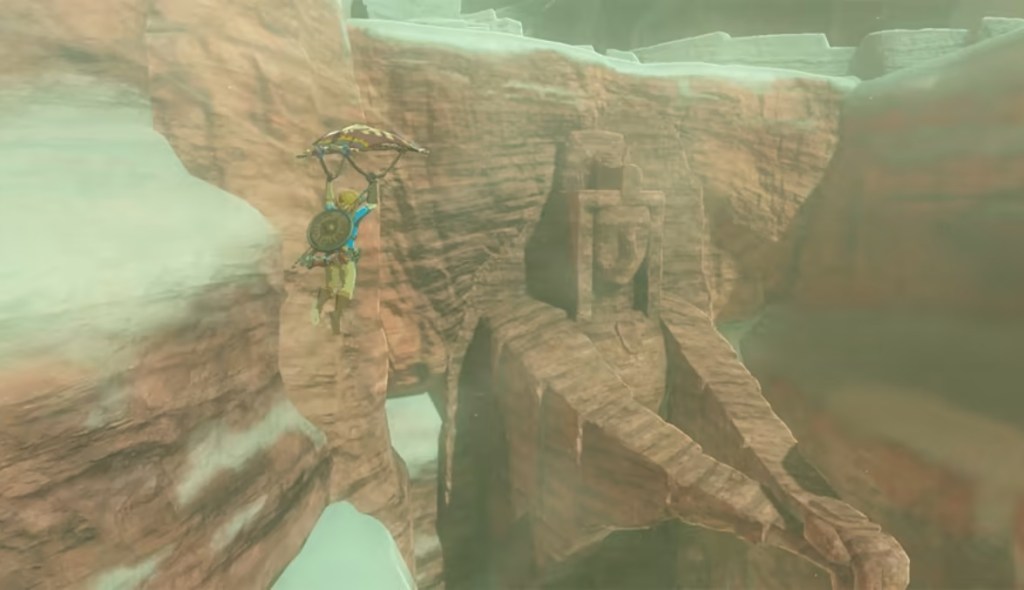
And climbing is so very much a massive part of this game, thanks in part to the brilliant implementation of the glider into the open-world formula. Again, this is not a new invention for the genre – Batman: Arkham City allowed you to glide over Gotham years before this game came out. However, Breath of the Wild had the stroke of brilliance to again tie this gameplay element to progression – you can only glide as long as you have stamina, meaning that the more you explore and uncover shrines, the longer you can glide… but the longer you can glide, the easier it is to explore.
In the way Breath of the Wild unifies its game design, it feels as though it took many of the disparate elements that made Open-World games so compelling, distilled them into their core essence, and then worked them together into a perfectly synergistic formula.
One of the other elements that ties into this unified game design is its physics-based game systems, which give players a feeling that the entire game is universally working with the same rules. Falling objects hurt enemies, fire creates thermals that lift floating objects higher, metal objects are magnetic and attract electricity, and the game lets you play with systems like this in countless ways. Your magnesis ability can be used to steal away metal weapons from enemies before they grab them, and those same metal items should be unequipped if you find yourself in a lightning storm. Or, even better, put a metal weapon in the grasp on an enemy in that storm and wait for the delightfully electrifying results. Suffice it to say, this game does a great job of ensuring that if you think you should be able to do something based on the game’s physics, odds are good you can.
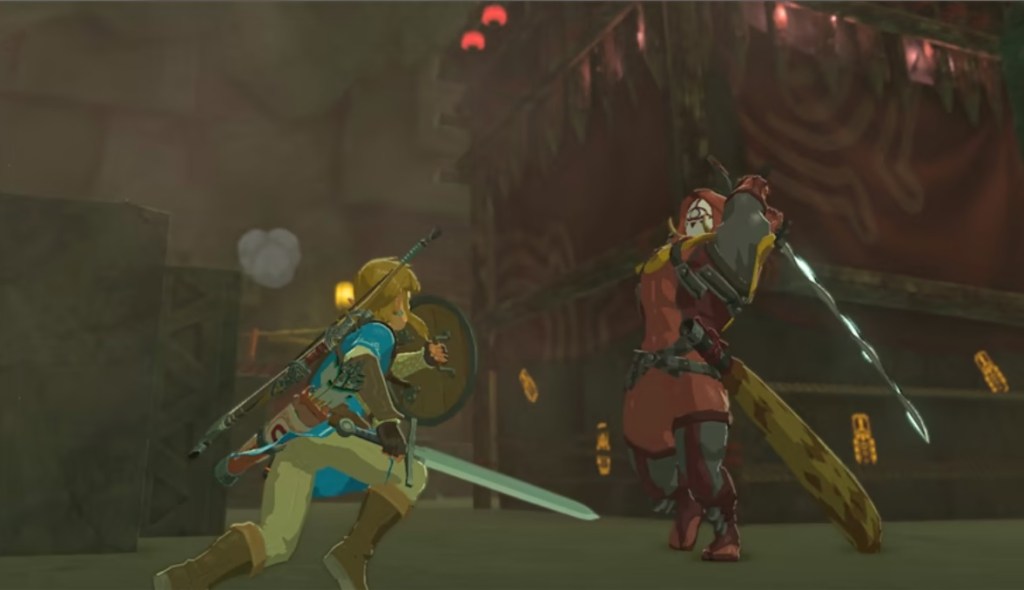
Another element of this game’s synergistic nature has to do with the game’s combat system, which is also nothing especially new – players are rewarded by timing dodges and shield deflections to coincide with enemy attacks, something numerous games have been doing for years. However, again, in an open-world game this adds a new dimension – in theory, a skilled combatant could make their way into even the most dangerous areas and topple the toughest foes, if they master the game’s systems. Those less-skilled at combat will undoubtedly choose to increase their heart supply instead, but this is a matter of choice and preference rather than necessity.
This also brings into play the game’s weapon system which, while it has its flaws, ties beautifully into the game’s traversal and open-world nature. A player who understands the game’s systems and knows not just how to take on enemies but which enemies to take on can quickly upgrade to increasingly better weapons, even getting some of the best weapons in the game soon after the start if they know where to go and have the ability to fight skillfully. So here, player skill is rewarded with power, which again makes traversal easier. And of course, this also adds great appeal to speed-runners, who are now given both the ability and the challenge to proceed directly to the final boss if they have the skill to do so.
Of course, this focus on traversal, exploration, and skill comes at a cost in other areas.
First and foremost, having the ability to go anywhere if you have the skill and grab powerful weapons from powerful enemies necessitated that one couldn’t just get off a lucky shot and be set for the rest of the game – this increase in power needed to be constantly reinforced with that high skill level. I’m talking, of course, about the weapons in this game breaking.
As has been bemoaned at length by this point, weapons in Breath of the Wild break with almost comical frequency. It has been joked by more than a few that Hyrule’s terrible loss in the war that preceded the game was no doubt due to the nation’s shoddy workmanship, as evidenced by its extremely frail weaponry. Clearly, while Breath of the Wild stands as a hallmark of many of the best qualities in videogames, it also has clearly demonstrated a noteworthy amount of ludonarrative dissonance as well.
It’s fun to joke about how little sense this gameplay element makes in the context of its story, or by any real measure of weapon durability. However, the main complaint that most people have about it is in terms of gameplay – it is not only frustrating to have to constantly keep changing weapons in this game, it is depressing that the result of this gameplay element is that no weapon will ever be a truly treasured discovery in Breath of the Wild, as they all (save for one) share the trait of being above all else temporary. While it can be a cause of great joy to find a new shrine or even stumble across a hidden Korok (little plant guys that give you seeds that can be traded for increased inventory space), finding a really spectacular weapon will at best result in a feeling of, “oh, that’s nice, I guess”.
Don’t get me wrong, I do believe that the weapon durability system of Breath of the Wild is an integral part of the game, although not for the reasons many seem to think – this notion that it’s the game’s way of “encouraging players to try out different weapons” is just silly. As I said before, making weapons temporary was probably a necessary trade-off to ensure that the game retained some degree of balance in the challenge level… still, that doesn’t make it any less frustrating or problematic, and even though I feel it’s an integral part of the game experience here, that doesn’t make it any less of an imperfection.
Another area sacrificed in the name of this game’s focus on traversal and exploration is much of the traditional Zelda series formula. Gone is the standard pattern of “find new themed dungeon”-”enter themed dungeon”-”get unique sub-weapon”-”fight boss”. While this game’s “Divine Beasts” sorta’ fill the role of more traditional Zelda dungeons, they all feature a similar motif, do not provide any special sub-weapons (nearly every ability you will ever get in the game, you get in the game’s opening area), and these Divine Beasts are nonlinear in much the same way the rest of the game is. However, there’s definitely a feeling that this game is missing something – at no point in this game do you ever walk into a room in a dungeon and get an item like the hookshot, which suddenly gives you the ability to head to new areas in the dungeon that you couldn’t before. That feeling of joy and discovery simply isn’t anywhere to be found in this game’s Divine Beasts, even if it is in abundance elsewhere in the game.
As such, I would argue that Breath of the Wild makes for a terrible introduction to the Zelda series, as it simply isn’t a good indication of what most games in the series are like. That’s not to say that I think this game is bad – quite the opposite, I think it’s spectacular. But it is spectacular as an open-world game and as its own experience, not as a Zelda game.
However, while I don’t think this makes for a good example of what a Zelda game is like, I am certainly not saying that this game is in any way not a Zelda game. While Breath of the Wild eschews series tradition in numerous ways that completely fundamentally transform it, it is still at its heart very much a Zelda game. The way players move and fight, the way the world looks and feels, the names of characters and places… in so many respects this game honors its series’ traditions while also completely abandoning many of those traditions.
The Goron people still eat rocks, roll up into balls, and have a problem with a monster who has taken up residence in their volcanic home of Death Mountain. The Zoras still reside in a watery utopia. The Gerudo are still a matriarchal society residing in the desert and bearing a clearly Middle Eastern aesthetic. There are even loving callbacks to specific games here and there, such as Eventide Island (in my opinion one of the best parts of the game), being pretty clearly inspired by The Legend of Zelda: Link’s Awakening, and Ocarina of Time’s Temple of Time being one of the first landmarks you discover in the game’s opening area, although it is perhaps symbolic in multiple ways that you find this landmark in ruins.
This ties into one of this game’s subtle strengths that really helps to make it something really special – while earlier games in the Zelda series were designed to make the player feel heroic, in this game, the tone of the game is unmistakably one of melancholy. The world of Breath of the Wild is a broken one, one overcome with sorrow and grief a hundred years old by the time you explore it, and the feeling of a great loss permeates its being. Yet this loss is so old now that its people have begun to grow accustomed to it, and the decay of a once-great civilization has taken on a new sort of beauty that lost civilizations have, as the buildings crumble and nature begins to take over again. And it is this feeling of sad, quiet beauty that will fill most of the player’s time exploring it.
This is thanks in part to the game’s soundtrack, which is far more subtle and subdued than any of the prior games in the series, and as such many players felt that it was disappointing. Apart from a light hint of it here and there, the rousing fanfare prior games were known for is gone in Breath of the Wild, replaced with a quiet, delicate piano solo that accompanies you through most of the journey. It’s not the sort of music players will be humming, but it does an excellent job serving the purpose of building the game’s atmosphere of quiet, sad serenity, and in that respect I feel that it does its job brilliantly.
That said, it’s not all one-note. Players will find that the music picks up tempo whenever engaging the enemy, there are familiar songs in places like stables, and the Rito theme is clearly present in their city, albeit in broken, morose form. Whenever the helpful character Kass is nearby, you’ll hear him playing his catchy theme on an accordion. And you get a very different feel from the musical themes found in shrines, imbuing them with the feeling of an ancient and somewhat alien place. This game absolutely brings fantastic quality music, just not in the way or the places people expect to find it in a Zelda game.

Graphically, The Legend of Zelda: Breath of the Wild stands as a testament to visual design always trumping graphical prowess. The Nintendo Switch simply is not as powerful as the PlayStation 4 and Xbox One, and yet here it does not matter. This game is massive and detailed and beautiful, and while it may not be a match for the most impressive of games on competing systems on a technical level (and it even suffers noticeable framerate drops in some areas), it is still every bit as impressive to look at, with a lovely subtle cel-shaded style that heightens the game’s otherworldly beauty that enhances every new discovery. There is simply no replacement for slowly cresting a hill and seeing the stunning vista that awaits you below, or seeing a wyrm-like dragon in the distance and eventually encountering its massive form face-to-face later on, or simply watching the wind blowing the grass and the trees. In countless ways big and small, this game is absolutely beautiful, whether on the TV or in handheld form.
Speaking of handheld play, that’s another area this game succeeds in brilliantly, and showed players right from the Nintendo Switch’s launch how a handheld experience doesn’t need to be a lesser one in any sense. Not only does the game look superb when played in handheld mode, the game design fits perfectly into handheld play. Players who only have a short time to play on a bus or in a doctor’s office can quickly search for and complete a shrine, or look around for a Korok, and make good progress in the game even in a short play session. And the game’s focus more on theme than story means you’ll rarely feel like you need a refresher on what was going on when you last left the game.
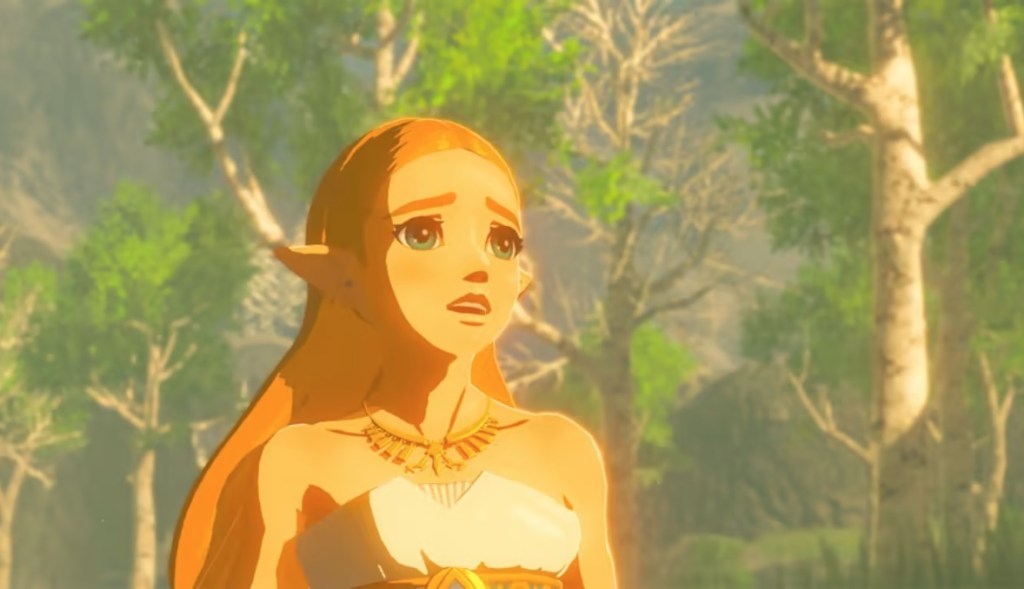
Ah, yeah, the story. That is an area where this game could have done with more time in development. While this game’s overall feel and its world are fantastic, its story feels largely incomplete. You get little snippets of Link’s past life with Zelda and the fall of Hyrule that led to the events of this game sprinkled throughout, but it never quite congeals into a cohesive narrative. The game’s ending is particularly noteworthy for how lacking it is, especially compared to prior entries in the series, which revisited various characters and places in the game for a good sense of closure. I won’t spoil this game’s ending, but suffice it to say, don’t expect the destination to be as good as the journey.
I think it’s safe to say that I’m not blind to this game’s flaws. While some of the choices made here were made for clear and understandable reasons, that doesn’t mean that they don’t have a real downside, and I don’t deny that. There are other flaws I haven’t touched on here – the game is absolutely punishing for newcomers thanks to its high difficulty early into the game, there’s a disappointing lack of enemy variety, the breakable weapons actually discourage players from engaging in the game’s otherwise good combat, the “blood moons” that replenish enemies and are initially delightfully ominous become annoying and intrusive before long… anyone claiming that this is a perfect game is absolutely full of crap, and I will say that anyone who walked away from this game hating it for these flaws is not wrong for doing so – this simply is not a game for everyone.
However, The Legend of Zelda: Breath of the Wild is still, despite these flaws, absolutely deserving of every bit of praise heaped on it. This is a game that arguably perfected the Open-World genre and propelled it forward, and did so with nearly unparalleled beauty and grace. It is an absolutely beautiful game that is perfect for playing for hours on end or even just a few minutes at a time. It is a game that both honors its series’ history while also wildly diverting from it to do something completely new and different. It is a massive game with an amazing amount of depth that truly taps into our desire to explore. There are other games on the Nintendo Switch with more universal appeal, but in my opinion no game on the Switch is a greater accomplishment than The Legend of Zelda; Breath of the Wild, even now, years after its initial release.
Even taking the gaming landscape as a whole, looking back at the last decade, there are few games that I would place in the same league as Breath of the Wild, games that truly reached an apex of gaming and accomplished something truly spectacular and groundbreaking. Skyrim, Minecraft, The Last of Us… like these games, no list of the best games of the last decade is truly complete without The Legend of Zelda: Breath of the Wild. And while this game may not be for everyone, I believe that no Nintendo Switch game library is complete without a copy of this game.
 eShopperReviews