
Cities: Skylines – Nintendo Switch Edition
Genre: Management Sim
Players: 1
The Nintendo Switch 2 Difference
.
Review:
Cities: Skylines is a Management Sim that is comparable to the Sim City series. So comparable, in fact, that when it was originally released in 2015 on PC, many pointed to it as a far superior alternative to the massively disappointing 2013 Sim City release. In the time since then, it has gotten nearly 30 DLC expansions and has been brought to multiple other platforms, with the Nintendo Switch getting a release in 2018.
So about that “Nintendo Switch Edition” subtitle this version of the game has… don’t get your hopes too high for a lot of Switch-exclusive content here. You won’t find any unique buildings or scenarios, there is zero support for motion control or the touchscreen, and while this version of the game does come packed-in with two of the expansions (After Dark and Snowfall), all of its other content is not here in any shape or form. In fact, beyond portability, the Nintendo Switch version of the game only brings two unique things to the table: more fleshed-out tutorials and HD rumble support… both of which are actually kinda’ nice, and having the rumble go off when the spot you’re about to place is ideal is a really nice touch, but let’s be honest, these two small additions hardly justify the addition of a new subtitle for this version of the game.
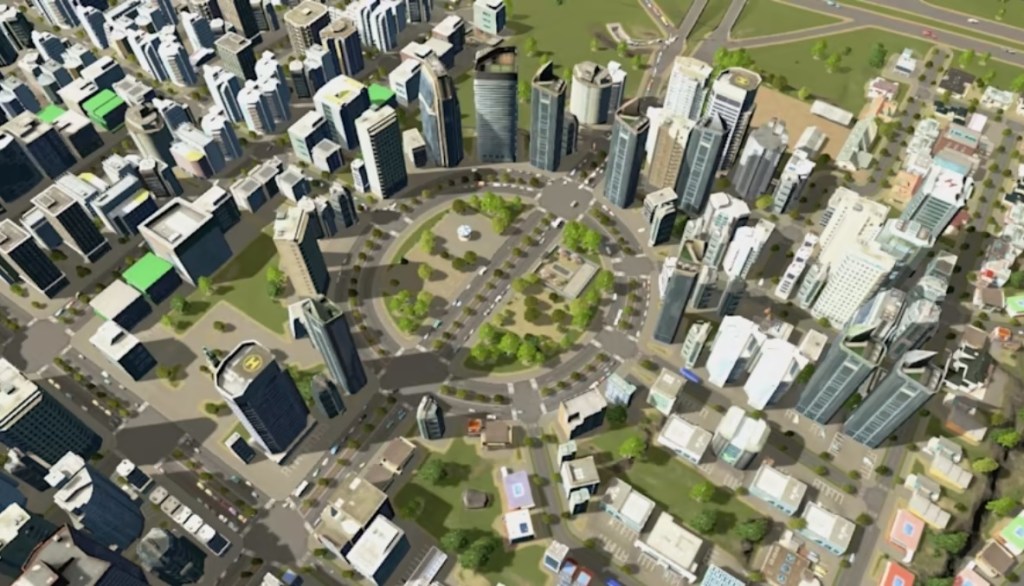
And of course that’s not getting into what this game sacrifices to work on the Nintendo Switch in terms of graphics and performance. I’m not gonna’ sugarcoat it here – when it comes to visuals, this game is rough. It definitely has its good qualities – there is a massive level of detail here, and at any time you can zoom in really close to the street level to take it all in, not just the various buildings, but the people, the traffic, and the hustle and bustle of the city, and at least that much is all impressive. However, to get all of that to fit on the Nintendo Switch, the resolution took a huge hit, textures are constantly popping in and out, and the framerates frequently shudder under the weight of it all. Thankfully this is not a game that requires a steady framerate to play, but it’s a damn shame when you can clearly see the game struggling to play on your Nintendo Switch, especially once you’ve spent a good amount of time building up your city.
Despite the technical difficulties this game has on the Nintendo Switch, its high quality still shines through in its gameplay – this is an absolutely phenomenal city building game, giving players a lot of freedom to construct their dream city, with the option of playing within a budget and with gradual progression that unlocks as you go, or the ability to turn off either or both of these to turn the game into your own free-for-all sandbox.
However, it bears mention that this is also a very technical city builder. Your populace needs roads leading to residential areas that house them, some way to get to commercial areas to shop and industrial areas to work, everything needs to be connected to electricity and plumbing, coverage from police, medical, and fire services, as well as a nearby cemetery to collect the deceased. Your residents care about noise in their living area as well as pollution, industrial zones will complain if the populace isn’t providing enough workers or if those workers don’t have good access to education, they may also complain if they don’t have good access to supplies from supply routes, traffic is simulated on a ground level meaning that areas that become gridlocked will do so in real time, stopping up workers’ commutes and services… the game thankfully gets you used to all of these rules gradually, but it’s a lot to juggle, and I have only just detailed a fraction of it.
I’d like to focus on the commute a bit more, because clearly this is one of the passions of the development team (this game actually originated from a game that was all about managing traffic routes and commute). It’s not initially clear to players just how much they’re expected to micromanage some of this game’s elements. Take buses, for example – players can’t just set up bus depots in an area and expect that to do anything. No, after doing that, they need to establish bus routes. And they can’t just draw a line and call it a day, they need to set up the route in a complete circuit, and not only that, but also establish bus stops, and if they want buses to go both directions, they need to establish a second route going the opposite way, going over all of that as well. Want to make a subway? You can’t just set up the metro stops, you have to set up the actual subway tunnels connecting them, as well as the routes they’ll take through those tunnels. Seriously, if you really want to perfect your city, you’ll be spending hours working on these tiny details, and the game kinda’ demands that of you, too, at least if you want the game’s pop-ups to stop hassling you about traffic.
However, this is one area of the game where one of the game’s biggest flaws (beyond its graphics) rears its ugly head the most – while the game’s creators have done a mostly solid job bringing the mouse and keyboard controls of the PC game to a gamepad, this game can get extremely finicky when it comes to targeting just the right spot, and it can be a real pain to get the game to detect what you’re trying to do, and this is most evident when you’re trying to set up bus routes. However, it rears its ugly head in other places too, sometimes making a simple act like trying to place a road an exercise in frustration. At one point, I wanted to change the location of a freeway connecting to the outside world, and upgrade it in the process to something with noise barriers – the game absolutely refused to recognize that the roads were connected, even when they very clearly were (cars were driving on them and everything!).
Do I think Cities: Skylines on the Nintendo Switch is a disaster? Absolutely not – despite its very severe flaws, this is still the same intensely addictive Management Sim that people fell in love with on the PC, and I got sucked into playing it for hours on end well after I felt like I had gotten enough to review it. However, I can’t give it a pass for those flaws either, as they are pretty terrible. Make no mistake, if you want a great city building game on the Nintendo Switch, you will thoroughly enjoy Cities: Skylines, but you will do so while constantly being frustrated with its technical flaws at seemingly every turn. If that sounds acceptable to you, go ahead and give this game a try. However, if you can play this game on the PC instead, it’s highly recommended that you do so.
tl;dr – Cities: Skylines is the “Sim City killer” Management Sim that took the PC by storm in 2015, and it is every bit as fun and compelling on the Nintendo Switch. However, here that fun is heavily weighed down by a slew of technical flaws that cripple the framerates, make the resolution a mess, and make the interface a temperamental pain to deal with. It’s still loads of fun, but if you can play the PC version, that is clearly the better way to go.
Grade: B-
.
The Nintendo Switch 2 Difference
Cities: Skylines – Expanded Edition
Genre: Management Sim
Players: 1
.
Review:
I previously featured Cities: Skylines in a Nintendo Switch 2 Difference article, thinking that surely if Nintendo Switch 2 were to receive a game in the series, it would be the sequel, Cities: Skylines II. While that may or may not still happen, we did actually get a Nintendo Switch 2 version of the first game, so I’m taking another look to compare this new version to the Nintendo Switch version of the game, which infamously had quite a lot of performance and graphics issues.
First, let’s talk about upgrade path, because this is an odd case. An upgrade path does exist… but only for a limited time. Until April 28, 2027, those who own the digital version of the Nintendo Switch game can get a 70% discount on the Nintendo Switch 2 version, meaning it’ll cost you $15 to upgrade. It’s not the absolute worst-case scenario, but it’s still kinda’ gross that this upgrade path will only be available for about a half-year.
Okay, so what do you get for that $15?
Well, for starters, this release comes packed-in with 10 DLC expansions and content packs. For the record, the included expansions are After Dark, Snowfall, Green Cities, and Sunset Harbor, and the other included content is Map Pack 3, Country Road Radio, Deep Focus Radio, Match Day, Pearls From the East, Carols Candles & Candy, and Match Day. To be clear, After Dark and Snowfall were already included in the Nintendo Switch version of the game, and Match Day, Pearls from the East, and Carols Candles & Candy were free updates on other platforms, but the other upgrades aren’t available in the Nintendo Switch version of the game at all, and buying them on other platforms at standard price would add up to $42, which makes this a pretty great deal just with content alone.
This version also increases the buildable tile limit from 9 tiles in the Nintendo Switch version to 25 on Nintendo Switch 2, giving players the opportunity to build much bigger cities (though players are warned that doing so may result in reduced performance). This release also adds a map editor, supposedly adds changes to the user interface (I didn’t see a difference), adds environmental controls, and support for USB keyboard and mouse controls. However, this game does not support Mouse Mode using Nintendo Switch 2 Joy-Con 2 controllers (and still no touchscreen or gyroscopic motion-controlled cursor either), which seems like a pretty glaring omission… but honestly, the gamepad controls work fine for me so I’m not terribly upset over that.
But of course the big question is how well the graphics and performance hold up in this version, and for this we have two display modes: Performance mode and Quality mode. Performance bumps the framerates up to a smooth 60FPS, while quality maintains a steady 30FPS framerate while improving the resolution and the amount of detail in the game’s world.
I’ll say that even with a moderate-sized city taking up only one tile, the game doesn’t maintain its 60FPS framerates in performance mode – I definitely notice drops. Even so, it’s really jarring to see the game running so smoothly. However, I find myself preferring the improved detail in quality mode, and even the steady 30FPS framerates of that mode are a welcome improvement over the Nintendo Switch version. And both modes lack the nasty abundance of aliasing present in the Nintendo Switch version of the game.
I should also note a difference in the loading times, though not a dramatic one. The Nintendo Switch version loaded to the title screen in 22 seconds, with the game taking 35 seconds to load a game save (last time I tested this, it was 21 and 31), while the Nintendo Switch 2 version of the game had those same times taking 23 seconds and 27 seconds – definitely not as nice as playing the Nintendo Switch version on Nintendo Switch 2, which roughly halved the loading times last time I tested it. However, I think the difference is very much worth it here.
To take this comparison away from tech specs for a moment, playing Cities: Skylines again without the graphical and technical issues of the Nintendo Switch version made me fall in love with this game all over again. I had to force myself to stop playing this game at 4AM after maybe 6 hours playing this game even though I was only checking how the different versions of this game played. I just couldn’t help myself, working to fill a need my city had, or perfecting an expansion that would make things just right, or checking out a new building I had just unlocked. This game is just that good, and playing it on Nintendo Switch 2 after playing the Nintendo Switch version just feels like clearing away the cobwebs to discover that again.
I’m not dismissing the flaws here. The frustratingly stingy form the upgrade path is taking, the lack of Mouse Mode support, and the minor performance issues I still see over a decade after this game’s original release on PC. Yet despite all of that, I think Cities: Skylines is brilliant, and the Nintendo Switch 2 version of the game rights the wrongs of the previous generation to make it much easier to see that brilliance.
tl;dr – Cities: Skylines is the “Sim City killer” Management Sim that took the PC by storm in 2015, and it is every bit as fun and compelling on the Nintendo Switch 2, especially now that this version fixes the glaring graphics and performance issues that plagued the Nintendo Switch version, in addition to including 10 free DLC updates and expansions and a slew of other smaller improvements throughout. This is not a perfect version of Cities: Skylines, but it’s a very good version of an absolutely outstanding game. And if you enjoy Management Simulation games, you need to consider this a must-have.
Grade: A
.
You can support eShopperReviews on Patreon! Please click HERE to become a Sponsor!


Leave a Reply