
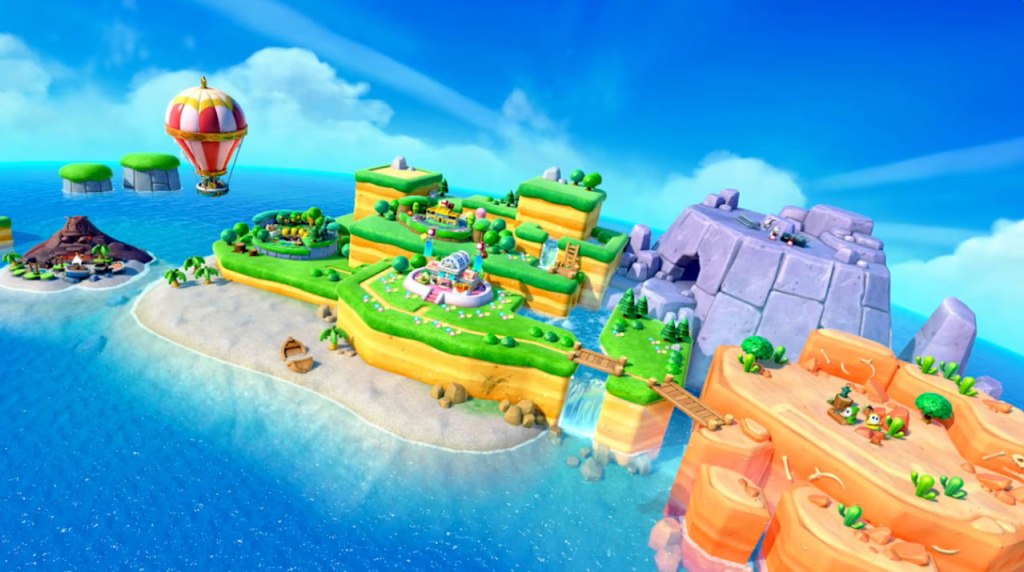
Super Mario Party Jamboree
Genre: Party Game / Minigame Collection
Players: 1-4 Competitive / Cooperative (Local / Online), 2-8 Cooperative (Online), 2-20 Competitive (Online)
The Nintendo Switch 2 Difference
.
Review:
Since 1999, the Mario Party franchise of family-friendly Party Game and Minigame Collection titles has been a staple of Nintendo platforms, not only releasing on every console and handheld Nintendo has released (as well as the e-Reader attachment for Game Boy Advance), but often seeing multiple releases per game platform. Case in point, Super Mario Party Jamboree is the third game in the series to release on Nintendo Switch, and the eighteenth or nineteenth game in the franchise overall, depending on how you count. And overall, I think I am not alone in seeing this series as churning out games that are fine for what they are, but rarely particularly noteworthy or anything that truly offers something new and exciting.
The previous two games in the series on Nintendo Switch did little to break this mold. While I personally thought Super Mario Party was an excellent game thanks to its inspired Partner Party mode, many others were frustrated at the lack of game boards to play on, and found those boards uninspired. Mario Party Superstars was much more warmly received by most, though I suppose I’m a contrarian there, because I wasn’t thrilled with it. However, even those who loved it would have to concede that this game offered little more than recycled content from the series’ past. With these games representing the state of the series, there was little reason to expect anything major from the franchise’s next installment.
And yet, Super Mario Party Jamboree might actually be the best game the franchise has ever seen.
.
Gate Key-pers
To be fair, this is not a claim I can make with complete certainty. I haven’t actually played Mario Party-e, and I’m pretty sure I missed a few of the Mario Party games during the GameCube and Wii years. So many of those games melt together in my memory. However, I can say this much: I cannot remember the last time I felt so much joy playing a Mario Party game.
The core of Jamboree is the standard Mario Party game mode, which includes four new game boards to start with, plus three unlockable boards (two of which are remakes of classic boards from Mario Party 1 and 2). Rainbow Galleria, a giant indoor mall, seems to be the favorite of many, but I’m partial to the simplicity and thematically-consistent Roll ‘Em Raceway, which encourages players to speed around the track as quickly as possible. Overall, I think this game’s boards are good, though I think Goomba Lagoon is a clear stinker due to the way its changing tides can trap players on a small island for the majority of the game if they’re particularly unlucky.
The game includes 20 playable characters (plus two additional unlockable characters), and while these characters all play identically, the character you select does have an effect on the gameplay by restricting which remaining characters are left to randomly appear on the board as “Jamboree Buddies”, a new feature in this game that seems loosely based on the “allies” in Super Mario Party’s Partner Party mode. When these characters appear, the player who encounters them on the board starts off a minigame (with the initiating player getting an advantage), with the winner of said minigame pairing up with that character for three turns, doubling their winnings, getting the opportunity to buy two stars instead of just one when they reach the star, and getting a special character-specific bonus, such as improved dice rolls from Mario, or Donkey Kong giving players the option to move to a random board space before rolling each turn.
.
All the Marbles
The minigames this time around are, as always, a mixed bag, though I think on average they’re better than usual. Before starting, players can choose whether or not to include motion-controlled games in the mix, and even though doing so restricts players to a single Joy-Con I still highly recommend doing so, as these games are not only generally good, they add to the variety, with Jamboree boasting a massive 112 minigames total. Some standouts include Camera-Ready, where players must recreate a camera shot from a photo, Sandwiched, where players must jump on sandwich squares in a giant picnic basket to avoid more falling sandwiches, and Pickin’ Produce, where teams of two sort vegetables on conveyor belts.
However, the real treat here are the Jamboree Buddy minigames, which are custom-designed based on the character they’re for: For example Mario has players competing against him in three classic Mario Party minigames, Waluigi has players aiming to get a high score in pinball, Donkey Kong has players slapping congas in a music-rhythm minigame, and Peach has players competing to win the princess’ affections in minigames involving bringing her gifts and serving her pastries. Each and every one of these minigames had me smiling ear to ear with not only how fun they are, but how wonderfully they represent these characters’ unique personalities.
There is one other major new element to Super Mario Party Jamboree that may not get as much attention, but I feel it is a major contributor to how much I feel this game has improved over prior games: Pro Rules. After playing through one game of standard Mario Party, players unlock this option, and it massively cuts down on the randomness and chaos that Mario Party is known for, and that has been a cause for many players to lose interest in this franchise. Pro Mode tells you possible star locations, lets players choose a bonus item to start with, lets players choose their bonus when landing on lucky spaces, limits the stock of items sold in shops (first-come, first-serve!), letting players wager with stars in “duel” minigames, and telling players what the game’s “bonus star” (just one) will be before the game starts. These changes (plus a few others) make this more of a skill-based game where players can better plan out their strategy… though of course, with dice rolls involved there’s still an element of chance here.
.
Tiny Triathlon
I think this is already my longest Mario Party review ever, and I’ve only discussed one game mode!
In addition to the standard Mario Party game mode, there’s also Minigame Bay, for players who want to choose their individual minigames. Rhythm Kitchen offers players a mix of motion-based Music-Rhythm minigames with a cooking theme, completely separate from the minigames in the main game (and playing a lot like a motion-controlled Rhythm Heaven would). Toad’s Item Factory is a motion-based co-op game where players move platforms in a factory to get balls to a goal. Paratroopa Flight School is a few motion-based minigames for two players where each player holds two Joy-Cons and flaps them like a bird to move their character around a small open 3D space (this makes me kinda’ sad the Nintendo Switch never got a Pilotwings game, as this mode absolutely feels like a perfect realization of the classic “Birdman” stages). And for solo players, there’s also Party Planner Trek, which has players exploring the game’s boards as a campaign, complete with fetch quests and bosses.
All of the above minigames can be played in local or online multiplayer with friends or strangers (well, not Party Planner Trek, that’s single-player only). However, Super Mario Party Jamboree also adds two new game modes designed with online play in mind, though you can also play them solo with bots – Bowser Kaboom Squad and Koopathlon. Bowser Kaboom Squad is an 8-player co-op game where players move around on a 3D map collecting bombs to feed to a cannon while avoiding a rampaging giant-sized Bowser, interspersed with co-op minigames that can give players helpful items if they do well. Koopathlon, on the other hand, is a 20-player take on the Mario Party formula, where players compete in a selection of minigames to try to score the most coins, racing farther around a racetrack with each coin they gather.
I think some of these game modes have more legs than others, but all add some excellent variety, and in particular I can see Koopathlon and Bowser Kaboom Squad really extending the life of this game in online multiplayer.
.
Light-Wave Battle
Moving on to the presentation, Super Mario Party Jamboree doesn’t really hold any major surprises for a modern Mario Party release, which is to say it looks fantastic, and is extremely polished. As expected, the water effects look great, the lighting and shadow is excellent, the game’s 3D characters and environments look nicely detailed while retaining the expected cartoony Mario look to everything, and in particular I need to highlight how wonderful the food in Rhythm Kitchen looks – playing that game mode really got me feeling hungry!
The soundtrack is pretty good this time around too, with lighthearted and energetic themes including some standout tunes like the Main Theme, Too Dangerous, Cut Through the Wind, Battle With Mega Rocky Wrench, Koopathlon: Intermission, Roll ‘Em Raceway 1, Rainbow Galleria 2, Goomba Lagoon 1, King Bowser’s Keep 1, and this game’s excellent remix of Mario’s Rainbow Castle 1 along with Mario’s Rainbow Castle 2.
.
Hammer It Home
In the end… look. I have occasionally liked Mario Party games, but I have never really loved this series. At best I always found it to be a fun distraction, something to briefly enjoy with more casual players before gently nudging them toward truly great games like Mario Kart or Smash Bros. But Mario Party Jamboree breaks that mold by doing pretty much everything right. A decent selection of fun and varied game boards, tons of excellent minigames, wonderful options that cut down on the series’ tiresome randomness, multiple great extra gameplay modes that add a ton of variety, and an absolute wealth of online gameplay modes. The result is a game that is full to bursting with joyous, delightful gameplay that absolutely epitomizes what Mario Party truly should be – an absolute smorgasbord of fun and variety that can appeal to all ages, not just youngsters who don’t care about things like “skill”.
If you have never played a Mario Party game before, this is the one to start with. If you have played and enjoyed Mario Party before, you should absolutely give this a look. And if you played Mario Party before but didn’t care for it, this game might just change your mind. While Jamboree still isn’t perfect (even with Party Planner Trek, this isn’t really a game meant for single-player), it is in my opinion as close to perfect as this series has ever achieved.
tl;dr – Super Mario Party Jamboree is, in my opinion, the absolute best that the Mario Party series of family-friendly Party Game and Minigame Collection titles has ever had to offer. This game has an absolute wealth of varied content, gives players the option to cut down on the series’ infamous randomness, and has some delightfully inspired game modes, including some excellent online-focused multiplayer play. Apart from underwhelming single-player (never this series’ focus), there’s little to complain about here, and so very much to love. Going forward, I believe this will be the Mario Party game all future titles in the series will be measured against.
Grade: A-
.
This game has been nominated for one or more of eShopperReviews 2024 Game Awards:
Winner:
Best Arcade / Party Game – When you’re talking about a Party Game, it’s hard to beat the Mario Party franchise, but it’s even harder when you’re talking about what I feel to be the best game the series has ever had. There were some other excellent games in this category, but they never had a chance when this is what they were up against.
Best Sequel – I like the Mario Party series, but have never been thrilled with any games in the series until Jamboree. This is not just a better game than both previous Mario Party games on Nintendo Switch, it is the best game in the entire series. If you’re a Mario Party fan, you absolutely do not want to miss out on this game!
Best Game for Kids and Casual Players – Mario Party is always a safe bet for kids and casual players, but this year it’s an absolute must-have for family-friendly Switch owners because of its massive variety of content and overall top-notch quality. I think that all of the games on this year’s list of runners-up in this category are a solid choice for any less-experienced gamers, but Super Mario Party: Jamboree is one they’ll be absolutely delighted with, and keep coming back for more.
Best Multiplayer – This one can’t possibly come as a surprise, right? Mario Party’s entire schtick is its focus on multiplayer, and this installment in the series finds numerous new ways to make it even better, with a new co-op Music-Rhythm game mode, a new 1v1 motion-sensing “Paratroopa Flight School” mode, a new 8-player online co-op mode, and a new 20-player online competitive mode… all in addition to the fantastic traditional Mario Party mode.
Runner-Up: Game of the Year, Best Card/Board/Dice Game, Most Underrated, The “Wow, this game was way better than I expected!” Award, Best Graphics
.
The Nintendo Switch 2 Difference
Super Mario Party Jamboree: Nintendo Switch 2 Edition + Jamboree TV
Genre: Party Game / Minigame Collection
Players: 1-4 Competitive / Cooperative (Local / Online), 2-8 Cooperative (Online), 2-20 Competitive (Online), Game Share
.
Review:
When Nintendo revealed the existence of Nintendo Switch 2 Edition games, it felt like opening a door of endless promise and possibility for some of the best games on the Nintendo Switch library, and a second chance for games that were maybe a bit lacking the first time around. Super Mario Party Jamboree: Nintendo Switch 2 Edition + Jamboree TV, one of the first Nintendo Switch 2 games revealed (and from here on just referred to as Jamboree TV for brevity’s sake), was definitely in the former camp – I previously said that this was the best Mario Party game of all-time, and I stand by that assessment. So a Nintendo Switch 2 Edition version of the game had the potential to be even better.
This version of the game can be purchased as a $20 paid upgrade for those who already own the game, or the full package can be purchased together for $80. So in a way this presents us with two questions: Is it worth the $20 upgrade, and is the full package worth $80?
Well, first of all, we need to address some issues here. Firstly, while players can still opt to play the original Super Mario Party: Jamboree after buying this upgrade, that content has zero improvements at all – not even an improved resolution or framerate (note: after launch, Nintendo released a patch that brought this game mode up to 1080p resolution on Nintendo Switch 2). It’s a puzzling omission and a pretty disappointing one, forcing players to choose from the new game modes with graphical improvements or the old game modes without.
Having said that, I don’t think anyone but the most discerning players is likely to notice. The original Super Mario Party: Jamboree already looked great, and while I did see some improved textures in this version like the grass texture, and a few nice effects like the twinkle of water under the sunlight in the distance, overall this seemed visually much the same experience to me. The others who played with me strongly agree on this point too – they both felt any graphical difference was negligible at best. Certainly not bad, and quite good in fact, but definitely nothing that feels like a hardware generation above what we played on the original Nintendo Switch just one year ago.
All of the new game modes are lumped together under this game’s “Jamboree TV” umbrella. This thankfully does include a Mario Party mode with all the same content as the original game -all unlocked from the start here, regardless of whether you’ve done so in the base game. However, this version of Mario Party mode has dropped the one game mode that I felt most delighted by in the original game: Pro Mode, which let players enjoy the game with less randomness. In its place are two new game variants: Frenzy Mode and Tag Team Mode.
Frenzy Mode has the entire game using bigger bonuses and penalties like the final few rounds of a standard game, and while this and the name would seem to indicate that it will make for a much faster game, we found quite the opposite – a standard 5-round Frenzy Mode game will still take an hour to get through. Tag Team Mode, meanwhile, ditches Jamboree’s signature partner system and instead has two pairs of players competing as teams. I suppose it’s nice to have these options, but not at the expense of Pro Mode.
One other change to Mario Party mode this time around is the inclusion of new mouse mode minigames. While the others who played with me were skeptical going into these minigames, I think we all came out in agreement that this is absolutely the best part of Jamboree TV. These minigames are varied, creative, and often use the mouse combined with the gyroscope in ways that make for gameplay that could never be done on another game platform, freely moving things around with the mouse while twisting to use the gyroscope.
The only problem? There’s only 14 of these new mouse mode minigames. In fact, during our first play-through in Frenzy Mode, an entire hour, we didn’t encounter a single one of these minigames, it was all just the content from the base game. Very disappointing.
Of course, players who want a tour of the mouse mode minigames can opt to just pick the new Carnival Coaster game mode, which focuses specifically on mouse mode minigames, interspersing them with an on-rails shooter using mouse mode. This was fun, but with only a handful of minigames to pull from for this mode, it promises to get repetitive very quickly.
Then there’s Bowser Live, which features minigames that make use of the Nintendo Switch camera and microphone. Ah yes, let’s take a moment to talk about the Nintendo Switch camera, shall we? Its functionality is put to use throughout Jamboree TV, but mostly just as a gimmick to show your face live next to your character, or blow it up across the screen when you get a star. However, in Bowser Live, it’s used for motion-controlled gameplay in a manner similar to Sony’s EyeToy from past generations… and it seems like it works about as well as they did decades ago (or worse).
Even with Nintendo’s own camera, the image quality and detection is pretty terrible, and Bowser Live doesn’t make it clear that this mode is meant to be played standing, with the camera taking in your full body. If you don’t have the camera, or don’t have a large room with enough space for everyone to be standing in the camera’s range, you basically won’t be able to play this mode at all. And even if you can, expect the camera to be extremely finicky and inaccurate.
The microphone detection is better here, but still has problems. There seems to be a noticeable delay between the time you make a sound and the time the game detects it, and there’s no way to adjust the calibration to fix this. And some of these minigames seem like they would be easy for an opponent or onlooker to screw up for you, even by accident, by making a noise at the wrong time, even laughing. This is a pretty terrible design flaw for a game intended to be played in a party setting.
When playing Bowser Live, players must select to play either camera-centric minigames or mic-centric minigames, and the game will randomly select two of the three camera games or two of the three mic games depending on which you choose, following it up with one more minigame that combines both camera and mic (the same one every time). Ah, yes, did I mention? There’s only three new camera minigames and three new mic minigames, plus one camera/mic game specific to this game mode.
So in combination with the 14 mouse mode minigames, that means that Jamboree TV only adds about 20 new minigames to what was already present there. For a $20 paid upgrade, I really hoped there would be more.
There’s one more addition I should add here, but it’s almost not worth mentioning. Jamboree TV adds local Game Share to let you play this game with players using either a Nintendo Switch or Nintendo Switch 2. However, it only lets players play the original Mario Party mode, without any of the new mouse mode games, and it only lets you play the Mega Wiggler’s Tree Party board. With all these limitations, and the fact that this is a Party Game, and everyone is going to be right there next to you anyway, there doesn’t seem much reason to use this game mode instead of just sharing one screen.
In the end, Jamboree TV is an upgrade that almost feels like a downgrade. While you can always still play the original game in its original form, every upgrade this game adds either has a massive caveat or a major flaw that makes it not worth your time. The best part has to be the new mouse mode minigames that this adds to the standard Mario Party mode, but you’ll rarely see them while playing, and to play them you’ll need to abandon the excellent Pro Mode of the original game.
Do I feel like Jamboree TV is worth the extra $20 for those who already own the original? Not really, no. I can see the mouse mode content being enjoyable for a little while, but the tradeoff you have to make to play them doesn’t really feel worth it. Do I feel like this package is worth $80 for those who never bought the original game to begin with? Well… probably, but that’s largely just because the original Super Mario Party Jamboree is so very good, and you can always just get that for $60 instead.
If I had to give just Jamboree TV a grade, it would probably be a C, but since I’m judging this as an overall package, I’ll cut the difference and say B, thanks to just how good the original game still is. But wow, what a major disappointment this “upgrade” is.
tl;dr – Super Mario Party Jamboree is, in my opinion, the absolute best that the Mario Party series of family-friendly Party Game and Minigame Collection titles has ever had to offer, and this is still true on Nintendo Switch 2. Unfortunately, just about every “upgrade” the Nintendo Switch 2 Edition has to offer is either a mixed bag or an absolute flop, from negligible graphical upgrades that don’t extend to the original game’s content, a terrible lack of new minigames, camera minigames that just don’t work right, and poorly-conceived mic minigames. At the very least the mouse mode minigames are quite good, but there’s only 14 of them, and to play them you have to ditch the original Mario Party Jamboree’s excellent Pro mode. Overall, this paid expansion is a major disappointment, and the fact that the original game is still truly outstanding is the only reason this is still being rated as highly as it is.
Grade: B
.
This game has been nominated for one or more of eShopperReviews 2025 Game Awards:
Winner:
Most Disappointing – Super Mario Party Jamboree was a game that I celebrated last year on Nintendo Switch. In my opinion, it is the greatest game in the Mario Party series, pairing great minigames with fun game boards, solid graphics, and superb features like the new “Pro Mode” that removes much of the randomness from the game. For the paid expansion on Nintendo Switch 2, Nintendo apparently decided to fence off the great features of that game from the new features of this one. Want to play with the new minigames? Say goodbye to Pro Mode. At launch, you couldn’t even play with the graphical improvements in the original game! What’s more, the new content… well, it’s mostly all bad. The mouse mode minigames are fun, but there aren’t many of them. And the camera and microphone stuff is pretty much all garbage. What a way to take one of the greatest successes from last year and somehow turn it into a dismal failure this year.
Runner-Up: Worst Port / Remake
.
You can support eShopperReviews on Patreon! Please click HERE to become a Sponsor!
This month’s sponsors are Ben, Ilya Zverev, Andy Miller, Homer Simpin, Johannes, Francis Obst, Gabriel Coronado-Medina, Jared Wark, Kristoffer Wulff, and Seth Christenfeld. Thank you for helping to keep the reviews coming!

 eShopperReviews
Leave a reply to Jared Cancel reply