
Phantom Brave: The Lost Hero
Genre: Turn-Based Strategy-RPG
Players: 1
.
Review:
It has long been a bit odd how reluctant developer Nippon Ichi Software has been to making sequels to their games outside of their flagship Disgaea series, and 2004’s Phantom Brave stands out as a particularly glaring omission. Not only was it warmly-received critically, but its refreshingly unique take on the Turn-Based Strategy-RPG genre is not only very different from Disgaea, but still remains novel even to this day.
The original Phantom Brave has received numerous ports and remasters since its initial release, including a port to Nintendo Switch as a part of Prinny Presents NIS Classics Volume 1: Phantom Brave: The Hermuda Triangle Remastered / Soul Nomad & the World Eaters. But it is only now, over two decades later in 2025, that the game is finally receiving an actual sequel in the form of Phantom Brave: The Lost Hero, releasing on PlayStation 5 and Nintendo Switch, with a PC version due out later this year.
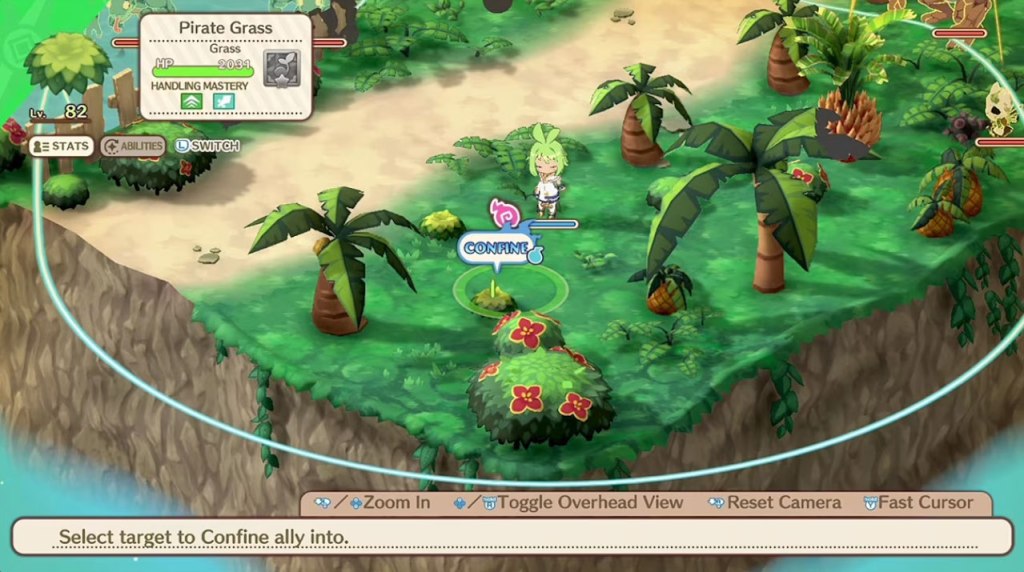
In some ways, The Lost Hero remains faithful to the original game, bringing back Phantom Brave’s “gridless” combat system and imaginative “confine” system that has you summoning allies into objects within the environment, with units enhanced by that object’s inherent stats. However, this game isn’t afraid to modernize the series, adding new gameplay and presentation elements.
The most obvious change is undoubtedly the presentation, which builds on Disgaea 6 and Disgaea 7‘s chibi-style cel-shaded 3D visuals while retaining the classic anime-style character portraits in character profiles and conversations. The chibi-style cel-shaded characters were divisive when first revealed, but I think by this point Nippon Ichi fans have come to accept them (some of them grudgingly so), and thankfully in this game they look clean and polished, seeming to suffer none of the performance issues that plagued Disgaea 6.
These visuals are backed by a pretty good soundtrack with a mix of instrumental, synthesized, and vocal elements, with a few examples of standout songs including Seraphic, Woodpecker, Freezing Rain, Floral Garden, Passionate Violin, Be With You, and A Single Tear.
I should also mention this game’s voiced dialogue which… well, it has its ups and downs. Phantom Brave has always been more emotional and dramatic than its comedic cousin Disgaea, and the cartoony archetypal characters don’t always work well for that. The first game’s protagonist Marona returns here and remains a shining beacon for the game, her irrepressible positivity and empathy powering through some rough situations, but her companion Ash from the first game is pushed out of the way early on in favor of a crew of pirates who are less than charismatic, with the major secondary protagonist here being Apricot, whose class in the game is literally “Crybaby Captain”, and I inwardly groan when she speaks, her high-pitched tone made worse by the character’s indecisiveness and frequent whining.
The plot this time around has Marona, no longer a social outcast and now seen far and wide as a hero, contending with a ghost pirate fleet captained by a villain seeking to steal her ability to speak with and command phantoms, the ghosts of the deceased. Her initial confrontation with this phantom leaves parts her from her friend and defender Ash, marooned on an island where she meets Apricot, who the phantom of a young girl whose pirate captain father went missing when he ventured out to challenge the ghost ship fleet. Having a common enemy, the two join together to rebuild Apricot’s father’s pirate crew and challenge the ghost pirate captain themselves. Overall, I don’t think it’s an especially inspired story, but it works.
When it comes to the gameplay, this game makes a change that helps to prevent an issue I had with the first Phantom Brave – all attacks now have an area of effect, meaning that characters no longer need to pile up on top of each other to perform melee attacks, and positioning becomes far more vital here. This game also adds multiple new gameplay elements, such as “gadgets” in the environment like canons that can not only be used directly, but Marona can confine phantoms to them to make them move about and act on their own. There’s also a new “confriend” special move that allows Marona to combine with a phantom to power-up using the abilities of one of your other characters.
On top of this, there are new options that gradually open up in your home base as you gain new classes, such as an ability to send your crew out scavenging for new items, or a drink shop where you can micromanage the distribution of experience earned in battle. While I do think there was potential in the way the game ties these different features to characters you create, I don’t think it fully explores that potential here, with the effect mostly just being things like access to better items to buy as you level up your shopkeeper character.
While I do think this is overall an improvement on the first Phantom Brave, there were definitely some issues I encountered here as well. First, the game’s unorthodox battle system means that battles in the game can be pretty time-consuming, even compared to other Nippon Ichi games like Disgaea. However, even worse than this is the way the game does a poor job conveying information to the player, such as not giving you the ability to directly compare items while you’re in the shop. While some of this game’s issues may have been present in the original game… well, it’s over two decades later, so it’s a bit less forgivable that these problems are present now.
If it wasn’t for these frustrating “quality of life” issues and the mixed bag when it comes to story and characters, I would be absolutely celebrating this long-overdue sequel to a truly unique Strategy-RPG. As it is, I think Phantom Brave: The Lost Hero is still a very good entry in the genre that’s well worth playing, but it also has some major flaws that I seriously hope get addressed if and when Nippon Ichi comes back for a third entry in the series.
tl;dr – Phantom Brave: The Lost Hero is a long-awaited sequel to the first Phantom Brave, bringing back the original Turn-Based Strategy-RPG’s “gridless” combat and its unique “confine” system while adding new gameplay elements and bringing the presentation in line with the developer’s recent Disgaea games. This is overall a solid sequel, but I think the characters and story are a mixed bag, and there are some quality of life problems that cause frustration too. It’s still worth playing, but it’s not quite the great comeback this could have been.
Grade: B-
.
This game has been nominated for one or more of eShopperReviews 2025 Game Awards:
Runner-Up: Best RPG, Best Strategy Game
.
You can support eShopperReviews on Patreon! Please click HERE to become a Sponsor!
This month’s sponsors are Jamie and His Cats, Ben, Ilya Zverev, Andy Miller, Homer Simpin, Johannes, Francis Obst, Gabriel Coronado-Medina, Jared Wark, Kristoffer Wulff, and Seth Christenfeld. Thank you for helping to keep the reviews coming!


 eShopperReviews
Leave a comment