
Dark Deity 2
Genre: Turn-Based Strategy-RPG
Players: 1
.
Review:
Note: This review has been directly sponsored by a kind donation from Jamie and His Cats. Thanks again for your generous contribution!
Dark Deity 2 is a Turn-Based Strategy-RPG released in 2025 on PC, PlayStation 5, Xbox Series X|S, and Nintendo Switch. This game places you in the role of a group of members of a paramilitary organization charged with protecting the medieval fantasy kingdom of Verroa, only to encounter the kingdom being invaded, setting off both internal and external tensions with the kingdom.
When I reviewed the original Dark Deity, I couldn’t ignore that this was a game that seemed to be pretty clearly inspired by Nintendo’s Fire Emblem franchise, but just couldn’t quite live up to that inspiration. This time around, it’s once again clear that the Fire Emblem games are near and dear to the heart of Dark Deity 2, so I was curious how this sequel addressed the issues I had with the first game and whether or not it managed to escape the shadow of Nintendo’s franchise.
Once again, I think Dark Deity 2 starts strong with its story and characters, which have more personality and interpersonal chemistry than I tend to associate with the Fire Emblem games. Right from the start, your party’s characters have clear individual voices and a camaraderie that seems unique to each pair of characters, and this is further emphasized by the returning character relationship system, which gives players both story cutscenes and bonus upgrades when characters fight near each other long enough to upgrade their “relationship”, and these bonuses are different enough from what we see in the Fire Emblem games to set Dark Deity apart.
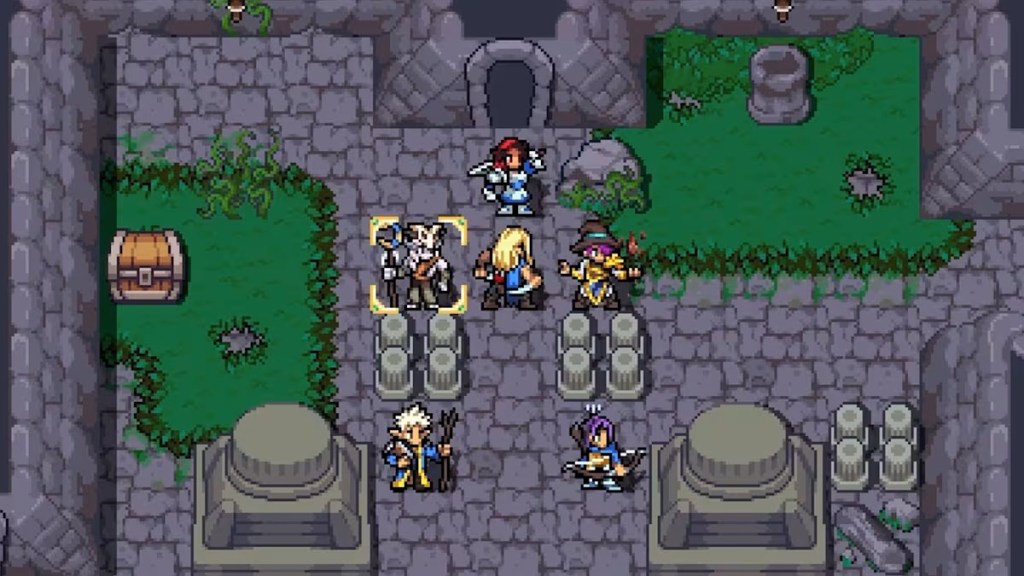
For the rest of the presentation, we once again have anime-style character portraits and some really nice pixel art 2D visuals, with absolutely gorgeous animation that outdoes even this game’s predecessor. This is joined by some solid voice acting for the game’s characters throughout the game, and once again backed by an orchestral soundtrack that’s really nice, but you might not notice it at first because the game’s sound levels are oddly low, and you’ll want to adjust that. Some good examples of what you’ll encounter are Battle: Grettanian Countryside, On the Move, Battle: Take Your Shot, World Map 4: Awakening, to name a few.
The gameplay here will be familiar to anyone who’s played a Fire Emblem game, or the original Dark Deity, moving units on a tile-based battlefield, trying to make strategic use of melee and ranged units. However, this time there are a number of changes that I feel do a much better job of setting this game apart.
Firstly, your individual units have special abilities that are much more strongly highlighted here, using a limited pool of magic strategically to make the most of this resource at pivotal points during battle. What’s more, this game lets you use resources to level up these abilities in multiple ways, such as choosing whether to level up a stat-boosting ability to have a greater effect or to give the unit the ability to self-cast. This is exactly the sort of the that really gives players the feeling that their choices have a real impact on their party’s progression.
Secondly, this game further refines its predecessor’s take on Fire Emblem’s “permadeath” mechanic, and unlike the prior game, this time I think they got it right – now, when one of your units is eliminated in battle, it doesn’t die but it does suffer an injury that affects its performance in the next battle. I feel like this strikes the balance that the last game was looking for but failed to manage, since losing units still bears consequences, but those consequences can be overcome so they’re not going to reverberate through your entire campaign, making the choice of whether or not to use a unit in a risky move less one-sided, since not surviving the battle doesn’t mean you’ll be giving yourself a handicap for the rest of the game.
Third, instead of the prior game’s clunky weapon-swapping system, you now have different class types you can have units swap between battles, with each unit having access to a few different classes. I do wish this class system more clearly indicated each class’s strengths and weaknesses, but it’s nice that players have more flexibility in changing up their characters, and this is absolutely more meaningful than simply having characters swap their weapon when they approach an enemy weak to a different weapon.
Another wonderful change here is that players have multiple settings they can change to customize their game difficulty and playing experience. There’s an overall challenge level, but you can also change the turn limit, shutting it off if you prefer not to be pressured to speed through battles. In addition, you can turn on or off things like battle animations, longer level-up analysis, and so on.
There are a lot of improvements here, but there are still some issues. I don’t think the game’s tutorial is nearly extensive enough, and there are multiple game mechanics that are poorly-explained or not at all explained. The game does a poor job indicating the reach of individual units, and it took me a while to even find where on a character’s stats it indicates how far they can attack. Want to know how a weapon stacks up against the ones your characters currently have equipped? You’ll need to jump between the shop screen and equipment screen and memorize the stats. This sort of poor information management really holds Dark Deity 2 back, and makes me feel like this game wasn’t properly play tested, as surely this sort of inefficient menu design and poor communication of information to the player is the sort of thing play testing would have uncovered.
Despite these flaws, I think Dark Deity 2 is a huge improvement over its predecessor, and a great Strategy-RPG in its own right that finally steps out of the shadow of the Fire Emblem games. And while it may lack the custom user-created campaigns of the Wargroove series, and the in-depth character dynamic system and “dating” mechanics of Fire Emblem: Three Houses, its character customization, strong characters and plot, and healthy amount of gameplay options make it a solid alternative to those games worth trying out.
tl;dr – Dark Deity 2 is a Turn-Based Strategy-RPG which, like its predecessor, is clearly inspired by the Fire Emblem franchise, but unlike its predecessor I feel like it brings enough unique ideas to the table that it manages to stand on its own, with excellent customization and good characters and story. I do think this game still suffers due to how poorly it conveys information to the player, but overall this is a solid entry in the genre that fans of Strategy-RPGs should check out.
Grade: B+
You can support eShopperReviews on Patreon! Please click HERE to become a Sponsor!
This month’s sponsors are Jamie and His Cats, Ben, Ilya Zverev, Andy Miller, Johannes, Jaka, Jared Wark, Gabriel Coronad-Medina, Francis Obst, Kristoffer Wulff, Seth Christenfeld, and Vince Verrinoldi. Thank you for helping to keep the reviews coming!
 eShopperReviews
Leave a comment